 Bellingham Siding
 Two Solid Products, One Decision We Had to Make
Homeowners in Bellingham researching siding replacement will run into two materials that dominate the conversation: fiber cement and engineered wood, most commonly sold under the LP SmartSide brand. Both are legitimate step-ups from vinyl. Both are manufactured products designed to outperform old-growth cedar and primed spruce. And both have passionate advocates in the building industry.
We install only James Hardie fiber cement siding. We don't carry LP SmartSide or any other engineered wood product on our trucks, and we think homeowners deserve to know exactly why before they sign a contract with us or anyone else. This page walks through what each material actually is, how they behave in Whatcom County's specific climate, and the trade-offs that led us to standardize on fiber cement.
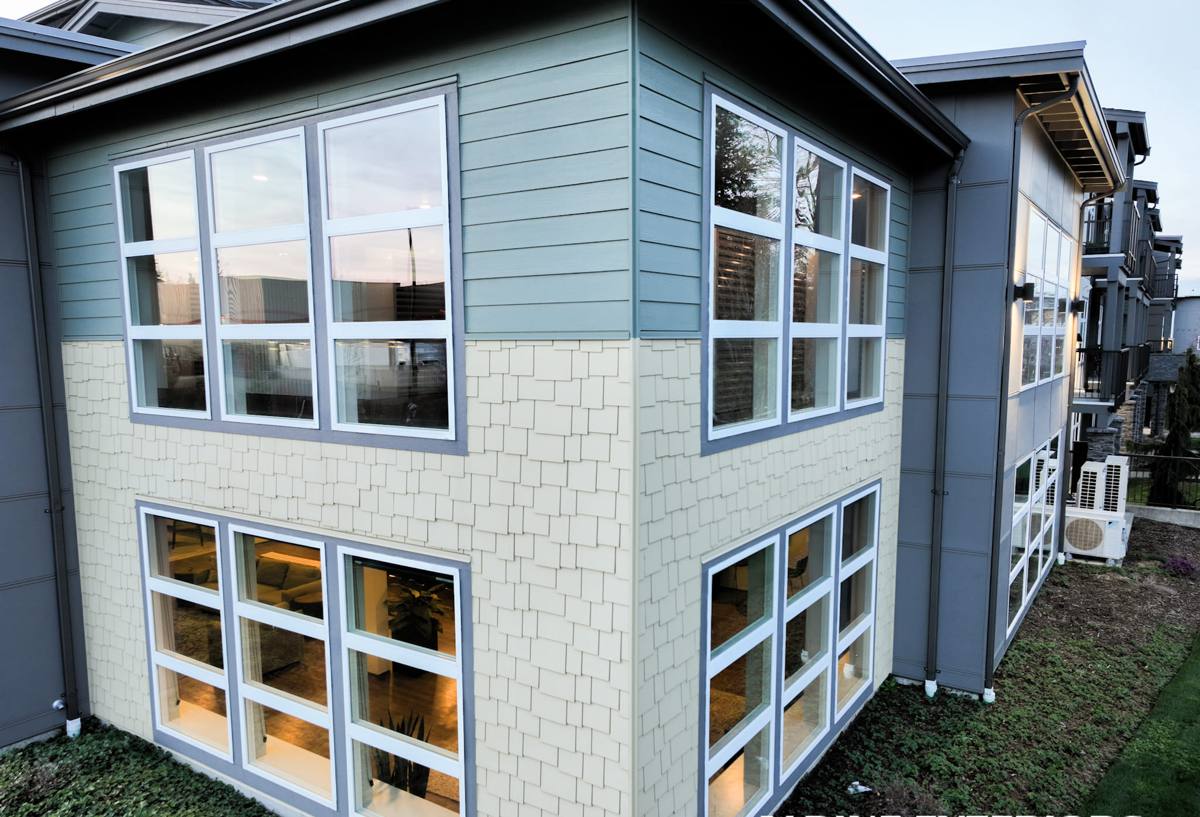
What Engineered Wood Siding Actually Is
LP SmartSide and similar products are made from wood strands or wafers bonded with resin under heat and pressure, then coated with a wax-based moisture repellent called SmartGuard and finished with a factory primer or paint. It's a genuine improvement over solid wood lap siding — the engineering process reduces the checking, warping, and knot problems that plague natural cedar, and it costs less than fiber cement in most markets.
It's also lighter and easier to cut than fiber cement, which is part of why it remains popular with builders who want wood-grain texture without wood's worst failure modes. Manufacturers back it with multi-decade warranties, and when it's installed correctly and maintained on schedule, it can perform well for a long time in the right climate.
The word doing the heavy lifting in that last sentence is "wood." Underneath the resin and wax coating, the core material is still an organic, wood-based product. That matters a great deal once you factor in where this house sits.
What Fiber Cement Siding Actually Is
James Hardie fiber cement is a mix of Portland cement, sand, and cellulose fibers, cured into a dense, rigid board. There's no wood core to swell, rot, or feed fungal growth. It's manufactured in region-specific formulations — Hardie's HZ5 product line, engineered for cold, wet Pacific Northwest conditions, is what we install here.
Hardie's ColorPlus finish is baked on in a factory-controlled process rather than field-applied, which produces a more consistent, UV-stable topcoat than job-site painting can reliably match. The material is also non-combustible, which matters more each year as wildfire smoke and dry-season fire risk become a bigger part of Pacific Northwest summers, even west of the Cascades.
Why the Distinction Matters Here Specifically
Bellingham sits on Bellingham Bay, which means many homes deal with salt-laden air on top of the region's already heavy rainfall. Add Whatcom County's long, low-sun winters, and you get months at a stretch where north- and west-facing walls barely dry out between storms. Moss doesn't just grow on roofs here — it colonizes damp siding laps, fence posts, and anything organic that stays wet long enough. That combination of salt air, driving rain, and extended moss season is the exact environment where the difference between a cement-based product and a wood-based one, however well engineered, shows up over time.
Side-by-Side: What Actually Differs
| Factor | Engineered Wood (LP SmartSide) | Fiber Cement (James Hardie) |
|---|---|---|
| Core material | Wood strands, resin-bonded | Cement, sand, cellulose fiber |
| Moisture response | Water-repellent coating; core can absorb and swell if coating is compromised | Dimensionally stable; does not swell, rot, or support fungal growth |
| Fire classification | Combustible, treated for fire resistance | Non-combustible |
| Finish | Factory primer or paint; often needs field topcoat | Factory-baked ColorPlus finish, field-painted options available |
| Cut-edge and penetration sensitivity | Every cut, nail hole, and joint must be sealed per manufacturer spec or moisture can enter the core | Cut edges and penetrations still need proper sealing, but the material itself doesn't wick and rot the way wood does |
| Typical material cost | Lower | Moderate to higher |
| Manufacturer warranty structure | Multi-decade, often prorated and coating-dependent | Long-term, non-prorated on the substrate; transferable |
Installation Sensitivity: The Part Contractors Don't Always Explain
Both materials perform well when installed exactly to manufacturer specification and poorly when corners get cut. That's not unique to either product. But the consequences of a missed detail differ.
With engineered wood siding, every cut end, every fastener penetration, and every seam is a potential moisture entry point into an organic core. Manufacturer installation guides are explicit about field-sealing cut edges with the specified sealant, maintaining clearances from grade and roof lines, and keeping caulk joints maintained over the life of the siding. Skip a step, or let caulk fail years later without recaulking, and moisture can get into the core where the protective coating no longer covers it. Because the core is wood, once moisture is inside, deterioration can progress from that point.
With fiber cement, correct installation still matters — proper fastening, clearances, flashing, and joint treatment are all part of the Hardie installation spec, and we follow it on every job. But because the substrate itself is cement-based rather than organic, a small installation lapse doesn't carry the same risk of feeding rot or fungal growth into the board itself. That's a meaningful difference in a climate where wall assemblies don't get much of a summer to fully dry out.
Maintenance Over the Ownership Timeline
This is where the two products diverge most in practice, not in a single dramatic failure, but in the recurring maintenance list a homeowner has to keep up with year after year.
- Caulk and sealant inspection: Engineered wood siding depends on intact sealant at every cut edge and joint; those joints need periodic inspection and recaulking, especially on sun- and rain-exposed elevations.
- Repainting cycle: Field-applied topcoats on engineered wood typically need repainting on a shorter cycle than a factory-baked ColorPlus finish, which is engineered to hold color and resist UV breakdown longer between paint jobs.
- Moss and algae management: Any siding in Whatcom County benefits from periodic gentle washing to keep moss and algae from taking hold, but the consequences of neglecting it are lower-stakes on a non-organic substrate.
- Edge and corner monitoring: Outside corners, butt joints, and areas near grade are the first place moisture problems show up on any siding; these deserve an annual look regardless of material.
- Gutter and drainage upkeep: Keeping water moving away from walls matters more here than almost anywhere, given how much of the year Bellingham spends under rain.
Cost: Upfront vs. Lifetime
Engineered wood siding usually costs less to install than fiber cement, and we won't pretend otherwise — for a homeowner working with a tight budget, that upfront gap is real. Where the calculation shifts is over a 20-to-30-year ownership horizon: less frequent repainting, less exposure to core moisture risk, and a warranty structure that isn't prorated on the board itself all reduce the total cost of ownership for fiber cement in a climate this wet. Whether that trade-off is worth it depends on how long you plan to own the home and how much ongoing maintenance you want to take on.
What We Weigh Before Recommending a Project Scope
| Consideration | Why It Matters in Whatcom County |
|---|---|
| Wall orientation and sun exposure | North and west walls dry slower and see more wind-driven rain off the Bay |
| Proximity to salt air | Closer to the water, coatings and fasteners see more corrosive exposure |
| Roof overhangs and existing drainage | Minimal overhangs mean siding takes more direct rain impact |
| Planned length of ownership | Longer hold times favor lower-maintenance materials |
Why We Standardized on James Hardie
We made the decision to install only James Hardie fiber cement after weighing these trade-offs across enough projects to see the pattern hold. It comes down to a few points:
- A cement-based core doesn't give moisture an organic material to work on, which matters in a region that stays wet for most of the year.
- The HZ5 product line is formulated specifically for cold, wet climates like ours, not a general-purpose national product.
- The ColorPlus factory finish holds up longer under Pacific Northwest UV and moisture cycling than most field-applied coatings.
- Non-combustible construction is a meaningful, no-downside advantage as regional fire risk grows.
- Standardizing on one system means our crews install it the same correct way on every job, with no guesswork switching between manufacturer specs.
None of that means engineered wood is a bad product — it isn't. It means that after comparing how each material actually holds up against Bellingham's salt air, driving rain, and moss season, fiber cement is the one we're willing to put our name behind and warranty.
Questions to Ask Any Siding Contractor
- What specific product line are you installing, and is it formulated for this climate zone?
- How is the warranty structured — is it prorated, and what does it actually cover?
- What's the manufacturer's spec for sealing cut edges, joints, and penetrations?
- What maintenance schedule does this material require to hold its warranty?
- Can you walk me through why you chose to carry this product over the alternatives?
If you're weighing siding options for a home in Bellingham or elsewhere in Whatcom County, we're glad to walk your property, look at your wall exposures, and give you a straight answer on what we'd recommend and why. Reach out for a free, no-pressure estimate using the form below.