 Bellingham Siding
 Siding Built for Lynden's Weather, Not Just Its Look
Lynden sits in a part of Whatcom County that gets weather from two directions: marine systems rolling in off the Salish Sea and the wetter, cooler air pattern that settles over the whole county for much of the year. Homes here deal with long stretches of damp weather, driving rain that comes in sideways during winter storms, and the kind of persistent humidity that keeps north-facing walls and shaded siding sections damp for days at a time. That combination is hard on exterior materials that aren't built for it, and it's a big part of why we standardized on one product for every siding job we do: James Hardie fiber cement.
We're not a general contractor who happens to install siding. Siding, roofing, windows, and decks are what we do, and on the siding side we install James Hardie exclusively. We don't carry vinyl, LP SmartSide, Cemplank, Allura, or wood products like primed spruce or cedar. That's a deliberate standard, not a limitation on what we're capable of installing — and on a page like this, it's worth explaining why, specifically for a property in Lynden.
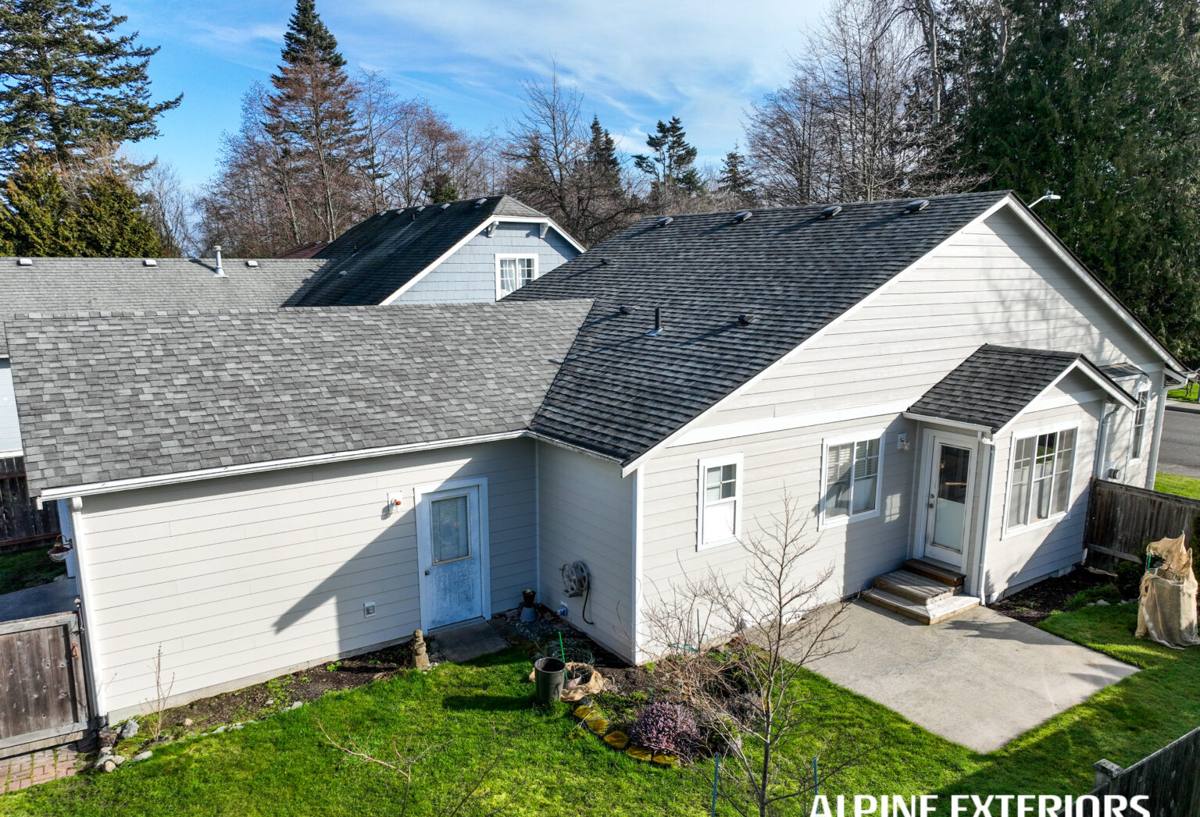
What Lynden Homes Actually Face Over a Year
Whatcom County doesn't get extreme weather often, but it gets persistent weather, and persistence is what wears siding down. A few things stand out for homes in and around Lynden:
- Extended wet seasons. Fall through spring brings long runs of overcast, drizzly days rather than a handful of heavy storms. Siding here spends a lot of time damp, not just occasionally soaked.
- Moss and algae growth. Shaded siding, north walls, and areas under trees or overhangs stay moist long enough for moss and green staining to take hold, especially on materials with any wood content or texture that traps moisture.
- Driving rain and wind-driven moisture. Storm systems moving through the region can push rain sideways into wall assemblies, which stresses seams, joints, and anywhere water can find a way behind the cladding.
- Temperature swings between seasons. Summers can get warm and dry enough to stress materials that don't handle expansion and contraction well, right after a winter of saturation.
None of this is dramatic on its own. It's the cumulative effect — year after year of damp, mossy, marine-influenced weather — that separates siding products that hold up from ones that need constant upkeep or fail early.
Why We Don't Install Everything on the Market
Vinyl
Vinyl is inexpensive and low-maintenance in the sense that it doesn't need painting, but it's a thin plastic product that can warp, crack, or fade over time, and it doesn't offer the same fire resistance or impact durability as fiber cement. In a climate with real seasonal swings, vinyl's expansion and contraction can also open gaps at seams over the years. We don't think it's the right long-term investment for the homes we work on.
LP SmartSide and other wood-based composites
Engineered wood siding has improved over the years, but it's still a wood-based product at its core, which means it's more vulnerable to moisture intrusion than true fiber cement — particularly at cut edges, seams, and fastener penetrations. In a county where siding stays damp for extended periods, that's a real maintenance risk, not a theoretical one.
Cemplank and Allura
These are other fiber cement brands, and fiber cement as a category is a good decision. But we've standardized on one manufacturer so we can guarantee installation quality, warranty coverage, and color consistency across every job. Mixing brands means mixing specs, and that's not a compromise we make.
Primed spruce and cedar
Natural wood siding can look beautiful, but it demands ongoing maintenance — repainting, caulking, and moisture monitoring — that most homeowners underestimate until they're a few years in. In a climate with a real moss season and extended wet stretches, wood siding requires more attention than most people want to give it, and the failure points (checking, rot at butt joints, insect vulnerability) are well understood risks.
Why James Hardie Is What We Install
James Hardie fiber cement is made from cement, sand, and cellulose fiber, which makes it non-combustible and dimensionally stable — it doesn't expand and contract the way vinyl or wood does, and it doesn't rot or feed pests the way wood-based products can. Hardie also engineers specific product lines for different climate zones through its HZ5 designation, which is built for regions that see more moisture and freeze-thaw cycling — a good match for Whatcom County's weather pattern.
The factory-applied ColorPlus finish is another piece of it. Instead of field-painting siding after installation, ColorPlus baking-on the finish at the factory under controlled conditions, which gives more even coverage and better fade resistance than a job-site paint job, and it comes backed by its own finish warranty separate from the product warranty. For a homeowner, that means less repainting over the life of the siding, which matters in a climate where exterior surfaces already take a beating from moisture.
Hardie also backs its siding with a strong, transferable limited warranty, which adds real value if you sell the home down the road — buyers and inspectors recognize the brand and know what they're getting.
| Factor | James Hardie Fiber Cement | Vinyl / Wood-Based Alternatives |
|---|---|---|
| Moisture resistance | Engineered for wet climates (HZ5) | Vulnerable at seams, edges, fasteners |
| Fire performance | Non-combustible | Vinyl melts/deforms; wood is combustible |
| Finish | Factory-baked ColorPlus, separate warranty | Field-painted or molded color, fades faster |
| Maintenance | Occasional wash, minimal upkeep | Regular painting, caulking, or moss treatment |
| Dimensional stability | Minimal expansion/contraction | Warps, cracks, or checks with temperature swings |
What Correct Installation Looks Like
Fiber cement is only as good as the installation behind it. A lot of the moisture problems people associate with siding failures trace back to poor flashing, wrong fastener placement, or skipped gaps at trim and butt joints — not the material itself. On every Lynden-area job, our crew follows James Hardie's installation specifications closely, including:
- Proper weather-resistive barrier and flashing details at windows, doors, and wall penetrations
- Correct fastener type, spacing, and placement per Hardie's fastening schedule
- Manufacturer-specified gaps and sealant at butt joints and trim to allow for minor movement
- Ventilation behind the cladding where the wall assembly calls for it
- Field-cut edges primed or sealed before installation to protect against moisture intrusion
Skipping any one of these can lead to problems down the road even with the best siding material on the market. It's a big reason we keep our installation standards tight rather than treating siding as a quick swap-out job.
Working With a Local Crew
A crew that works Whatcom County regularly understands the difference between what a spec sheet says and how a wall assembly actually behaves once it's been through a wet Pacific Northwest winter. We see how siding, flashing, and trim details hold up locally over time, and that experience shapes how we install every job — not just in Lynden, but across the communities we serve throughout the county. Local also means being reachable for questions after the project wraps, not just during the sale.
What a Siding Project Involves
Every home is different, but most siding replacement projects follow a similar path:
- On-site assessment. We look at your current siding, any moisture or rot issues, trim condition, and the overall wall assembly.
- Product and color selection. We walk through Hardie's plank profiles, panel options, and ColorPlus color palette to match your home's style.
- Prep and removal. Old siding comes off, and we address any sheathing or moisture damage found underneath before new material goes up.
- Installation. Flashing, weather barrier, and siding go on to manufacturer spec, with attention to every seam, joint, and penetration.
- Final walkthrough. We review the finished work with you and make sure everything meets our standard and yours.
Cost Factors Worth Understanding
We don't publish blanket pricing because every home is different, but a few things generally drive the cost of a siding project:
| Factor | Why It Matters |
|---|---|
| Home size and wall complexity | More square footage and more corners, gables, or dormers add material and labor time |
| Existing wall condition | Hidden rot or moisture damage found during tear-off adds repair scope |
| Product line and profile | Hardie offers multiple plank widths, panel styles, and trim options at different price points |
| Color and finish | ColorPlus factory finishes vs. primed-for-paint options affect cost |
| Access and site conditions | Multi-story homes or tight lots can affect equipment and labor needs |
The only way to get real numbers is a walk-through of your specific home, which is what our free estimate is for.
Beyond Siding
Siding rarely fails in isolation. Roofing, windows, and decks all interact with the same wall assembly and drainage plane, and problems in one area often show up as damage in another — a leaking roofline can rot the siding beneath it, and failing window flashing can do the same. Because we handle roofing, windows, and decks alongside siding, we can look at your home as one system rather than patching one component while ignoring what's feeding a problem into it.
If you're planning a siding project for your Lynden home, we're happy to take a look and give you a straightforward, no-pressure estimate — just fill out the form below.