 Bellingham Siding
 Sudden Valley's Setting Creates a Different Siding Problem
Sudden Valley sits in a wooded pocket of Whatcom County along Lake Whatcom, southeast of downtown Bellingham. It's a different environment than a house sitting in the open on a windswept lot near the water. Many Sudden Valley homes are tucked under fir and cedar canopy, set back from direct sun for large parts of the day, and close enough to the lake that humidity lingers longer than it does on more exposed sites. That combination — shade, tree debris, and slow-drying moisture — is hard on exterior siding in ways that are easy to underestimate until you're looking at a wall that's been quietly failing behind a layer of green.
Across Whatcom County generally, homes deal with a long wet season, driving rain off Bellingham Bay, and a marine climate that keeps moisture in the air for much of the year. Sudden Valley gets its own version of that: less direct wind-driven rain than a coastal lot, but more standing shade and organic buildup. The siding that survives here needs to handle both realities — moisture exposure and a moss season that can run from fall through spring.
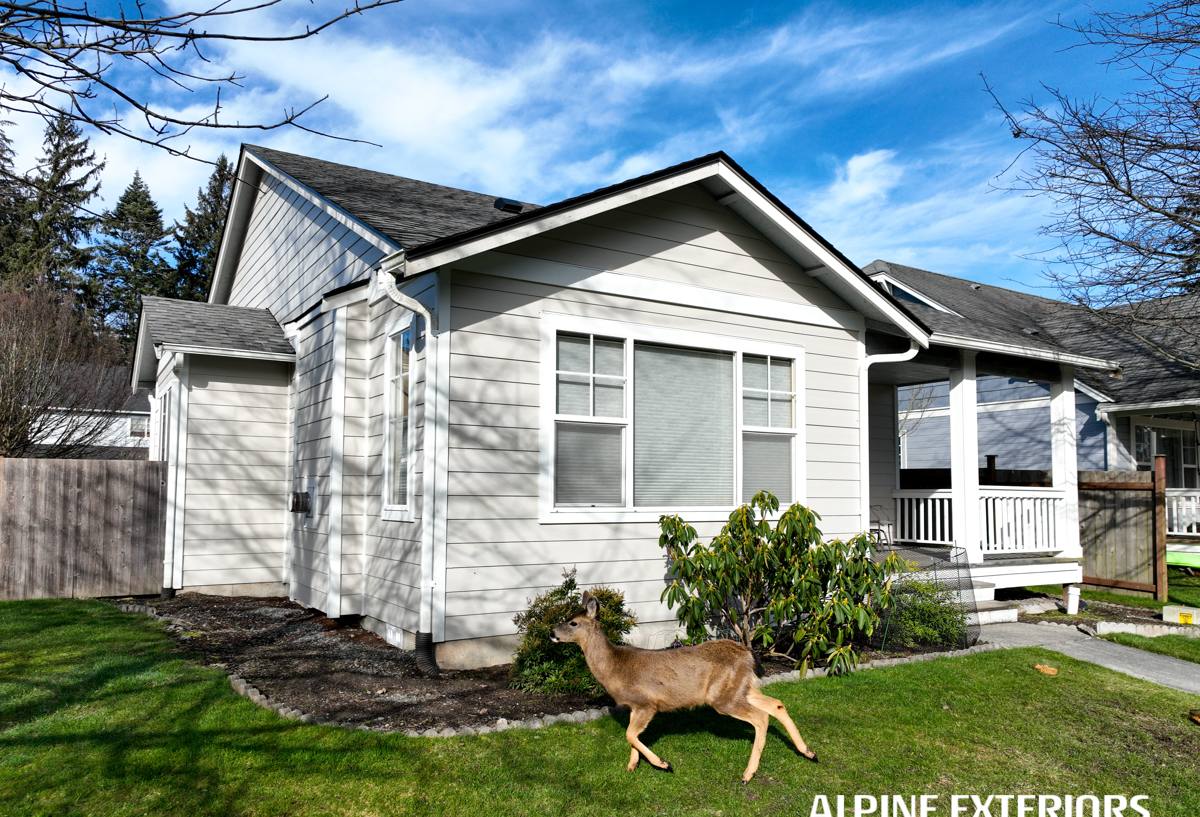
What the Climate Actually Does to a Sudden Valley Home
Shade and Moisture Together
Siding dries out fastest in direct sun and airflow. Under a tree canopy, walls stay damp longer after every rain, and in a climate where it rains often, "longer" adds up over a season. Wood-based products and some engineered wood siding are particularly sensitive to this — sustained moisture at seams, laps, and butt joints is exactly the condition that leads to swelling, soft spots, and eventual rot.
Moss, Algae, and Organic Growth
Shaded, moist siding is a good surface for moss and algae to take hold on, especially on north-facing walls or sections tucked behind landscaping. Beyond the cosmetic issue, moss holds moisture against the siding surface, which extends the time the material stays wet after every rain event and accelerates whatever underlying moisture damage is already happening.
Debris and Gutter Load
Homes under heavy tree cover deal with more needle and leaf debris in gutters and valleys than open lots do. When gutters back up, water sheets down the siding face instead of draining away cleanly, which concentrates moisture exposure right where you don't want it — at the top courses and around window and door trim.
Why We Only Install James Hardie Fiber Cement
We stopped offering vinyl, LP SmartSide, and other wood-based composite sidings a while back, and it wasn't a marketing decision — it was a response to what we kept seeing on service calls in exactly the kind of environment Sudden Valley has. Wood-based siding relies on a factory-applied moisture barrier and precise field sealing to keep water out at every cut edge and joint. In a shaded, slow-drying climate, any gap in that system gets exploited season after season. Vinyl doesn't rot, but it doesn't hold paint, distorts under enough heat and cold cycling, and has no real defense against the kind of moss growth that thrives in shade.
James Hardie fiber cement is cement, sand, and cellulose fiber — it doesn't feed mold or rot the way wood-based products can, and it isn't vulnerable to the same swelling-at-the-seams failure mode. It's also non-combustible, which matters for homes surrounded by trees. The ColorPlus factory finish is baked on and warranted separately from the substrate, so you're not relying on field-applied paint to hold up under years of damp shade. None of that makes a home maintenance-free — moss will still land on any exterior surface given enough shade and moisture — but it removes the failure mode where the siding material itself starts breaking down underneath the growth.
How Hardie's Product Lines Compare for This Kind of Site
| Siding Type | Behavior Under Shade & Moisture | Maintenance in a Moss-Heavy Setting |
|---|---|---|
| James Hardie fiber cement | Does not swell or rot from sustained dampness; factory finish resists fading and moisture intrusion | Periodic gentle washing to remove moss/algae buildup; no repainting needed for years |
| Vinyl siding | Won't rot, but can warp with temperature swings and offers no real advantage in shaded, damp conditions | Moss and algae still take hold on the surface; can't be repainted, only replaced or power-washed carefully |
| LP SmartSide / engineered wood | Wood-based core is vulnerable to moisture wicking at cut edges and seams if the barrier is ever compromised | Requires diligent caulking and field sealing maintenance; failure often starts invisibly at the bottom |
| Cedar / primed spruce | Natural wood is directly susceptible to rot and moss anchoring in prolonged shade and moisture | Needs regular refinishing and active moisture monitoring to avoid decay |
How We Approach a Sudden Valley Job
Every wooded, lake-adjacent lot has its own quirks — driveway access, canopy clearance, where equipment can stage without damaging landscaping. A local crew that knows the neighborhood spends less time figuring out logistics and more time on the actual work. We walk the property first and look specifically at what a generic estimate might miss: which walls carry the heaviest shade and moss load, where gutters are dumping water onto siding instead of away from it, and whether trim, fascia, or window flashing already shows signs of the same moisture stress that's affecting the siding.
Because Sudden Valley properties often sit close to trees and slopes, we also pay attention to site protection during the tear-off and install — keeping debris contained, protecting landscaping, and coordinating around narrower or shared access roads where they exist.
What a Typical Replacement Involves
- Removal of existing siding and inspection of the sheathing underneath for hidden rot or moisture damage
- Repair or replacement of any compromised sheathing before new siding goes on — this step gets skipped by corner-cutting crews and it's the single biggest cause of early siding failure
- Installation of a proper weather-resistive barrier, correctly lapped and sealed
- James Hardie fiber cement installed to manufacturer specifications, including correct fastening, clearances, and joint treatment
- Attention to flashing at windows, doors, and any roof-to-wall intersections, which are common failure points on shaded, damp walls
- Final walk-through so you know what to expect from the new siding and how little maintenance it actually needs
Beyond Siding: The Same Climate Hits Roofing, Windows, and Decks
Shade and prolonged moisture don't stop at the siding. Roofs under heavy tree cover accumulate moss and organic debris faster and need more attention to valleys and flashing. Older windows in a damp, shaded setting are more prone to seal failure and frame deterioration, which shows up as fogging or drafts. Decks exposed to the same conditions face accelerated wear on wood surfaces and connectors. We handle all four — siding, roofing, windows, and decks — which matters on a property like this because these systems interact: a gutter or roof problem often shows up first as a siding moisture problem, and fixing one without checking the other just delays the next call.
Signs a Sudden Valley Home May Need Siding Attention
- Persistent moss or dark streaking that returns quickly after cleaning, especially on shaded or north-facing walls
- Soft spots, bubbling, or visible warping, particularly near the bottom courses or around trim
- Paint that's peeling or blistering rather than just fading evenly
- Visible gaps or separation at seams and butt joints
- A musty smell near exterior walls, which can indicate moisture getting past the siding
- Gutters that overflow regularly, sending water directly down the wall face
What to Expect Cost-Wise
Every Sudden Valley property is different — lot size, wall complexity, how much of the existing sheathing needs repair, and access all factor into the final number. Fiber cement generally costs more upfront than vinyl and is competitive with or less than higher-end engineered wood systems once you account for the maintenance those alternatives require over time. We don't quote a number without walking the property, because a shaded, moisture-affected wall can hide problems that only show up once the old siding comes off, and we'd rather give you an accurate estimate than a low one that changes later.
Why a Local Crew Matters Here
A contractor who mainly works open, sunny lots elsewhere in the county doesn't always anticipate what a wooded, lake-adjacent property like a Sudden Valley home actually needs — the moss cycle, the shade patterns, the way water moves differently off a canopy-covered roof. We work throughout Whatcom County and see this pattern often enough on Sudden Valley homes specifically that it shapes how we inspect, price, and install the job, not just what material we recommend.
If you're noticing moss buildup, soft siding, or just want an honest read on where your home's exterior actually stands, we're happy to take a look. The estimate is free, there's no pressure, and you'll get a straight answer about what's going on and what it would take to fix it — fill out the form below to get started.