 Bellingham Siding
 Siding in Barkley: What Local Homes Are Up Against
Barkley sits close enough to Bellingham Bay and the Nooksack lowlands that its houses take a steady, low-grade beating from moisture year-round. It's not the dramatic weather that wears siding out here — it's the relentless, ordinary kind. Salt-tinged air drifting off the water, driving rain that comes in sideways during winter fronts, and a moss season that can run from October well into May. Individually, none of these are severe. Stacked on top of each other for twenty or thirty years, they're exactly what breaks down siding that wasn't built for this region.
Barkley is a newer, master-planned pocket of Bellingham, which means its housing stock skews a bit younger than the older neighborhoods closer to downtown. That's a mixed blessing for siding. Newer builds often came with vinyl or engineered wood products chosen for upfront cost rather than long-term performance in a wet marine climate. Homeowners in Barkley are increasingly finding that siding installed during initial construction ten to twenty years ago is now showing its age faster than they expected — not because it was installed badly, but because the material itself wasn't matched to Whatcom County's climate.
Why Bellingham's Climate Is Harder on Siding Than It Looks
Three things do most of the damage:
- Salt air: Even a few miles inland from Bellingham Bay, airborne salt accelerates corrosion of fasteners and trim, and it degrades certain coatings and adhesives faster than a dry, inland climate would.
- Driving rain: Bellingham's storms frequently come with wind, which pushes water horizontally into siding laps, seams, and butt joints instead of just running down the face of the wall. Products with weak seams or poor water-shedding design suffer here in ways they wouldn't in a calmer climate.
- Moss and organic growth: Shade, moisture, and mild temperatures are a perfect combination for moss, algae, and mildew. Anything porous or slow to dry — bare wood, some engineered wood products, low-quality paint films — becomes a growth surface. Moss holds moisture against the surface long after the rain stops, which is often the real cause of rot, not the rain itself.
None of this means Barkley is an unusually harsh place to own a home. It means siding here needs to be chosen and installed with this specific combination of stresses in mind, not just picked off a shelf because it's the cheapest option at the yard.
Why We Install Only James Hardie Fiber Cement
We made a deliberate decision as a company to install one siding system: James Hardie fiber cement. We don't offer vinyl, LP SmartSide, Cemplank, Allura, or bare cedar and primed spruce as options, and we think homeowners deserve an honest explanation of why — not just a sales pitch for what we do carry.
What the alternatives get right
Vinyl is inexpensive and low-maintenance in the sense that it doesn't need painting. LP SmartSide and other engineered wood products are lighter to install and can look good initially. Cedar and primed spruce have real aesthetic appeal for homeowners who want a natural wood look. These aren't bad products in every context — they're just not the products we're willing to warranty our workmanship on in this specific climate.
Where they struggle in a climate like ours
Vinyl expands and contracts significantly with temperature swings, and its seams and J-channels can become water entry points over time, especially under wind-driven rain. It also softens and can warp with direct heat exposure. Engineered wood products, including LP SmartSide, are wood-based at the core — if the factory coating is compromised at a cut edge, fastener hole, or seam and moisture gets in, the substrate can swell and deteriorate, and that failure mode is hard to catch early. Bare or primed wood siding requires disciplined repainting and caulking on a cycle most homeowners underestimate; skip a cycle in a climate with this much rain and moss, and rot risk climbs fast.
Why Hardie is what we put on homes instead
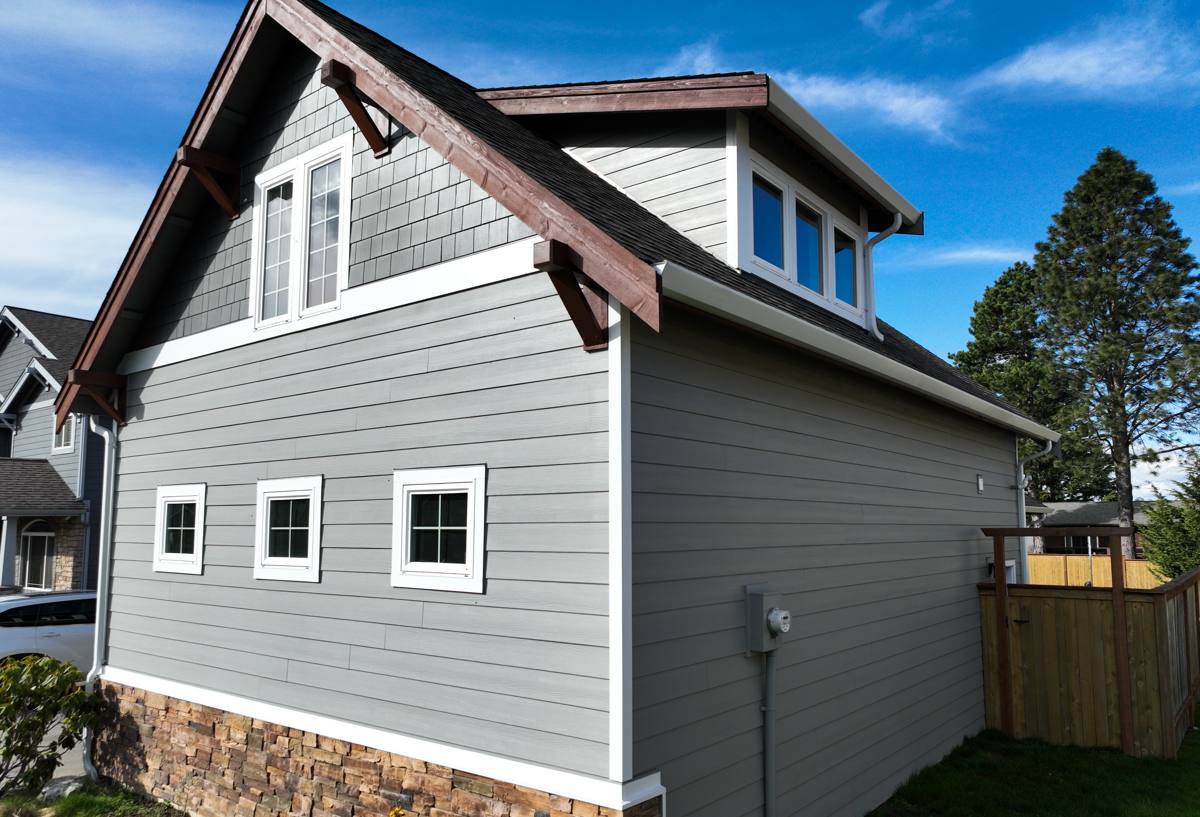
James Hardie fiber cement is non-combustible, doesn't support moss and mildew growth the way wood does, and holds up to swings in moisture without swelling or rotting the way wood-based products can. Hardie's ColorPlus factory finish is baked on under controlled conditions, which gives it better adhesion and UV resistance than field-applied paint, and it comes with a longer color warranty than most homeowners can maintain themselves with routine repainting. Hardie also engineers regional product lines (HZ5 and HZ10) specifically for climate zones like ours, accounting for moisture exposure rather than using one generic formulation everywhere. It's also backed by a strong, transferable manufacturer warranty, which matters if you plan to sell the home in the next decade.
What This Looks Like for a Barkley Home Specifically
Because Barkley is a mixed-use, relatively planned community, homes here tend to be closer together than in more rural parts of Whatcom County, and many share similar architectural styles from the same building era. That means moisture problems and coating failures often show up on a similar timeline across a block or cul-de-sac — if your neighbor's siding is starting to show cracking, chalking, or moss staining, it's worth taking a look at your own, even if it looks fine from the street. Problems on the north and west-facing walls, which get the least sun and the most wind-driven rain, usually show up first.
Our Siding Replacement Process
Inspection and honest assessment
We start by walking the exterior and checking the condition of the existing siding, the sheathing and weather barrier underneath where accessible, window and door flashing, and any obvious rot or moisture staining. Not every home needs a full tear-off — sometimes a targeted repair or partial re-side is the right call, and we'll tell you that instead of upselling a full replacement you don't need.
Installation to manufacturer spec
Fiber cement siding is unforgiving of shortcuts. Correct fastener placement, proper clearances at grade and roofline, correctly lapped and caulked joints, and proper flashing details all matter more with Hardie than with more forgiving materials, because the whole system is designed to work together. We install to James Hardie's published specifications, not a generalized "siding install" — that's what keeps the manufacturer warranty valid and keeps water out of the wall assembly for the long run.
We Handle the Full Exterior, Not Just Siding
Siding failures rarely happen in isolation. A roof that's shedding water poorly, windows with failed flashing, or a deck ledger board holding moisture against the house can all accelerate siding problems nearby. Because we also do roofing, window replacement, and decks, we can look at a Barkley home's exterior as one connected system rather than quoting siding in a vacuum and missing a related issue that will undercut the new siding within a few years.
What Siding Replacement Costs Depend On
| Factor | Why It Matters |
|---|---|
| Home size and wall complexity | More corners, gables, and trim details mean more cutting, more waste, and more labor hours |
| Current siding removal | Tear-off of old vinyl, wood, or engineered siding adds labor and disposal cost versus building on prepped sheathing |
| Underlying damage | Rotted sheathing or framing found once old siding is off needs repair before new siding goes on |
| Hardie product line and profile | Lap width, texture, and plank versus panel systems price differently |
| Trim and accessory work | Fascia, soffit, and window trim replacement alongside siding affects total scope |
| Access and site conditions | Tight lots, slopes, and landscaping near the foundation affect staging and labor time |
We won't quote a number without seeing the house, but these are the variables that actually move the price, and we'll walk through each one with you during the estimate.
Signs Your Siding Needs a Closer Look
- Persistent moss or dark streaking that comes back shortly after cleaning
- Soft spots, or a spongy feel, when you press on the siding near the base of the wall
- Visible cracking, buckling, or warping, especially on north- and west-facing walls
- Peeling or bubbling paint, or chalky residue that rubs off on your hand
- Gaps opening up at seams, corners, or around window and door trim
- Rising energy bills that suggest air and moisture are getting through the wall assembly
Why a Local Crew Matters in Barkley
A crew that works across Whatcom County regularly sees how the same siding product performs differently depending on exposure — a wall facing Bellingham Bay's prevailing wind behaves differently than a sheltered wall a few blocks inland. That local pattern recognition affects real decisions: where to be extra careful with flashing, which walls need the most attention to moss prevention, and how a given home's microclimate compares to the next one over. It also means someone is nearby to stand behind the work if a question comes up five or ten years down the road, not a crew that worked the region for one season and moved on.
If you're noticing wear on your siding, or you're just planning ahead, we're happy to come take a look and give you a straightforward, no-pressure estimate. Use the form below to get started.