 Bellingham Siding
 Homeowners in Bellingham ask us some version of this question almost every week: is vinyl siding really that much worse than fiber cement, or is that just what contractors say to sell a pricier product? It's a fair question, and it deserves a straight answer instead of a sales pitch. Both products can look fine on a house. The real differences show up over time, and they show up faster here than they would in a drier, calmer climate.
We install James Hardie fiber cement siding exclusively. We don't install vinyl, and we think homeowners deserve to know exactly why before they sign a contract with anyone — us or someone else. This page lays out how the two products actually compare, not just on a spec sheet but on a house sitting a few miles from Bellingham Bay.
Why This Comparison Matters More in Whatcom County
Siding choice matters everywhere, but coastal Northwest weather is a harder test than most parts of the country. Bellingham sits close enough to salt water that airborne salt reaches homes well inland, especially on west- and south-facing walls that catch weather off the Sound. Add driving rain that comes in sideways during fall and winter storms, and a moss season that can stretch from October into May on shaded north walls, and you've got a climate that's constantly probing for weak points in a building envelope.
Vinyl and fiber cement respond to that environment differently — not because one is "good" and one is "bad," but because they're fundamentally different materials with different failure modes. Understanding those failure modes is the whole point of this page.
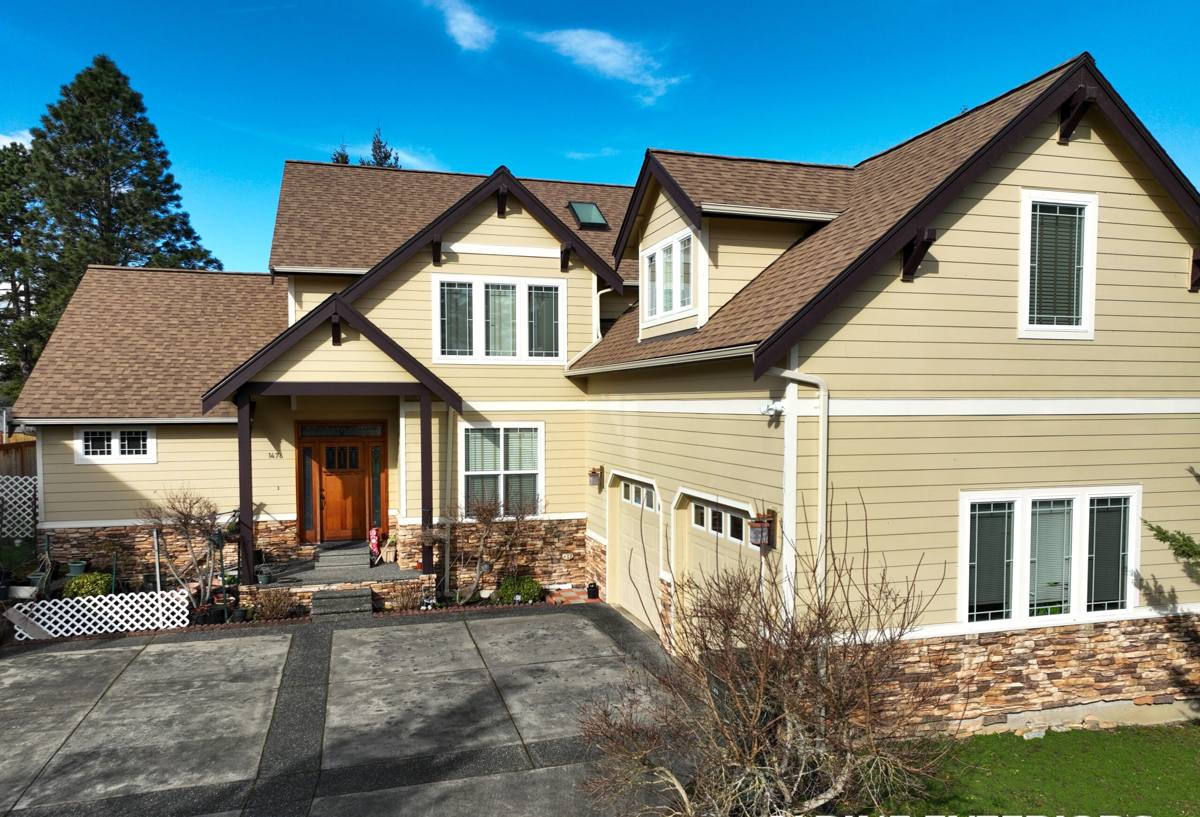
What Vinyl Siding Gets Right
We'll say this plainly: vinyl siding is not a scam product, and plenty of it is out there performing acceptably. It has real advantages that explain why it's the most common siding material in North America.
- Low upfront cost. Vinyl is typically the least expensive siding option installed, which matters on a tight renovation budget.
- No paint required. Color is mixed through the material, so there's no painting cycle to plan for.
- Fast installation. Panels go up quickly, which can mean a shorter project timeline.
- Widely available. Materials and replacement panels are easy to source almost anywhere.
If someone tells you vinyl is junk, they're overselling their point. The honest issue isn't that vinyl fails outright — it's how it behaves over 15-25 years in a wet, salt-exposed, moss-prone climate, and what that behavior costs a homeowner in maintenance, energy performance, and eventual replacement.
Where Vinyl Runs Into Trouble Here
It Moves With Temperature — A Lot
Vinyl is a petroleum-based plastic, and it expands and contracts with temperature swings far more than fiber cement does. Installers have to leave gaps and use loose-hanging fastening methods to accommodate that movement. Done wrong — and it's a surprisingly easy detail to get wrong — panels buckle, warp, or work themselves loose over the years. Bellingham's swings between damp winter cold and warm dry summer stretches keep that movement cycle running constantly.
Impact Damage Is Permanent
Vinyl cracks and shatters, especially in cold weather when it's brittle. A wind-thrown branch, a ladder bump, or a stray baseball leaves a crack that doesn't patch — the panel has to be replaced. Matching color on an older house is often impossible once a run has faded, since manufacturers change color lines over time.
Moisture Doesn't Damage Vinyl — But It Doesn't Stop Moisture Either
Vinyl itself doesn't rot, which is genuinely one of its strengths. But vinyl siding is not a water barrier — it's designed to shed the bulk of the water while relying entirely on the house wrap and flashing behind it to manage anything that gets past the panels. In a region with as much driving, wind-blown rain as Bellingham gets, panel seams, corner posts, and J-channels around windows are constant entry points. If the water-resistive barrier behind the vinyl is compromised, the siding itself gives no early warning — the damage happens in the sheathing and framing, invisibly, until it's a much bigger repair.
Salt Air and Sun Exposure
Vinyl color is baked into the material, but it still chalks and fades under years of UV exposure, and salt-laden air accelerates the surface breakdown of the plastic. Darker colors fade faster and more visibly. This isn't a defect — it's the nature of the material — but it means a vinyl-clad home near the water tends to look noticeably duller after a decade or so, well before the panels have physically failed.
Moss and Algae Find Vinyl Just as Easily
Vinyl's slightly textured, non-porous surface still gives moss and algae plenty to grip in our shaded, damp microclimates — it doesn't resist organic growth any better than most siding materials, and once established, moss holds moisture against the wall assembly longer.
How Fiber Cement Behaves Differently
James Hardie fiber cement is cement, cellulose fiber, and sand, engineered and cured into a rigid plank. That composition changes the physics of how the siding handles this climate.
- Dimensionally stable. It doesn't expand and contract with temperature the way vinyl does, so panels stay flat and fastened tight for decades.
- Non-combustible. It carries a Class A fire rating, which vinyl — a plastic product — cannot claim.
- Impact resistant. It stands up to hail, debris, and everyday bumps far better than vinyl without cracking.
- Factory-cured ColorPlus finish. Baked-on, not painted after installation, resisting fade and chalking substantially longer than field-applied paint or vinyl's mixed-in pigment.
- HZ5 formulation. Hardie's HZ product lines are engineered specifically for moisture and freeze-thaw conditions like the Pacific Northwest sees.
Fiber cement isn't magic, and it isn't maintenance-free — it still needs proper caulking, flashing, and periodic inspection like any siding. But its resistance to moisture-driven swelling, its rigidity, and its factory finish give it a meaningfully longer service life in exactly the conditions Bellingham throws at a house.
Side-by-Side: The Honest Numbers
| Factor | Vinyl Siding | James Hardie Fiber Cement |
|---|---|---|
| Typical installed cost | Lower | Moderate to higher |
| Expected service life | 15-25 years, variable | 30-50+ years with proper install |
| Fire rating | Combustible plastic | Class A, non-combustible |
| Impact resistance | Cracks, especially in cold | Resists denting and cracking |
| Color/finish stability | Fades and chalks over time | Factory ColorPlus resists fading |
| Behavior in driving rain | Relies fully on house wrap behind it | Rigid planks, engineered moisture management |
| Repainting needed | Not typically required | Not required with ColorPlus; possible eventually |
| Warranty structure | Manufacturer-dependent, often prorated | Strong, transferable Hardie warranty |
What Correct Fiber Cement Installation Actually Requires
Fiber cement's long-term performance depends heavily on installation quality — this is one honest trade-off worth naming. It's heavier to work with, requires specific fasteners and clearances, and needs proper flashing and caulking details at every penetration. Cutting corners on install undermines every advantage the product has. That's why we treat installation to Hardie's published specifications as non-negotiable, not optional.
A Few Things a Homeowner Can Check
- Siding held a minimum clearance above roof lines, decks, and grade — not butted tight against them
- Butt joints properly flashed or sealed per Hardie's instructions
- Correct fastener type and spacing for the HZ zone rating
- Caulking at trim and penetrations done with a product rated for the application
- Factory-cut edges properly primed or capped where field cuts occur
Why We Standardized on One Product
We used to get asked to install several different siding products, and for years we did. What changed our minds wasn't a sales pitch from Hardie — it was watching how different materials aged on real Whatcom County homes over 10, 15, 20 years. Vinyl that looked fine at installation showed fading, buckling, or hidden moisture problems behind it well before its expected lifespan was up. Fiber cement, installed correctly, held its look and its integrity far longer against the same salt air, rain, and moss exposure.
Standardizing on one product also means our crews aren't relearning installation details across five different systems — they install Hardie, to Hardie spec, on every job, every time. That consistency is part of what keeps a warranty meaningful instead of theoretical.
Making the Right Call for Your Home
Vinyl isn't wrong for every homeowner or every budget, and we're not going to pretend otherwise. But if you're planning to stay in your Bellingham home for the long haul, or you're re-siding a house that's already shown moisture problems, the durability gap between vinyl and fiber cement is worth weighing seriously against the upfront cost difference.
If you'd like to see and touch both materials, compare colors, and talk through what your specific house and exposure would need, we're happy to walk through it with you — no pressure, no upsell script. Reach out for a free estimate and we'll give you a straight answer about what your home actually needs.