 Bellingham Siding
 Siding in Columbia: A Neighborhood That Sits Close to the Weather
Columbia is one of Bellingham's older, closer-in neighborhoods, and that history shows up on its houses. You'll find a mix of early-1900s homes, mid-century additions, and newer infill, often sitting on lots with mature trees and close neighbors. That combination — older wall assemblies, dense tree cover, and proximity to Bellingham Bay — means siding here works harder than it does in newer subdivisions further from the water.
We've replaced siding on plenty of homes in and around Columbia, and the pattern is consistent: whatever's on the wall is fighting a three-front battle against salt-laden air off the bay, wind-driven rain that gets pushed sideways during winter storms, and a moss and algae season that runs longer here than it does inland. Any siding product can look fine in a photo. What matters is how it performs after fifteen winters of that combination.
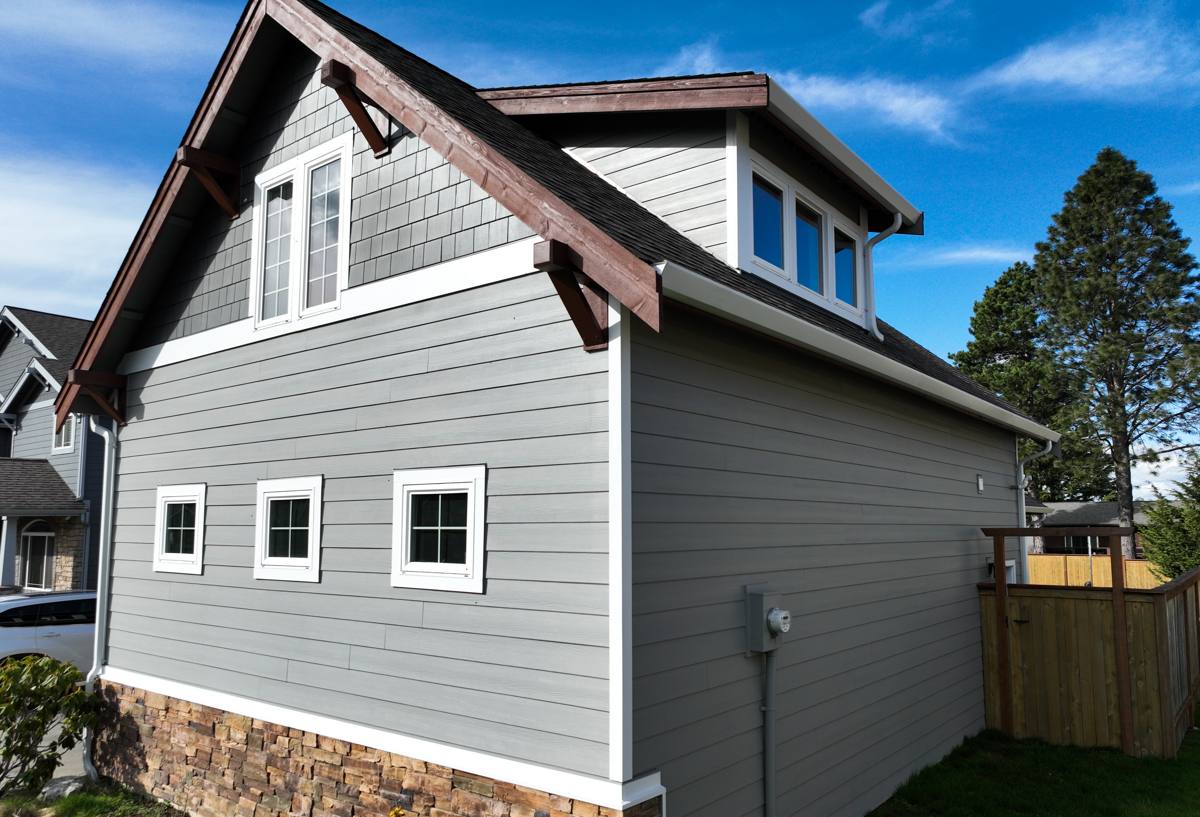
What Whatcom County's Climate Actually Does to Siding
Salt Air
Homes closer to Bellingham Bay pick up airborne salt that settles on exterior surfaces and accelerates corrosion of fasteners, trim flashing, and any metal components in the wall system. It also interacts with certain coatings over time, causing fading and chalking faster than the same product would show inland.
Driving Rain
Bellingham doesn't get the heaviest rainfall totals in the state, but it gets a lot of wind-driven rain — storms that push water sideways into wall assemblies rather than just down. That's a different stress than a simple downpour. It tests every lap, every joint, and every piece of flashing on a house, and it's exactly the condition where poor installation shows up first, regardless of what product is on the wall.
Moss and Algae Season
Shaded, north-facing walls and anything tucked under tree canopy — common throughout Columbia's older, tree-lined lots — stay damp for long stretches of the fall, winter, and spring. That extended dampness is what feeds moss and algae growth on siding, trim, and roofing. Materials that absorb moisture or have inconsistent factory finishes tend to show streaking and growth years before their warranty period ends.
Signs Your Current Siding Is Losing That Fight
- Paint that's peeling, bubbling, or needing repainting more often than every 8-10 years
- Soft spots, especially near the bottom courses, corners, and around window and door trim
- Visible cupping, warping, or boards that no longer lie flat against the wall
- Persistent moss, algae, or dark streaking that comes back within a season of cleaning
- Gaps opening at seams, laps, or where siding meets trim and flashing
- Rising energy bills that suggest the wall assembly behind the siding is no longer doing its job
Any one of these can be a minor fix. Several at once, especially on a home over 20-30 years old, usually means the siding is at or past the point where patching makes sense.
Why We Only Install James Hardie Fiber Cement
We get asked why we don't offer vinyl, LP SmartSide, or cedar as options. It's a fair question, and the honest answer is that we made a standardization decision rather than trying to be everything to everyone.
Vinyl is affordable and low-maintenance in mild conditions, but it can warp or distort under direct heat and doesn't hold up as well against the wind-driven rain and impact events that show up in this region. LP SmartSide is a wood-strand product with real strengths, but it depends heavily on maintaining an intact factory coating and tight joints — a wood-based core does not forgive water intrusion the way fiber cement does. Cedar and primed spruce are attractive, natural materials, but they require ongoing painting, staining, and moisture vigilance that most homeowners don't want to sign up for indefinitely, especially in a climate with this much sustained dampness.
James Hardie fiber cement is non-combustible, dimensionally stable in wet and dry cycles, and comes with a factory-applied ColorPlus finish that's baked on rather than field-painted — which matters directly for the salt-air fading and moss-season staining problems we see locally. Hardie also engineers specific product lines (its HZ5 formulation) for wetter, harsher climates, which is a closer match to Whatcom County conditions than a one-size-fits-all product. It carries a strong, transferable warranty, and when it's installed to manufacturer spec — correct clearances, proper flashing, correct fastening — it's simply a product we're comfortable standing behind for decades, not just for the first few years.
James Hardie Product Lines We Commonly Install
| Product | Best Use | Notes |
|---|---|---|
| HardiePlank Lap Siding | Most homes, classic and modern styles | Available in multiple textures and exposures |
| HardiePanel Vertical Siding | Accent walls, modern facades, gable ends | Often paired with lap siding for contrast |
| HardieShingle | Craftsman and cottage-style homes | Common on older Bellingham neighborhood styles |
| HardieTrim | Window and door surrounds, corners, fascia | Matches siding durability and finish |
How a Full Siding Replacement Works
A proper tear-off and replacement isn't just swapping old boards for new ones. On most Columbia homes, especially older ones, the process looks like this:
- Full removal of existing siding and trim to expose the wall sheathing
- Inspection of the sheathing and framing for rot, moisture damage, or pest issues, with repairs made before anything new goes on
- Installation of a code-compliant weather-resistive barrier and correctly lapped flashing at every window, door, and penetration
- Installation of James Hardie siding and trim to manufacturer-specified clearances, fastener patterns, and joint treatment
- Caulking, touch-up painting at cut edges, and final cleanup
That second step — what's actually behind the old siding — is often the most important part of the job on a house that's 40, 60, or 80 years old. We won't cover up rot or skip flashing details just to get new siding on faster. It's the number one reason siding fails early, regardless of the product on top.
Siding Doesn't Work in Isolation
Siding is one piece of a home's exterior envelope. On many of the homes we work on in Columbia, siding problems show up alongside roofing, window, or deck issues that stem from the same root causes — age, moisture exposure, and deferred maintenance. We handle all four (siding, roofing, windows, and decks) because they interact:
- A roof past its service life will keep pushing water into fascia and top courses of siding no matter how good the siding is
- Old, poorly sealed windows are one of the most common entry points for water damage that gets blamed on siding
- A deck attached to the house needs proper ledger flashing so it doesn't feed water into the wall behind the siding
When we quote a siding job, we look at the whole envelope, not just the walls, so you're not paying to fix the same water problem twice.
What Drives Cost on a Siding Project
| Factor | Why It Matters |
|---|---|
| Home size and wall complexity | More corners, dormers, and trim details mean more labor and material cuts |
| Condition of the sheathing underneath | Rot repair adds cost but is not optional if damage is found |
| Siding profile and accessories | Lap vs. shingle vs. panel, plus trim board width and corner style |
| Access and site conditions | Mature trees, tight lot lines, and multi-story walls affect staging and time |
| Tear-off vs. overlay | We only recommend full tear-off; it costs more up front but avoids trapping moisture |
We don't quote off square footage alone — an accurate number comes from an in-person look at the walls, trim, and what's likely underneath.
What to Look for in a Contractor
- Manufacturer training or certification specific to fiber cement installation, not just general carpentry experience
- A written scope that names the exact product lines, trim details, and flashing approach
- Willingness to open up a section of wall before quoting, if damage is suspected
- Local references and a local presence — not a crew that showed up from out of the area for one project
- Proper licensing, bonding, and insurance you can verify independently
- A clear warranty explanation covering both the material and the labor
A local crew matters here specifically because Whatcom County's exposure conditions aren't uniform even within Bellingham — a wall on a Columbia lot shaded by fir trees behaves differently than an open, sun-exposed wall a few miles inland. Knowing that difference changes how a job should be flashed and detailed, and that only comes from doing the work in this specific climate repeatedly.
Get a Straightforward Look at Your Siding
If your siding is showing its age, or you're just not sure whether it's a paint job or a replacement job, we're happy to take a look. We'll give you an honest read on what we see, no pressure and no obligation, using the form below to get started.