 Bellingham Siding
 Ferndale's Exterior Climate Problem
Ferndale sits close enough to the water and far enough north that its homes take on a specific combination of weather stress most siding products were never designed to handle well over the long term. Salt-laden air moving in off the Salish Sea and Bellingham Bay settles on exterior surfaces year-round. Add Whatcom County's long, wet winters with driving, wind-pushed rain, and a moss season that can stretch from fall through spring, and you have a climate that is quietly hard on paint, caulk joints, and any siding material that isn't dimensionally stable when it gets wet.
None of this is dramatic. It's slow. A house doesn't fail overnight — it develops a hairline crack at a butt joint, moisture works in behind a panel, moss gets a foothold on a north-facing wall that never fully dries out, and five or ten years later a homeowner is dealing with soft trim, peeling paint, or siding that's warped and pulling away from the wall. Our job on a Ferndale home is to put an exterior system on it that doesn't quietly lose that fight.
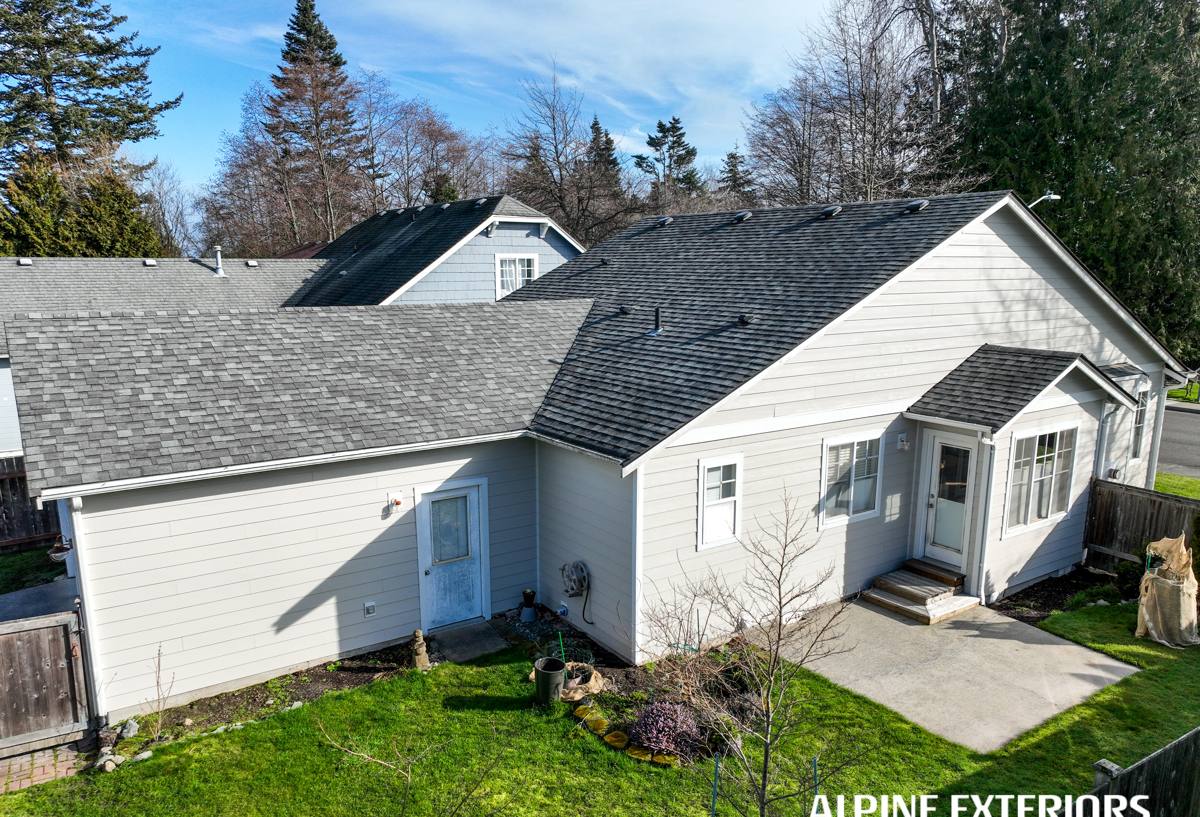
Why We Install Only James Hardie Fiber Cement
We install James Hardie fiber cement siding exclusively. We don't offer vinyl, LP SmartSide, Cemplank, Allura, primed spruce, or cedar, and that's a deliberate professional standard, not a limitation in what we're capable of installing. Each of those alternatives has real strengths — cedar looks beautiful, vinyl is inexpensive, engineered wood products install quickly — but each also carries a trade-off that shows up specifically in a climate like Ferndale's: wood-based products absorb moisture and are vulnerable at cut edges and seams if flashing and caulking aren't perfect and stay perfect for decades; vinyl can warp, fade, and doesn't hold paint if a homeowner ever wants to change the color; cedar demands a maintenance schedule most homeowners don't keep up with once the novelty wears off.
James Hardie fiber cement is cement, sand, and cellulose fiber. It doesn't absorb water the way wood-based siding does, it won't rot, and it's non-combustible — a meaningful consideration anywhere in the Pacific Northwest given how wildfire risk has crept westward in recent years. Hardie also engineers its HZ product lines by climate zone, and Ferndale falls into the wetter, cooler HZ5 zone specification, meaning the product formulation and installation guidance account for exactly the rain exposure and moisture cycling this area sees.
ColorPlus Factory Finish
Most Hardie siding we install goes on with the ColorPlus factory-applied finish rather than field paint. That finish is baked on under controlled conditions and backed by its own finish warranty, which matters in a place where field-applied paint has to cure and adhere in Ferndale's damp, low-sun-exposure conditions. It also means fewer repaint cycles over the life of the siding — a real cost consideration when you're weighing long-term ownership, not just install-day price.
More Than Siding: A Whole-Exterior Approach
Siding doesn't work in isolation. Water that gets past a roof edge, a window flashing detail, or a poorly built deck ledger board ends up in the same wall cavity, no matter how good the siding is. That's why we handle roofing, windows, and decks alongside siding rather than treating them as separate trades that happen to work on the same house.
- Roofing — the first line of defense against Whatcom County's rain volume, and the source of a lot of the moisture problems that eventually show up as siding damage below rooflines and around chimneys.
- Windows — flashing and integration at window openings is one of the most common failure points in any siding job; we detail these correctly the first time.
- Decks — ledger board attachment and deck-to-wall transitions are a frequent source of hidden rot if not built and flashed properly, especially on homes with covered or partially shaded outdoor living space.
When one crew is responsible for how these systems meet each other, there's no finger-pointing later about whose flashing detail let water in.
Signs a Ferndale Home Needs Siding Attention
Because siding failure is gradual, most homeowners don't notice it until it's fairly advanced. A few things worth checking, especially on north- and west-facing walls that stay damp longer:
- Persistent moss or dark streaking that comes back within a season of cleaning
- Paint that's peeling, bubbling, or chalking rather than just fading evenly
- Soft spots when you press on siding or trim, particularly near the bottom courses and around window and door trim
- Visible gaps, warping, or cupping in individual boards or panels
- Caulk that's cracked or pulled away at joints and corners
- A musty smell or unexplained interior wall staining, which can indicate moisture already behind the siding
Any one of these on its own isn't necessarily an emergency, but they're worth a professional look rather than waiting.
What a Siding Replacement Looks Like on Your Property
Assessment and Tear-Off
We start by evaluating what's actually happening under the existing siding — sheathing condition, house wrap or building paper condition, and whether there's evidence of past moisture intrusion. Old siding comes off completely; we don't install new siding over failing material, because that just hides a problem instead of fixing it.
Water Management Details
This is the step that determines whether siding lasts 10 years or 40 in a climate like this. Proper house wrap, correctly lapped flashing at every window, door, and penetration, and rainscreen or drainage plane detailing where appropriate all happen before a single piece of Hardie siding goes up.
Installation to Manufacturer Spec
Hardie siding is engineered for specific fastening patterns, gaps, and clearances, and those specs exist for a reason — get them wrong and you undercut the product's warranty and its actual performance. We install to spec, including proper clearance from grade, decking, and roof lines, which is exactly the kind of detail that gets skipped by crews unfamiliar with the product.
Cost Factors to Understand
Every siding project is priced around the specifics of the house, but the factors that move the number are consistent. This isn't a quote — it's a way to think about where your project falls before we walk the property.
| Factor | Why It Matters |
|---|---|
| Home size and wall complexity | More square footage and more corners, dormers, and gables mean more cutting, fitting, and labor time |
| Tear-off and substrate condition | Rotted sheathing or trim found during removal adds repair work before new siding can go on correctly |
| Siding profile selected | Lap siding, panel systems, and shingle-style Hardie products differ in material and labor cost |
| Number of stories and accessibility | Second-story and hard-to-access walls require more scaffolding and staging time |
| Trim and detail work | Corner boards, window trim, and fascia detailing add finish quality but also labor |
| Color and finish choice | ColorPlus factory finishes vs. field-painted options affect both material cost and long-term repaint cycles |
Why a Local Crew Matters in Ferndale
A crew that works throughout Whatcom County regularly sees how houses in this specific area actually age — which wall orientations hold moss, where wind-driven rain tends to find its way past aging flashing, and which older homes in the area were built with details that don't hold up under current conditions. That local pattern recognition shows up in small decisions during a project: extra attention to a north wall, a recommendation to upgrade flashing at a spot that wouldn't be a concern in a drier climate. It also means we're accountable locally — if a warranty question comes up years down the road, we're not a name from out of the area you have to track down.
James Hardie Product Lines We Work With
Hardie makes several distinct product lines, and part of our job is matching the right one to your home rather than defaulting to a single option:
- HardiePlank lap siding — the most common choice, available in multiple textures and exposures, for a traditional horizontal look
- HardiePanel vertical siding — often used for accent sections, gables, or a more modern aesthetic
- HardieShingle — a shingle-style profile for homes wanting that texture without the maintenance burden of actual wood shingles
- HardieTrim — matching trim boards that complete the system at corners, windows, and fascia
Color selection through the ColorPlus palette range gives real flexibility without sacrificing the factory-finish durability that matters most in this climate.
Ongoing Care After Installation
Properly installed Hardie siding is low-maintenance, not zero-maintenance. In Ferndale's climate, that mostly means an occasional gentle rinse to keep moss and organic growth from establishing on shaded walls, checking caulk joints every few years, and keeping gutters and downspouts clear so water isn't sheeting down wall surfaces it shouldn't be hitting. None of this is heavy work — it's a fraction of what cedar or engineered wood siding demands, which is part of why we standardized on this product.
If you're weighing a siding replacement, or want a straight answer about whether your current siding is holding up the way it should, we're happy to take a look. Reach out for a free, no-pressure estimate using the form below — we'll walk the property, tell you what we actually see, and give you an honest recommendation either way.