 Bellingham Siding
 Why Ferndale Homes Need Siding Repair Done Right, Not Just Patched
Ferndale sits close enough to Bellingham Bay and the Puget Sound shoreline that salt-laden air is a real factor in how exterior materials age here, and that's on top of the driving rain and long, damp Whatcom County winters every home in the area already deals with. Siding that looks fine from the curb can be quietly failing underneath — trapped moisture, softened wood, corroding fasteners — long before a homeowner notices a problem. A repair that only addresses what's visible on the surface tends to come back within a year or two. A repair that's diagnosed and executed correctly can add years of service life to siding that still has good years left in it.
This page is about siding repair specifically — not full replacement — for homes in and around Ferndale. If your siding is failing broadly across multiple walls or is past its usable life, replacement is usually the smarter investment, and we'll say so plainly. But a huge number of siding problems we see in this area are localized: a section of rot near grade, a failed butt joint, storm damage on one elevation, moss-driven deterioration on a shaded wall. Those are repair problems, and repairing them correctly takes more judgment than most homeowners expect.
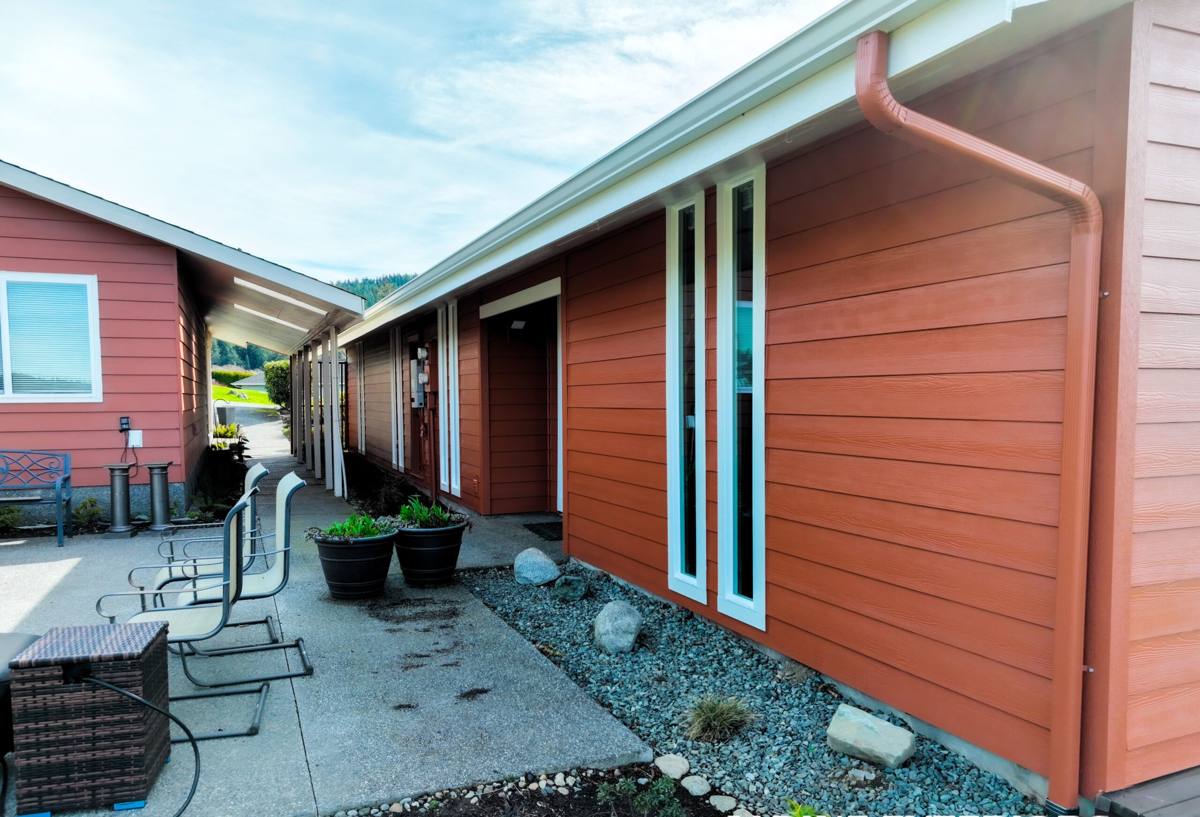
What Ferndale's Climate Actually Does to Siding Over Time
Salt Air and Coastal Exposure
Homes closer to the water pick up airborne salt that accelerates corrosion on anything metal — nail heads, flashing, screws, trim fasteners. Once a fastener starts to rust, it can streak the siding around it and, more importantly, lose its grip, which is how boards start to loosen, cup, or pull away from the wall. This is a slow process, which is exactly why it goes unnoticed until a board is visibly out of place.
Driving Rain and Wind-Driven Moisture
Whatcom County storms don't just fall straight down — wind-driven rain gets pushed sideways into lap joints, corner boards, and anywhere caulking has started to crack. Siding systems are designed to shed water, not seal it out completely, so once the water-resistive barrier behind the siding is compromised — from an old nail hole, a missed flashing detail, or simple age — water gets behind the cladding and stays there far longer than it would in a drier climate.
Moss, Algae, and the Long Wet Season
Ferndale's wet season runs long, and shaded north- and east-facing walls, especially near mature trees or close plantings, stay damp for extended stretches. That's ideal growing conditions for moss and algae, which hold moisture directly against the siding surface. On wood-based products, that constant dampness is what drives rot. On any siding, it's what causes the dark streaking and staining homeowners usually notice first — often before they notice the damage happening underneath it.
Common Siding Repair Issues We See in Ferndale
- Rot or soft spots at the bottom courses, near grade, where splashback keeps siding wet longer
- Failed or cracked caulking at butt joints, corners, and trim intersections, letting water track behind the siding
- Cupped, warped, or delaminating boards on older wood-composite or hardboard siding that's absorbed moisture
- Rust streaking and loosening fasteners on walls with direct salt air exposure
- Moss and algae staining on shaded elevations, sometimes masking deterioration underneath
- Impact damage from storms — cracked or missing sections after wind events
- Nail pops and popped seams from age and repeated wet/dry cycling
What a Correct Siding Repair Actually Involves
A repair that's done right starts before any new material goes up. We pull the damaged section and look at what's behind it — the water-resistive barrier, the sheathing, the flashing at windows and penetrations. If the sheathing underneath is soft or the barrier is torn, patching over that with new siding just hides a problem that will resurface. Addressing what's behind the siding is usually the difference between a repair that lasts and one that doesn't.
From there, correct repair work means matching the replacement material as closely as possible in profile and reveal, re-flashing anywhere water could re-enter, and re-caulking joints with a product rated for the exposure. On coastal-exposed walls, that also means paying attention to fastener choice — corrosion-resistant fasteners are worth the small extra cost given what salt air does to standard hardware over time.
Repair, Section Replacement, or Full Replacement?
Not every siding problem calls for the same scope of work. Isolated rot or storm damage on one elevation is usually a straightforward repair. Widespread failure — moisture damage that's spread across multiple walls, siding that's reached the end of its material life, or a home where repairs would end up patchworking a dozen different areas — is usually better served by full replacement, both for cost efficiency and for a consistent, warrantied result.
Repair vs. Replacement: How We Help You Decide
| Factor | Repair Usually Makes Sense | Replacement Usually Makes Sense |
|---|---|---|
| Extent of damage | Isolated to one area or elevation | Spread across multiple walls or the whole home |
| Siding age and condition | Overall siding is sound, still has service life left | Siding is near or past its expected lifespan |
| Cause of damage | One-time event (storm impact, isolated flashing failure) | Systemic moisture intrusion or ongoing material failure |
| Material match | Discontinued or mismatched product isn't a major visual issue | Original product is discontinued and a patch would clearly stand out |
| Underlying structure | Sheathing and barrier are sound once opened up | Sheathing shows widespread rot or compromise |
Our Ferndale Siding Repair Process
- On-site inspection: We look at the damaged area and check adjacent sections, corners, and trim for related issues before quoting anything.
- Open and assess: Where damage suggests moisture intrusion, we remove the affected siding to inspect the barrier and sheathing underneath.
- Address the cause: Failed flashing, gaps, or barrier damage get corrected first — not just covered back up.
- Repair or replace the section: We match material and reveal as closely as possible and install to manufacturer specification, including fastener pattern and gapping.
- Seal and finish: Proper caulking, touch-up, or factory-finish matching, depending on the material involved.
- Walkthrough: We show you what we found and what we did about it, including anything worth keeping an eye on going forward.
Why We Repair and Replace With James Hardie, Not Vinyl or LP
When a repair calls for new material — a section replacement, a full wall, or a full re-side — we use James Hardie fiber cement exclusively. It's a deliberate standard, not a default. We don't install vinyl siding or LP SmartSide, and here's the honest reasoning behind that, specifically as it relates to a climate like Ferndale's.
Vinyl siding is affordable and low-maintenance in mild climates, but it's a plastic product that expands, contracts, and can become brittle over time, and it's not particularly forgiving of the kind of wind-driven impact and temperature swings this region sees across seasons. LP SmartSide is a wood-strand product with a solid track record when installed and maintained correctly, but it remains wood at its core, which means it's more sensitive to sustained moisture exposure than fiber cement — a real consideration on a coastal, high-moss, high-rainfall site like Ferndale.
James Hardie fiber cement is non-combustible, dimensionally stable, and engineered specifically for wet regional climates through its HZ5 product line. Its ColorPlus factory finish is baked on and backed by a real finish warranty, which matters for repair work in particular — a factory-finished color match holds up and blends in far better over time than field-painted patches. When we do have to replace a section, we want that section to age the same way the rest of the wall does.
Why a Crew That Already Works in Ferndale Matters
Siding repair is diagnostic work as much as it's installation work, and local experience shortens that diagnostic process considerably. A crew that's worked on homes throughout Whatcom County knows which elevations tend to take the worst of the driving rain, which older subdivisions used siding products that are now discontinued, and how aggressively moss establishes itself on shaded walls near the water compared to more inland, sun-exposed sites. That local pattern recognition means fewer surprises once a wall is opened up, and it means the repair plan accounts for how this specific climate will keep testing the siding after we've left.
It also matters for permitting and code familiarity — knowing what Whatcom County and local jurisdiction requirements apply to exterior repair work, and building the job around them from the start rather than discovering an issue partway through.
Maintenance Checklist to Extend the Life of Your Siding
- Rinse siding annually, focusing on shaded, moss-prone walls, using a gentle low-pressure method
- Trim back trees and shrubs so siding gets airflow and sunlight, especially on north-facing walls
- Inspect caulking at trim, corners, and butt joints yearly and re-caulk before it fully cracks
- Check for loose or rust-streaked fasteners after major storms
- Look closely at the bottom few courses near grade for softness or discoloration
- Address small repairs promptly — a small patch job now is almost always cheaper than the section it becomes if ignored
Get an Honest Look at Your Siding
If you're seeing staining, soft spots, cracked caulking, or storm damage on your Ferndale home, it's worth having someone look at it before it becomes a bigger job. We'll give you a straightforward assessment of what's actually going on, what it will take to fix it correctly, and whether repair or replacement is the more sensible path — with a free, no-pressure estimate using the form below.