 Bellingham Siding
 Edgemoor's Setting Is Beautiful — and Hard on Exteriors
Edgemoor sits above Bellingham Bay on a wooded bluff, and that setting is exactly why the neighborhood's homes face a tougher exterior environment than a lot of inland Whatcom County properties. Elevation and water views come with direct exposure to marine air, wind driven off the bay, and a tree canopy that keeps large sections of roof and siding shaded and damp for long stretches of the year. None of that is a problem you can't build around — but it does mean the exterior materials and installation details matter more here than they would on a dry, open lot somewhere inland.
We work on homes throughout Bellingham and greater Whatcom County, and Edgemoor is one of the areas where we see the clearest evidence of what marine climate exposure does to the wrong siding material over time. This page walks through what that exposure actually looks like, how we approach siding replacement for it, and why we install only one type of siding on the homes we work on.
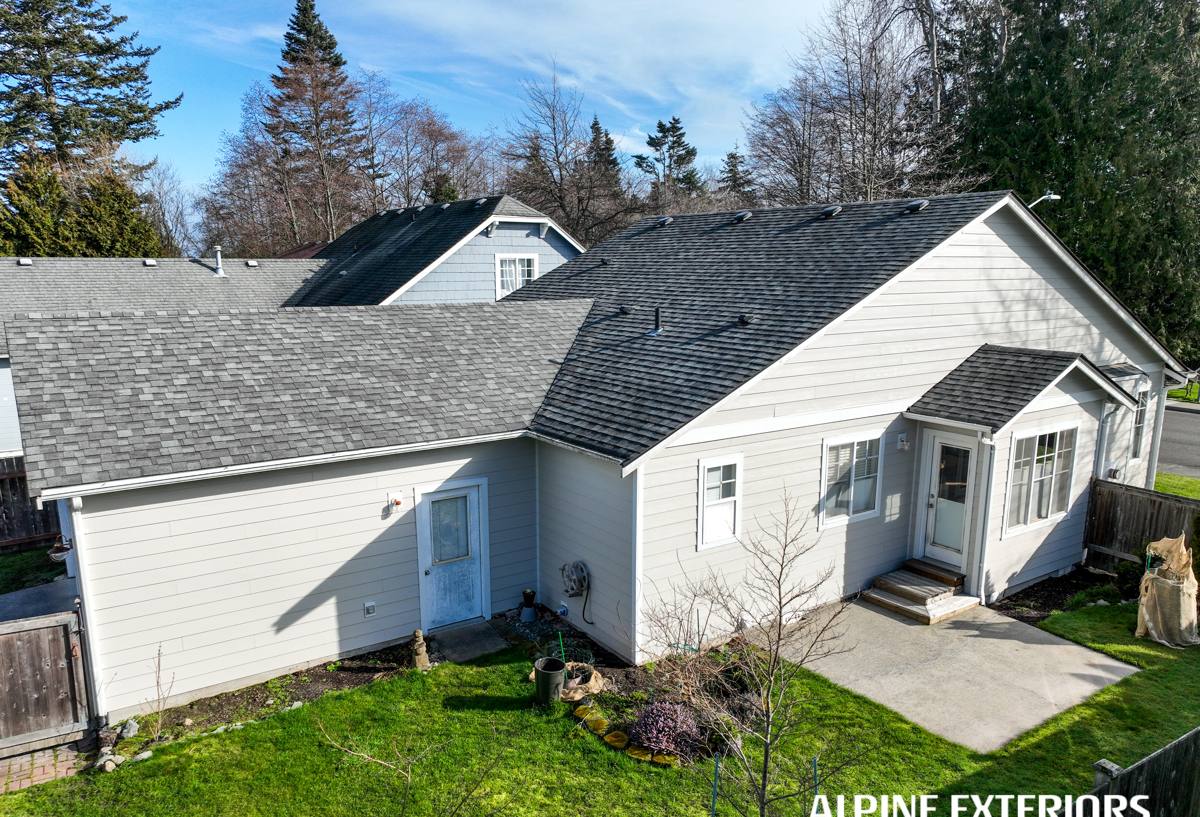
What the Climate Actually Does to Siding Here
Salt Air and Bluff Exposure
Homes closer to the bay's edge take on airborne salt and moisture that settles into siding seams, fastener heads, and any spot where paint or coating has thinned. Over years, that steady low-grade exposure accelerates corrosion on unprotected metal fasteners and trim, and it speeds up the breakdown of finishes that weren't built to handle it. It's a slow process, which is part of the problem — by the time it's visible, it's usually already been happening for a while.
Driving Rain
Bellingham's rain doesn't always fall straight down. Wind off the water pushes it sideways into wall assemblies, which puts real stress on horizontal laps, butt joints, and anywhere siding meets a window, door, or trim piece. A siding product and installation detail that "sheds water fine" in a calm-air climate can still let moisture track behind the cladding when rain is coming in at an angle for hours at a time.
A Long Moss and Mildew Season
Between the tree cover common on Edgemoor lots and the region's extended damp season, north-facing and shaded wall sections stay wet longer than sunnier ones. That's the environment moss, algae, and mildew need to take hold on a siding surface. Once organic growth establishes itself, it holds even more moisture against the material underneath it — which is exactly the kind of feedback loop that shortens the life of moisture-sensitive siding.
Why We Install Only James Hardie Fiber Cement
We don't install vinyl, LP SmartSide, Cemplank, Allura, or primed wood siding like cedar or spruce. That's not a marketing line — it's a standard we hold to because of what we've seen these conditions do to those materials over time, and because we'd rather stand behind one product system we know is engineered for this climate than offer several and hope one works out.
- Vinyl can warp, fade, and become brittle with UV and temperature swings, and it's not fire-resistant — a real consideration for a wooded, tree-covered lot.
- LP SmartSide, Cemplank, and Allura are engineered wood or fiber-cement alternatives that each carry their own moisture-management requirements and installation tolerances; we simply standardized on one system rather than juggling several.
- Cedar and primed spruce look great on day one but need ongoing refinishing, and in a climate with this much sustained moisture and moss pressure, that maintenance burden shows up fast — often within a few years, not decades.
James Hardie fiber cement is non-combustible, dimensionally stable in wet-dry cycling, and comes from the factory with a baked-on ColorPlus finish rather than a job-site paint job. That finish is a big part of why it holds color and resists the kind of surface breakdown that lets moisture and organic growth get a foothold. Hardie also backs its products with a strong transferable warranty — worth something specifically because the material is engineered to earn it, not just paperwork.
Matching the Right Hardie Product to an Edgemoor Home
Hardie makes several product lines, and part of doing this right is choosing the correct one for the wall, the exposure, and the look the home is going for — not defaulting to whatever's easiest to install.
| Product | Best Fit For | Notes for This Area |
|---|---|---|
| HardiePlank lap siding | Most standard walls, traditional look | Available in smooth or cedar-textured finish; the most common choice for full re-sides |
| HardieShingle | Accent walls, gables, coastal/craftsman styling | Popular for the kind of architectural detail seen on larger bluff-lot homes |
| HardiePanel | Modern vertical siding, board-and-batten look | Works well combined with lap siding for a two-material design |
| HardieTrim | Fascia, corners, window and door trim | Matches the siding's moisture resistance instead of leaving wood trim as the weak point |
James Hardie also engineers regional HZ formulations specifically for climate zones — a moisture-heavy, moderate-freeze Pacific Northwest exposure like Bellingham's calls for a different HZ specification than a hot, dry climate would. Getting that specification right at the material level is part of what correct installation means; it's not something that gets fixed later with extra caulk.
Installation Details That Actually Matter Here
Fiber cement performs the way it's rated to perform only when it's installed to spec. In a driving-rain, salt-air environment, the details that get skipped on a rushed job are exactly the ones that cause problems five or ten years down the road.
- Correct nailing pattern and fastener type — not whatever's fastest, and not fasteners that will corrode under salt exposure
- Proper lap and butt joint spacing so water is shed outward, not drawn in by capillary action
- Rain screen or drainage plane behind the siding where the wall assembly calls for it
- Correctly flashed and sealed transitions at windows, doors, and rooflines — the highest-risk spots for wind-driven rain intrusion
- Proper clearance between siding and grade, decks, and roof lines to avoid constant wicking moisture
This is where hiring locally actually shows up in the result. A crew that installs Hardie on Bellingham and Whatcom County homes week in and week out has already made the adjustments a marine climate demands — a crew unfamiliar with this specific weather pattern is more likely to install to a generic spec that works fine somewhere drier.
Beyond Siding: The Rest of the Exterior Works Together
Siding doesn't perform in isolation. On a lot with Edgemoor's tree cover and bay exposure, the roof, windows, and any deck or exterior structure all interact with the same moisture and wind conditions, and problems in one area often show up as damage in another.
We handle siding, roofing, windows, and decks, which matters practically: a roof with a compromised drip edge or flashing can send water straight into a siding wall no matter how well that siding was installed. Window flashing that isn't integrated correctly with the siding plane is one of the most common sources of hidden moisture intrusion we find during exterior evaluations. Treating the exterior as one connected system — rather than four separate trades that don't talk to each other — is how you actually stop repeat problems instead of chasing them.
What Drives the Cost of a Siding Project Here
| Factor | Why It Matters in Edgemoor |
|---|---|
| House size and wall complexity | Larger bluff-lot homes with multiple gables and dormers take more labor and material than a simple rectangular footprint |
| Existing siding removal | Tear-off complexity depends on what's underneath and whether hidden moisture damage is found once old siding comes off |
| Sheathing and framing repair | Long-term moisture exposure sometimes means rot repair is needed before new siding goes on — this is common enough on older homes that it's worth budgeting a contingency for |
| Product line and trim package | HardieShingle accents and custom trim details cost more than a straightforward lap-siding re-side |
| Site access | Wooded, sloped, or bluff-edge lots can add setup and material-handling time compared to flat, open lots |
Signs an Edgemoor Home Should Have Its Siding Looked At
- Persistent moss or dark streaking on north- or shade-facing walls that keeps coming back after cleaning
- Soft spots, bubbling, or visible warping anywhere on the siding surface
- Paint that's peeling or chalking faster than it used to, especially on wood-based siding
- Rust staining running down from fastener heads or trim
- Gaps opening up at butt joints, corners, or window and door trim
- Rising energy bills that suggest the wall assembly isn't performing the way it should
Any one of these on its own isn't necessarily an emergency, but they're worth a professional look before they turn into sheathing or framing repair.
Why a Local Crew Is the Right Call for This Neighborhood
A siding job in Edgemoor isn't the same job as a siding job in a dry, inland part of Washington, and it's not quite the same as a job three blocks away on flatter, more sheltered ground either. Bluff exposure, tree cover, and proximity to the bay all change the moisture-management decisions that go into a correct installation. A local crew that works across Bellingham and Whatcom County year-round has already run into these conditions repeatedly and adjusts for them as a matter of course — not as an afterthought.
If your Edgemoor home's siding is showing its age, or you're planning ahead before the next wet season sets in, we're happy to take a look and talk through what we're seeing — no pressure, no obligation. Request a free estimate using the form below and we'll get back to you with a straightforward assessment.