 Bellingham Siding
 South Hill: A Neighborhood That Wears Its Weather
South Hill sits above downtown Bellingham, rising toward Western Washington University with views out over Bellingham Bay and the islands beyond. That elevation and exposure is part of what makes the neighborhood desirable — and part of what makes it hard on a house. Homes up on the hill catch wind and driving rain coming off the water in a way that lower, more sheltered parts of the city don't. Add in Whatcom County's long, damp shoulder seasons, and exterior surfaces on South Hill homes are working overtime for most of the year.
We've been doing siding, roofing, window, and deck work around Bellingham long enough to know that a house on South Hill doesn't age the same way as a house tucked into a low, tree-sheltered lot in a newer subdivision. The mix of older character homes and newer infill construction up here means we see a wide range of exterior conditions — but the underlying stressors are consistent: salt-tinged air, sustained rain exposure, and a moss season that seems to start earlier and end later every year.
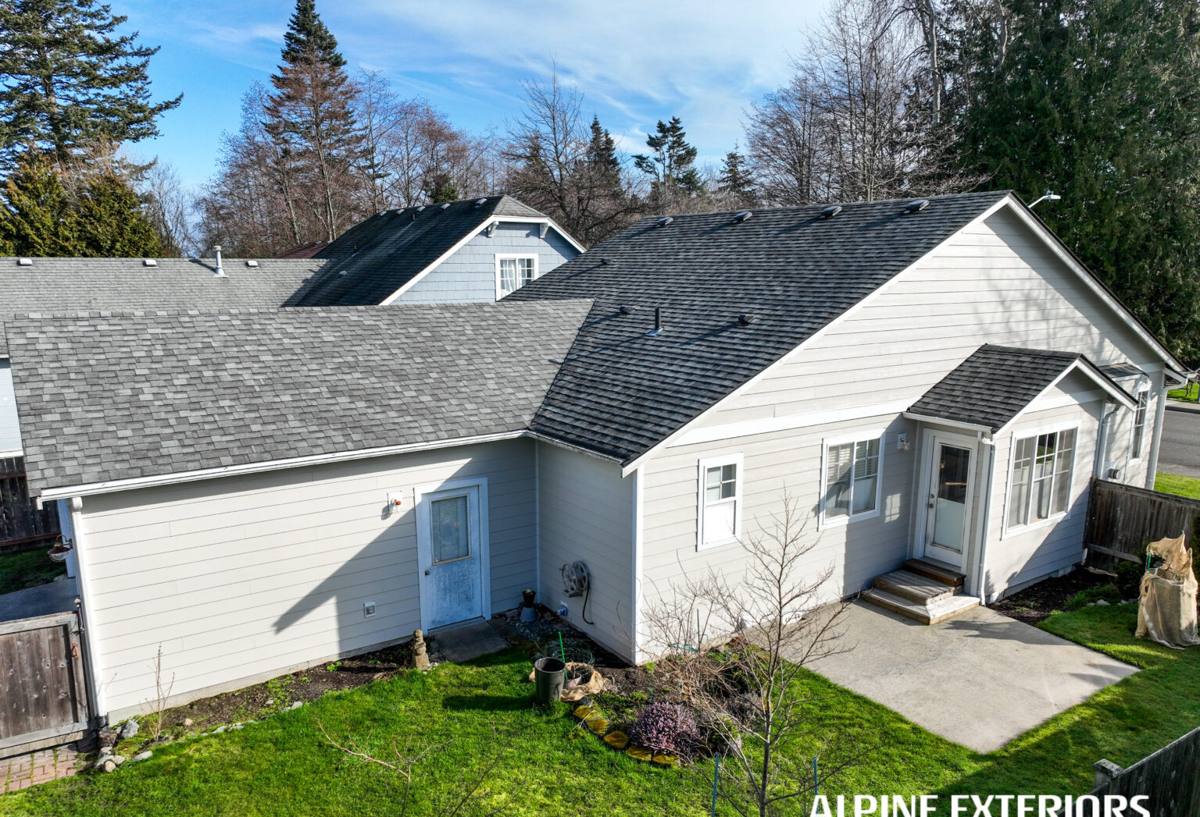
What Bellingham's Climate Actually Does to Siding
Salt Air
Bellingham Bay is close enough that homes with exposure toward the water pick up airborne salt, especially during winter storms. Salt air accelerates corrosion on fasteners and metal trim, and it can speed up the breakdown of finishes that aren't formulated to handle it. This shows up as premature fading, chalking, or peeling on paint and lower-grade siding products long before a manufacturer's stated lifespan is up.
Driving Rain
Whatcom County doesn't just get a lot of rain — a good portion of it arrives sideways, pushed by wind off the Strait and the Bay. Driving rain finds every weak point in a building envelope: gaps at trim, poorly lapped siding courses, unsealed penetrations around windows and light fixtures. On an elevated, exposed site like South Hill, that wind-driven moisture load is higher than it is in more sheltered parts of Bellingham.
Moss Season
Constant moisture plus shade from mature trees (common in South Hill's older sections) equals a long moss and algae season. Moss holds water against a surface, which is exactly what you don't want against wood, house wrap, or a siding product that isn't moisture-stable. Left unaddressed, it becomes a slow, steady source of rot and finish failure, not just a cosmetic issue.
Common Issues We Find on South Hill Homes
- Wood and engineered-wood siding showing swelling, delamination, or soft spots at butt joints and lower courses
- Paint or factory finishes failing early on south- and west-facing walls exposed to wind-driven rain
- Moss and algae staining concentrated on north-facing and shaded elevations
- Trim and fascia rot around window heads and roof-to-wall transitions where flashing was undersized or missing
- Gutter and downspout systems undersized for the rainfall volume, dumping water where it doesn't belong
- Older vinyl siding that's gone brittle and cracked after years of temperature swings and UV exposure
None of these problems are unique to South Hill — but the combination of elevation, exposure, and tree cover means they tend to show up sooner here than in more protected parts of the city.
Why We Install Only James Hardie Fiber Cement
We made a decision as a company to install one siding system: James Hardie fiber cement. We don't install vinyl, LP SmartSide, Cemplank, Allura, or primed wood siding, and on a job like a South Hill home, that decision comes down almost entirely to how each material behaves under sustained moisture exposure.
How Fiber Cement Handles Moisture
Fiber cement is made from cement, sand, and cellulose fiber. It doesn't swell, delaminate, or rot the way wood-based products can when they take on repeated moisture — which matters a great deal on a site that gets driving rain and long stretches of shade-driven dampness. It's also non-combustible, which is a real consideration anywhere wildfire smoke and dry-season risk have become part of a normal Pacific Northwest summer.
ColorPlus Factory Finish
James Hardie's ColorPlus finish is baked on at the factory under controlled conditions, rather than field-painted after installation. That finish is engineered to resist fading and hold up against UV and moisture cycling — a real advantage over field-applied paint, which is exactly the finish type that tends to fail first on the salt-exposed, sun-and-rain-cycled walls we see on South Hill.
HZ5 Climate-Engineered Product Line
Hardie manufactures its siding in climate-specific formulations. The HZ5 line is engineered for wetter, freeze-prone regions like ours, which is what we specify for Bellingham installations. It's a small distinction on paper but a meaningful one in practice: the product is built for the moisture load a South Hill home actually experiences, not a generic national spec.
Warranty That Follows the House
James Hardie backs its siding with a substantial, transferable limited warranty on the product itself, plus a separate finish warranty on ColorPlus. That transferability matters on the resale-active South Hill market — a documented, warrantied exterior is a genuine selling point, not just a maintenance record.
Siding Options Compared
| Material | Moisture Behavior | Finish Durability | Fire Rating | Typical Warranty |
|---|---|---|---|---|
| James Hardie Fiber Cement | Dimensionally stable, does not rot or swell | Factory-baked ColorPlus, resists fade | Non-combustible | Long-term, transferable |
| Vinyl | Doesn't rot, but can warp/crack with age and temperature swings | Color molded through, but fades and chalks over time | Combustible | Varies widely by manufacturer |
| Engineered Wood (LP-type) | Vulnerable to swelling and edge deterioration if moisture reaches the substrate | Field or factory finish, maintenance-dependent | Combustible | Prorated, installation-sensitive |
| Cedar / Primed Wood | Requires consistent maintenance to resist rot and moss | Field-applied, needs periodic recoating | Combustible | No manufacturer warranty on material longevity |
We're not going to tell you every one of those products is a bad choice everywhere — plenty of them have a place. But for a site like South Hill, with real wind-driven rain and a long moss season, the moisture stability and factory finish of fiber cement is the difference between a house that needs attention every few years and one that doesn't.
Beyond Siding: The Rest of the Exterior Envelope
Siding doesn't work in isolation. We handle roofing, windows, and decks alongside siding because on a home exposed the way South Hill homes are, those systems all have to work together to keep water out.
Roofing
Roof condition drives siding condition. A roof shedding water improperly, or with failing flashing at wall intersections, will soak the siding below it no matter how good that siding is. When we're on a South Hill roof, we're checking those transition points closely.
Windows
Window flashing and sealant are a common failure point on older homes, and it's exactly where wind-driven rain finds its way behind the siding. Replacing siding without addressing failing window flashing just re-covers the same problem.
Decks
Elevated South Hill lots often mean elevated decks, which take the same rain and moss exposure as the siding — sometimes worse, since they're horizontal. We build and repair decks with the same moisture-first mindset.
What Working With a Local Crew Actually Gets You
A local Whatcom County crew knows what a Bellingham winter does to a job site and to a house. That means:
- Installation details — flashing laps, weather-resistive barrier integration, fastener spacing — specified for our actual rainfall and wind exposure, not a generic national default
- Scheduling built around realistic weather windows instead of guessing at a distance
- Familiarity with the mix of older and newer construction typical of South Hill, so we know what we're likely to find once the old siding comes off
- A crew that's still around locally next year if a warranty question comes up
Cost Factors for a South Hill Siding Project
| Factor | Why It Matters Here |
|---|---|
| Existing siding removal and disposal | Older homes may have multiple layers or hidden damage that adds labor |
| Substrate and framing repair | Moisture-damaged sheathing or trim found once old siding is off needs to be addressed before new siding goes on |
| Home elevation and access | Sloped South Hill lots can require additional staging, ladders, or lift access |
| Trim and flashing detail work | Proper flashing at windows, roof lines, and penetrations is what actually keeps driving rain out |
| Product line and finish selection | HZ5 panel styles and ColorPlus color selection affect material cost |
We don't publish blanket prices because these factors genuinely change the number from house to house — but every estimate we give breaks these out so you know what's driving the cost.
A Simple Maintenance Checklist for South Hill Homeowners
- Clean gutters and downspouts at least twice a year — clogged gutters push water back toward siding and trim
- Check for moss buildup on shaded, north-facing walls each fall before the wet season sets in
- Look at caulking around windows and trim annually; gaps let driving rain behind the siding
- Trim back tree limbs and shrubs that keep siding in constant shade and moisture
- Have roof-to-wall flashing inspected periodically, especially after a hard windstorm
Getting a Straight Answer About Your Home
Every South Hill property is a little different — lot slope, tree cover, sun exposure, and the age and condition of the existing siding all factor into what a project actually needs. We'd rather walk your specific house with you than talk in generalities. If you're noticing moss buildup, soft trim, or siding that's just looking tired, reach out for a free, no-pressure estimate. We'll tell you honestly what we see and what your options are.