 Bellingham Siding
 Why We Only Install One Brand of Siding
Homeowners sometimes ask why our estimates only ever include one name: James Hardie. It's a fair question — most exterior contractors carry two or three siding lines and let the customer pick based on budget. We used to see it that way too. But after years of doing tear-offs and repairs on homes across Bellingham and the rest of Whatcom County, a pattern became impossible to ignore: the siding that held up wasn't always the siding that looked best on the sample board. It was the siding engineered for exactly the kind of weather we get here.
Bellingham sits in a specific bind. We're close enough to the water that salt-laden air reaches siding on a regular basis, we get long stretches of driving, wind-blown rain off the Sound, and our mild, damp winters produce a moss season that can run from October through May. That combination is hard on some siding materials and barely noticed by others. James Hardie fiber cement, installed correctly, is in the second category. That's the whole basis for our decision, and it's what this page is about.
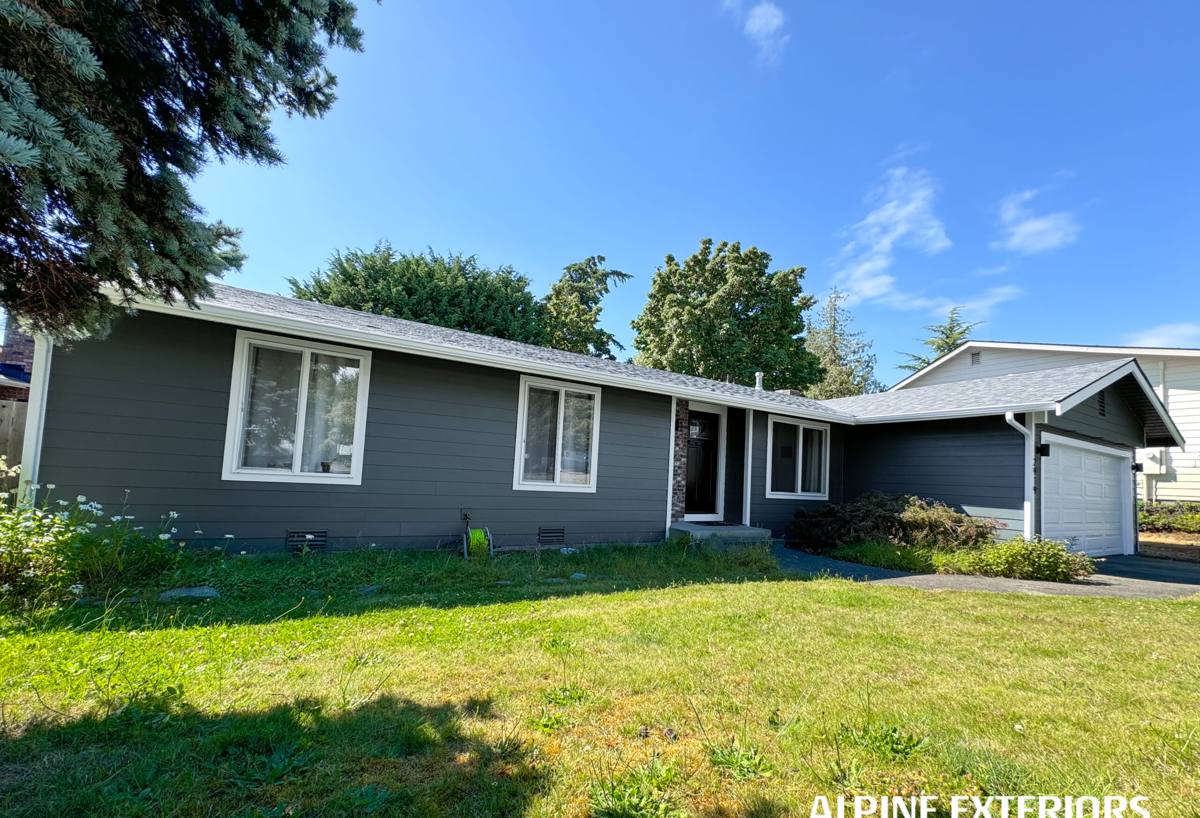
What James Hardie Siding Actually Is
Fiber cement isn't plastic, and it isn't wood. It's a composite of Portland cement, sand, cellulose fiber, and water, cured under controlled conditions into rigid boards and panels. The cement gives it density and rigidity; the cellulose fiber gives it enough flexibility to be worked, cut, and fastened without shattering like a masonry product. The result is a material that:
- Does not burn — fiber cement is non-combustible, unlike vinyl or wood-based siding
- Does not absorb water the way wood or wood-composite products do
- Does not soften, sag, or melt in direct heat or reflected sun
- Holds paint and factory finish far longer than raw wood substrates
- Resists insect damage — there's no organic wood fiber for carpenter ants or woodpeckers to target
None of that makes it maintenance-free or install-proof. Fiber cement is heavier than vinyl, it has to be cut and fastened to spec, and it still needs paint and caulk maintained over time. But the underlying material is doing the hard work for you, instead of against you.
How It Differs From "Engineered Wood" Siding
Engineered wood siding products (strand-based panels with a resin binder, sold under various brand names) are wood at their core, treated and coated to resist moisture. They can perform well when detailed and maintained exactly to spec, but wood-based cores remain sensitive to sustained moisture exposure at cut edges, fastener penetrations, and butt joints — exactly the failure points that show up first in a marine climate with a long wet season. Fiber cement has no wood core to protect, which is why we stopped offering wood-based engineered siding as an option.
Why the Climate Here Changes the Calculation
A lot of siding performs fine in a dry climate and struggles here. Three things about our local weather matter more than most homeowners realize when they're comparing siding brochures:
Salt Air
Coastal and near-coastal exposure accelerates corrosion of metal fasteners and trim, and it degrades some coatings faster than inland weathering would suggest. Fiber cement's cement-based composition isn't vulnerable to salt the way bare or lightly coated metal is, and Hardie's factory finish is formulated to hold color and adhesion through that kind of exposure better than field-applied paint on a porous substrate.
Driving, Wind-Blown Rain
Whatcom County doesn't just get a lot of rain — a good share of it comes in sideways off the Sound during winter storms, which pushes water into laps, joints, and penetrations that stay dry in a calmer climate. Materials that swell, wick, or hold moisture against a wood substrate are working against you in these conditions. Rigid, water-resistant fiber cement is not.
Moss and Sustained Dampness
Our mild winters and heavy tree cover mean siding often stays damp for days at a time, and shaded north walls can grow moss and algae if they're never given a chance to dry. Moss holds moisture directly against the siding surface. On a wood-based product, that's a slow path to rot underneath the growth. On fiber cement, moss is a cosmetic problem you can wash off — not a structural one.
Engineered for Where You Live: The HZ5 System
James Hardie doesn't sell one universal product — its HZ (HardieZone) system is engineered by climate region. HZ5 products are formulated for the wetter, more temperate regions of the Pacific Northwest and similar zones, with a moisture and freeze-thaw profile tuned to conditions like ours, as opposed to the HZ10 line built for hot, humid Southeast exposure. When we specify Hardie for a Bellingham home, we're specifying the HZ5 formulation — not a generic national product.
ColorPlus Technology: Why We Push Factory Finish
James Hardie siding is available primed for field paint or with ColorPlus Technology, a factory-applied finish baked on in a controlled environment before the boards ever reach a jobsite. We recommend ColorPlus on nearly every job for a simple reason: factory finish is more uniform, more resistant to fading and chipping, and backed by its own finish warranty separate from the base product warranty. Field-painting a primed board still works, and there are cases where it's the right call, but the color consistency and touch-up simplicity of ColorPlus is hard to match with a site-applied coat, especially under our overcast, high-moisture painting conditions.
The Hardie Product Lineup
| Product | What It's For | Typical Look |
|---|---|---|
| HardiePlank | Primary lap siding for most of the home's field | Traditional horizontal lap, several exposure widths and textures |
| HardiePanel | Vertical applications, accent walls, board-and-batten look | Smooth or stucco-textured vertical panels |
| HardieShingle | Accent gables, dormers, Craftsman and cottage detailing | Staggered or straight-edge shingle profiles |
| HardieTrim | Corners, window and door surrounds, fascia | Smooth or textured trim boards that match the field siding |
| HardieSoffit | Vented and non-vented soffit panels | Smooth panel, matched to the rest of the system |
Using Hardie components for trim and soffit alongside the field siding isn't cosmetic preference — it keeps expansion rates, fastening methods, and finish warranties consistent across the whole envelope, instead of mixing materials that move and weather differently at the seams.
How Hardie Compares to the Alternatives
| Factor | James Hardie Fiber Cement | Vinyl | Wood / Engineered Wood |
|---|---|---|---|
| Combustibility | Non-combustible | Melts/deforms in heat | Combustible |
| Moisture behavior | Does not absorb or swell | Doesn't absorb, but seams/traps moisture behind it | Absorbs at cut edges and joints |
| Moss/algae impact | Cosmetic only, cleanable | Cosmetic only, cleanable | Can lead to rot beneath growth |
| Finish longevity | 15+ years factory finish (ColorPlus) | Color molded in, fades over time, cannot be easily repainted | Field paint, typically 5-10 years before recoat |
| Impact resistance | High | Can crack in cold, dent easily | Moderate, denting and splitting possible |
| Warranty structure | Long, transferable, non-prorated | Varies widely, often prorated | Varies by manufacturer |
This table isn't meant to declare every alternative "bad" — vinyl and engineered wood both have legitimate uses and satisfied customers elsewhere. It's meant to show, side by side, why the trade-offs stopped making sense for us as a company installing exclusively in this climate.
The Warranty, in Plain Terms
James Hardie backs its fiber cement siding with a non-prorated limited warranty, and ColorPlus finishes carry their own separate finish warranty. Both are transferable to a subsequent homeowner within the warranty terms, which matters if you're thinking about resale — a documented, transferable siding warranty is a concrete selling point, not just a maintenance reassurance. The specific terms vary by product and finish, and we walk through the actual warranty documentation with every homeowner before installation, not just at the sales stage.
What Correct Installation Actually Requires
Fiber cement's performance depends heavily on installation quality — this is the part of the industry where corners get cut most often, and it's worth understanding before you hire anyone.
Non-Negotiables on Every Job
- Proper clearance from grade, roof lines, and decks — manufacturer minimums exist for drainage, not aesthetics
- Correct fastener type, spacing, and penetration depth per the Hardie installation manual
- Rainscreen or drainage plane behind the siding where conditions call for it, appropriate for our wet climate
- Proper flashing and integration at windows, doors, and all penetrations
- Butt joints treated and caulked per spec — a leading cause of callbacks when skipped
- Field-cut edges primed or sealed before installation, not left exposed
Every one of those items is spelled out in Hardie's published installation guidelines. Skipping any of them can void the manufacturer's warranty even though the siding itself is installed and looks fine on day one. That's the uncomfortable truth in this trade: a beautiful-looking installation and a correct installation are not automatically the same thing, and the difference usually doesn't show up until year three or four.
What Drives Cost
| Factor | Why It Matters |
|---|---|
| Product line (plank vs. shingle vs. panel) | Shingle and specialty profiles cost more in material and labor than standard lap |
| Factory finish (ColorPlus) vs. field paint | ColorPlus costs more up front, typically less over the life of the siding |
| Tear-off vs. install over existing sheathing | Removing old siding, checking for rot, and repairing sheathing adds labor |
| Wall complexity | Dormers, multiple gables, and cutouts increase labor time significantly |
| Access and site conditions | Multi-story walls, tight lots, and staging needs affect labor cost |
We don't publish flat per-square-foot pricing because these factors swing the total meaningfully from house to house — a simple single-story rambler and a steep, multi-gabled two-story cost very different amounts even with the identical product.
A Practical Checklist Before You Sign Anything
- Ask whether the crew doing the physical install is company employees or a subcontractor, and how much Hardie-specific experience they have
- Confirm which HZ product zone is being specified for your home
- Ask to see the manufacturer installation instructions the crew is working from
- Get the warranty paperwork — both the product warranty and, if applicable, the ColorPlus finish warranty — in writing before the job starts
- Ask how butt joints, flashing, and clearance from grade/decks will be handled on your specific home
- Confirm what happens to old siding, house wrap, and any sheathing repair needed underneath
Any reputable contractor should be able to answer every one of these without hesitation. If you get vague answers, that's worth noticing before the crew shows up.
Where This Leaves You
We're not going to tell you every other siding product on the market is a bad choice everywhere — that's not true, and it's not our call to make about someone else's climate or budget. What we can tell you is that after years of siding and re-siding homes throughout Whatcom County, James Hardie's fiber cement, in the HZ5 formulation, with correct installation, is the product we're willing to put our name behind against salt air, driving rain, and moss season. That's why it's the only thing on our trucks.
If you're weighing a siding replacement or repair and want a straight answer about what your home actually needs, we're happy to walk the exterior with you and put together a free, no-pressure estimate.