 Bellingham Siding
 Why We're Writing This Page
If you've priced out siding in Bellingham, you've probably run into LP SmartSide. It's a common product, contractors around Whatcom County install it, and on paper it looks like a smart middle-ground choice — cheaper than fiber cement, tougher than vinyl, and marketed as engineered for wet climates. We get asked about it regularly, so we want to explain plainly why we don't install it, without pretending it's a bad product. It isn't. It's just not what we put on homes here, and we think you deserve to know the actual reasoning instead of a sales pitch.
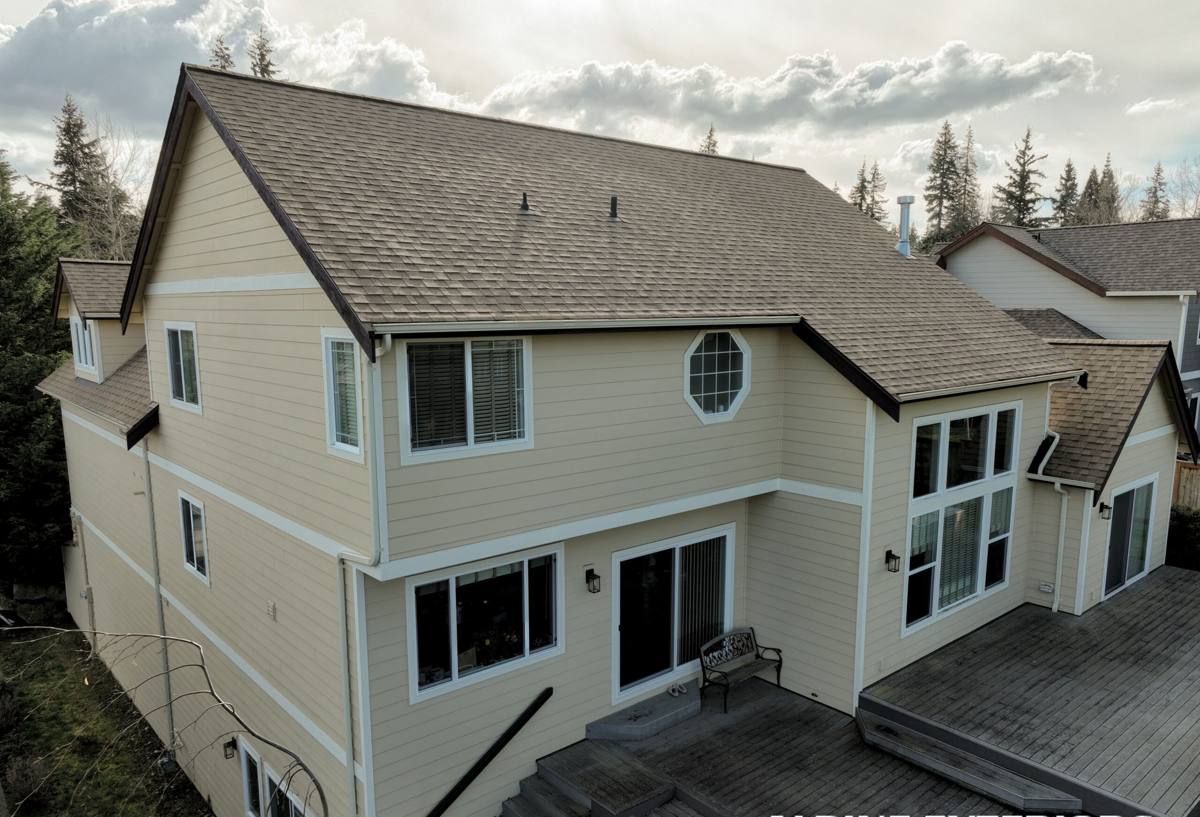
What LP SmartSide Actually Is
LP SmartSide is an engineered wood siding. The core is made from wood strands (similar in concept to OSB) bonded with resins, then treated with zinc borate to resist fungal decay and insect damage, and finished with a resin-saturated overlay meant to shed water and hold paint. It comes in lap boards, panels, and trim, and it installs faster and lighter than fiber cement, which is part of why it's popular with builders working on tight schedules or budgets.
Credit where it's due: modern LP SmartSide is a real improvement over the hardboard sidings of the 1980s and 90s that gave engineered wood a bad name industry-wide. The zinc borate treatment and resin overlay are genuine engineering, and LP backs the product with a warranty. For dry climates or homes where budget is the primary driver, it's a legitimate option other contractors can install well.
Where It Performs Reasonably Well
- Impact resistance — the wood-strand core handles hail and minor impacts better than vinyl
- Workability — cuts and fastens like wood, which speeds up installation
- Upfront cost — typically less expensive installed than fiber cement
- Weight — easier on the framing and easier to handle on multi-story installs
The Core Trade-Off: It's Still a Wood Product
Here's the thing that doesn't change no matter how good the treatment or overlay is: the core of LP SmartSide is wood strand. Wood swells when it absorbs water and it's vulnerable to decay if water gets past the protective layer and stays there. The zinc borate treatment slows decay, and the resin overlay is designed to keep water out — but "designed to keep water out" only holds up if every cut edge, every nail penetration, every seam, and every panel joint is sealed and maintained exactly as the manufacturer specifies, for the life of the siding.
That's a real installation and maintenance burden, and it's the single biggest reason we don't put it on homes in this area. Fiber cement doesn't carry that same failure mode — there's no wood core to swell or rot if a seal gets missed five years down the road.
Why Bellingham's Climate Raises the Stakes
Every siding product has a climate it performs best in. Bellingham and Whatcom County are not that climate for an engineered wood product. A few things stack up against it here:
Driving Rain Off the Salish Sea
Storms coming off the water don't just fall straight down — wind-driven rain pushes moisture sideways into joints, seams, and butt ends that a calmer climate would barely test. That's exactly where an engineered wood product is most dependent on perfect edge sealing.
Salt Air Near the Water
Homes closer to Bellingham Bay and the surrounding shoreline deal with salt-laden air that accelerates wear on fasteners, caulk joints, and painted finishes. Caulk and paint are the primary defense keeping moisture out of an engineered wood panel, so anything that shortens their service life shortens the siding's real-world protection window.
A Long, Genuine Moss Season
Whatcom County's wet season runs long — often October through May — and shaded, north-facing walls under fir and cedar canopy stay damp for extended stretches. Moss and algae aren't just cosmetic on a wood-based product; sustained surface moisture is exactly the condition that tests how well a resin overlay is holding up over time.
None of this means LP SmartSide fails automatically in this climate. It means the margin for installation error and maintenance neglect is thinner here than it is in a drier region, and we'd rather not sell homeowners a product where the difference between "performs great for decades" and "problems in year eight" comes down to whether every single seam was caulked correctly and every repaint happened on schedule.
The Maintenance Reality Homeowners Often Aren't Told
LP SmartSide is a paint-grade product — it requires a factory or field-applied paint finish, and that finish is doing real protective work, not just providing color. That means:
- Repainting on a cycle (commonly every 7-10 years depending on exposure, sooner in harsher conditions) to keep the moisture barrier intact
- Re-caulking joints, seams, and trim intersections as caulk ages and shrinks
- Prompt attention to any impact damage, chip, or gouge that exposes the wood-strand core, since a small exposed spot can allow moisture intake if left unaddressed
- Keeping the siding a minimum clearance above grade, decks, and roof lines per the manufacturer's install instructions — ignoring clearance requirements is a common source of moisture problems
This isn't unique to LP — most paint-grade sidings share some version of this maintenance schedule. But it's a real ongoing cost and a real ongoing homeowner responsibility, and it's worth factoring into any "cheaper upfront" comparison.
Warranty Fine Print Worth Reading
LP SmartSide's warranty is genuine and transferable, but like most siding warranties it comes with conditions: installation has to follow LP's published instructions exactly (fastener spacing, clearances, caulking, priming cut edges), and damage from improper installation or deferred maintenance typically isn't covered. That puts a lot of weight on the installer getting every detail right, every time, on every home — which is a fair ask of any contractor, but it's a narrower margin than a warranty on a product whose core material isn't moisture-reactive to begin with.
How It Compares to What We Install
| Factor | LP SmartSide (Engineered Wood) | James Hardie (Fiber Cement) |
|---|---|---|
| Core material | Wood strand, resin-bonded | Cement, sand, cellulose fiber |
| Moisture behavior | Water-resistant if sealed correctly; core can swell/decay if compromised | Non-organic core, does not rot or swell from moisture |
| Combustibility | Combustible (wood-based) | Non-combustible |
| Finish | Field or factory paint required; repaint cycle needed | ColorPlus factory finish available, longer repaint intervals |
| Installation sensitivity | High — cut-edge sealing and clearances are critical | Moderate — still needs correct install, less moisture-failure risk if missed |
| Typical upfront cost | Lower | Higher |
Why We Standardized on James Hardie
We made a decision as a company to install only James Hardie fiber cement siding, and this comparison is why. A cement-based product simply doesn't share the failure mode that worries us most about engineered wood in a marine, high-rainfall climate like Whatcom County's — there's no organic core that decays if a seal fails years after installation. Hardie's HZ product lines are engineered for specific climate zones, the ColorPlus factory finish reduces how often a homeowner needs to think about repainting, and the warranty structure is one we're comfortable standing behind on every home we touch. It costs more upfront. We think that cost buys a genuinely lower-maintenance, longer-performing wall system for this specific climate, and that's the trade we're willing to make with our customers.
Questions to Ask Before Choosing Any Siding Product
Whether you go with LP SmartSide, fiber cement, or something else, these questions apply to any contractor and any product in this climate:
- Who is treating and sealing every cut edge on-site, and is that step being inspected, not just assumed?
- What is the manufacturer's required clearance above grade, roofing, and decking, and will the installer confirm it in writing?
- What voids the warranty, and has the contractor read that language or just the sales sheet?
- What's the realistic repaint or recaulk schedule for this specific product in a wet, salt-air climate — not the manufacturer's best-case number?
- Is the installer certified or specifically trained on this product, or is it something they install occasionally alongside several other siding types?
Get an Honest Look at Your Home
Every home and every wall exposure is a little different — a covered porch wall on the lee side of your house doesn't face the same conditions as a north-facing gable catching wind off the water. We're happy to walk your property, look at your specific exposure, and give you a straight answer about what your siding needs, at no cost and no pressure. Fill out the form below to schedule a free estimate.