 Bellingham Siding
 Sunnyland's Exterior Challenge: Bay Air, Rain, and Moss
Sunnyland sits close enough to Bellingham Bay that homes here deal with a mix of conditions that's tougher on exterior materials than most people realize. Salt-tinged air moving off the water accelerates corrosion on fasteners, trim, and anything with exposed metal. Layer on Whatcom County's long, wet fall-through-spring stretch of driving rain, and you've got siding systems that spend a huge share of the year saturated or damp. Add a moss season that can run from October well into May, and homes with north-facing walls or heavy tree cover end up hosting moss and algae growth that traps moisture right against the siding surface.
None of this is unique to Sunnyland, but it's a real, cumulative load on a home's exterior. Wood-based products swell and shrink with that moisture cycle. Paint and caulking joints fail faster. Anything with a seam or a fastener that isn't properly sealed becomes a slow entry point for water. Over years, that's how you end up with soft spots at the bottom of siding boards, staining around window trim, or paint that won't hold no matter how often it's redone.
We've worked on enough homes in this part of Bellingham to know the pattern isn't dramatic — it's gradual. Siding rarely fails all at once here. It fails inch by inch, at the joints and the ground line, over ten or fifteen years of exposure that a drier climate would never produce.
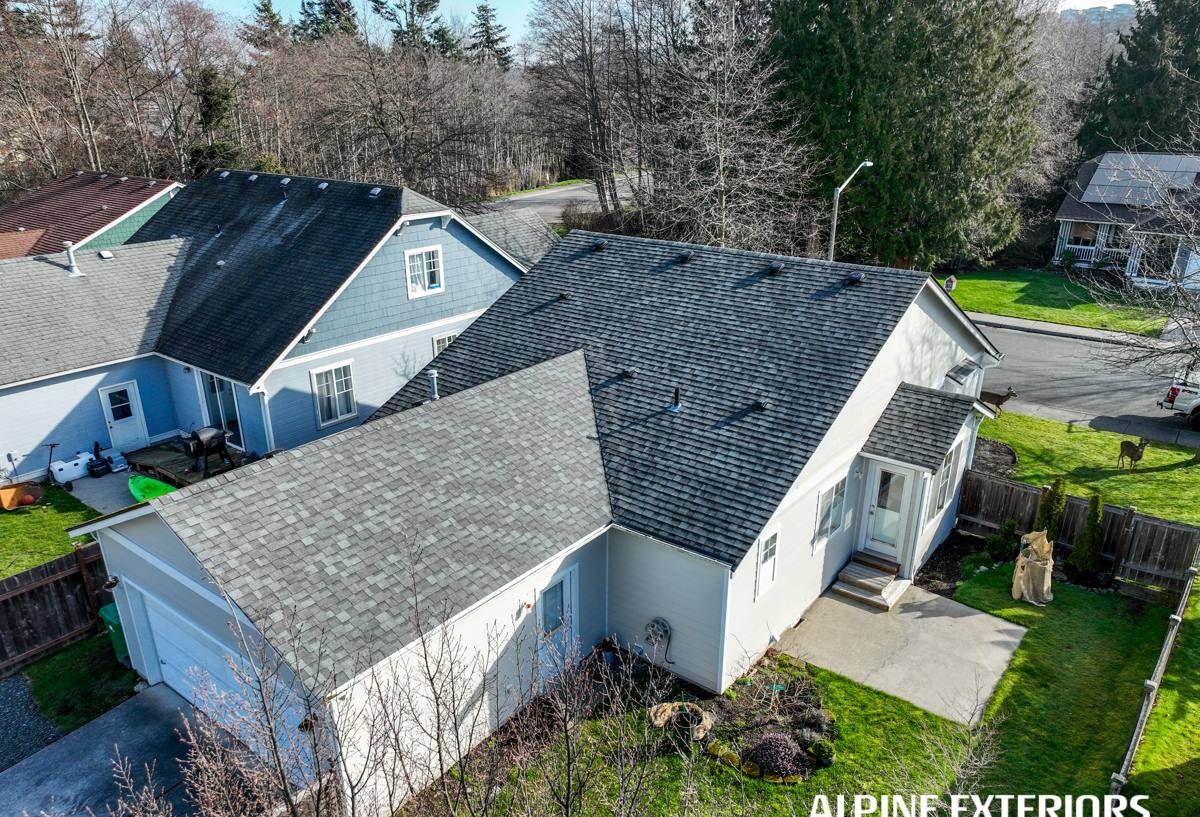
Why We Only Install James Hardie Fiber Cement
We made a deliberate call to standardize on James Hardie fiber cement siding and stop installing everything else — vinyl, LP SmartSide, primed spruce, cedar, and other fiber cement brands like Allura or Cemplank. That's not a marketing position; it's a decision based on what actually holds up in a climate like ours.
Fiber cement as a category resists moisture and rot in a way wood-based siding simply can't, because it isn't wood. It won't absorb water the way an engineered wood panel or solid cedar board will, which matters enormously given how much of the year Sunnyland spends under rain. Hardie's manufacturing process and quality control are the reason we picked their product specifically over other fiber cement brands — consistent thickness, consistent moisture resistance, and a factory finish (ColorPlus) that's baked on rather than site-applied, which means better fade and chip resistance than a field-painted product.
Hardie also builds region-specific product lines through its HZ5 engineering, which is formulated for wetter, colder Pacific Northwest climates rather than a one-size-fits-all national product. That regional engineering, plus a strong transferable warranty, is why we stopped installing alternatives and put our name behind one system.
What We Turned Down, and Why
Vinyl siding is inexpensive and low-maintenance in mild climates, but it's a petroleum-based product that expands and contracts significantly with temperature swings, can crack in cold snaps, and isn't rated to protect against wind-driven rain the way a properly flashed fiber cement system is. LP SmartSide and primed wood products perform reasonably well when maintained on a strict paint and caulk schedule, but that's exactly the maintenance burden Sunnyland's climate punishes — miss a cycle or two and moisture gets a foothold. Cedar is a beautiful, genuinely traditional Pacific Northwest material, but it demands ongoing sealing and refinishing to resist the rot and moss growth that our wet season practically guarantees if it's neglected. None of these are "bad" products in the abstract. They just aren't the right match for how much water this region throws at a house year after year.
How a Siding Replacement Project Actually Works
Every project starts with an on-site inspection, not a sales pitch. We look at the current siding, the condition of the sheathing underneath it, window and door flashing, and any trouble spots — usually the bottom few feet of wall, corners, and anywhere trim meets siding.
Typical Project Sequence
- Inspection and written estimate, including any sheathing or moisture damage found during the walkthrough
- Removal of the old siding and inspection of the wall sheathing once it's exposed
- Repair or replacement of any damaged sheathing, framing, or trim before anything new goes up
- Installation of a weather-resistive barrier and proper flashing details around every window, door, and penetration
- Installation of James Hardie panels or lap siding per manufacturer fastening and clearance specifications
- Caulking, trim work, and final ColorPlus touch-up where needed
- Final walkthrough with the homeowner
That third step — what's underneath the old siding — is often the most important part of the whole job. In a climate like ours, we regularly find soft or water-damaged sheathing behind siding that looked fine from the curb. Fixing that properly, rather than just covering it back up, is the difference between a siding job that lasts and one that hides a problem for a few more years.
Signs a Sunnyland Home May Need New Siding
Most homeowners don't think about their siding until something looks obviously wrong, but there are earlier signs worth watching for, especially given how our wet season works.
- Paint that's peeling, bubbling, or won't hold even after a fresh coat
- Soft or spongy spots when you press on the siding, especially near the bottom of walls
- Persistent moss, algae, or dark staining that comes back shortly after cleaning
- Visible gaps, warping, or boards that have pulled away from the wall
- Rising heating bills that suggest the wall assembly isn't insulating the way it used to
- Interior signs like musty smells or staining on interior walls near exterior corners
Any one of these on its own isn't necessarily an emergency. But a couple together, especially soft spots plus staining, usually means moisture has already gotten past the surface and it's worth having someone look before it spreads.
What Siding Replacement Costs and What Drives the Price
We don't publish fixed prices because every home is different, but the factors that move a bid up or down are consistent. The table below covers the main ones we walk through with homeowners.
| Factor | Why It Matters |
|---|---|
| Home size and wall complexity | More square footage and more corners, dormers, and trim details mean more labor and material |
| Condition of existing sheathing | Rot or water damage found during tear-off adds repair scope before new siding can go on |
| Siding profile chosen | Lap siding, panel siding, and shingle-style Hardie products carry different material and install costs |
| Trim and accessory work | Fascia, soffit, window trim, and corner detailing add scope beyond the flat wall area |
| Access and site conditions | Multi-story walls, tight lot lines, or landscaping that limits staging can affect labor time |
| Color and finish | Factory ColorPlus finishes and custom colors are priced differently than standard primed options |
The honest answer to "what will this cost" is that it depends on what we find once the old siding comes off, which is exactly why the inspection and written estimate come before any commitment.
A Full Exterior, Not Just Siding
Siding doesn't work in isolation — it's one part of a wall and roof system that's supposed to keep water out and heat in. We also handle roofing, windows, and decks, and on a lot of Sunnyland projects those trades intersect directly with a siding job.
A roof that's shedding water incorrectly at the eaves or a damaged gutter system can soak the top course of siding for years before anyone notices the pattern. Old, poorly sealed windows are one of the most common sources of the water intrusion we find when we open up a wall during a siding tear-off. And decks attached to the house need proper flashing where they meet the siding, or that ledger connection becomes a chronic leak point. Handling these trades under one crew means the flashing details between roof, wall, window, and deck actually get coordinated instead of left to whoever shows up last.
Why a Local Crew Matters Here
Bellingham and Whatcom County weather isn't the same as siding installed in Seattle, Spokane, or further inland. A crew that works this specific stretch of coastline knows how much rain exposure a wall typically sees, how aggressive the moss season can get on shaded north walls, and where salt air tends to accelerate wear on fasteners and trim. That local knowledge shows up in small decisions — flashing details, fastener choice, how tight to run caulk joints — that don't show up on a spec sheet but matter a lot ten years down the road.
What to Look For When Hiring
- Proper Washington State contractor licensing and current insurance
- Manufacturer training or certification specific to the siding product being installed
- A written estimate that explains scope, not just a bottom-line number
- Willingness to explain what they find once old siding or roofing comes off
- References or completed work you can actually see in the local area
- A clear warranty explanation covering both materials and labor
Ask any contractor bidding a siding job what they do when they find damaged sheathing behind the old siding. The answer tells you a lot about whether you're getting a quick cosmetic job or a properly repaired wall.
Living With Hardie Siding After Installation
Part of what we like about recommending James Hardie is how little ongoing work it asks of a homeowner compared to wood-based alternatives. It doesn't need repainting on the schedule wood does, and it won't absorb moisture the way an engineered wood product can. That said, "low-maintenance" isn't "no-maintenance," especially in a climate that grows moss as readily as ours does.
A periodic gentle wash to keep moss and algae from establishing on shaded walls, keeping gutters clear so water isn't sheeting down the siding face, and a quick visual check of caulk joints every year or two is really the extent of it. Compared to the paint and sealant cycles that wood and engineered wood siding require in this climate, it's a meaningfully lighter lift.
If your Sunnyland home's siding is showing its age, or you're just weighing options before a repaint, we're happy to walk the exterior with you and give a straight, no-pressure estimate — including what we find once we look past the surface.