 Bellingham Siding
 Why Storm Damage Hits Lynden Roofs Differently
Lynden sits inland from Bellingham Bay, out in the flatter farm country of Whatcom County near the Canadian border. That distance from the water doesn't buy the roofs out here a break. The same marine weather pattern that soaks Bellingham all winter — long stretches of driving rain, sudden windstorms off the Strait, and a moss season that can run eight or nine months — reaches just as far as Lynden does. What changes is the setup: more open exposure across farmland means wind gets a longer run-up before it hits a roofline, and older farmhouses and outbuildings out here often have roofs that were patched piecemeal over the years rather than fully replaced.
We also see a lot of tree-cover damage on properties near wooded lots and windbreaks — branches and debris that come down in a windstorm and take shingles, gutters, or flashing with them. None of this means Lynden roofs are worse off than anywhere else in the county. It means storm damage here shows up in slightly different patterns, and a repair crew needs to know what to look for rather than running the same checklist they'd use on a tight-lot city roof.
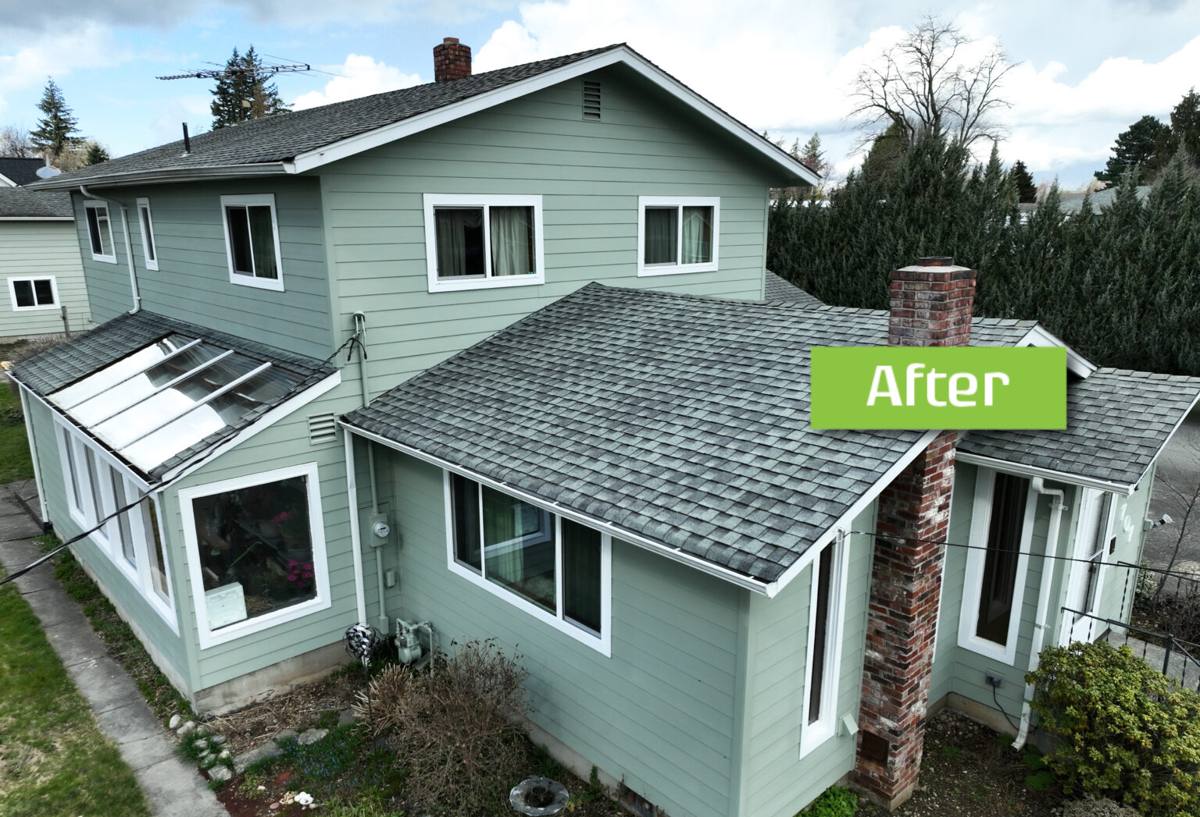
What Actually Counts as Storm Damage
Not every roof problem after a windstorm is storm damage, and not every roof problem that looks minor actually is. Getting this distinction right matters — both for what you pay to fix and for how an insurance claim gets handled.
- Wind damage: Lifted, creased, or missing shingles, usually concentrated along ridges, edges, and any place the roofline breaks (dormers, chimneys, vent stacks).
- Impact damage: Bruised or punctured shingles from falling branches, hail, or debris, sometimes with granule loss that isn't visible from the ground.
- Water intrusion: Staining on interior ceilings or attic sheathing that shows up days after a storm, once water has had time to work its way in through a compromised spot.
- Pre-existing wear mistaken for storm damage: Curling, brittle shingles or moss-lifted edges that were already failing and simply gave out during a storm rather than because of it.
That last category is the one honest contractors flag clearly. If a roof was already near the end of its life, a storm didn't "cause" the damage — it exposed it. We tell homeowners the difference straight, because it affects whether a targeted repair makes sense or whether you're better off putting that money toward a full section replacement.
What Happens If You Wait
A damaged roof section rarely stays a small problem in this climate. Whatcom County's wet season means a gap in your roofline isn't just letting in rain during the next storm — it's letting in moisture almost continuously for months at a time. Water that gets under a lifted shingle or past a cracked flashing seal doesn't just drip through; it wicks sideways along the decking, soaking sheathing and framing well beyond the point of entry.
Left through even one full moss season, a minor repair can turn into rotted decking, compromised rafters, or insulation that has to be pulled and replaced. We've also seen small leaks go unnoticed for months because they drain along framing before showing up as a ceiling stain somewhere else in the house entirely. Fast action after a storm isn't about urgency for its own sake — it's about stopping a contained problem from becoming a structural one.
What a Correct Storm Damage Repair Actually Involves
Inspection Before Anything Else
A proper storm damage repair starts on the roof, not on a ladder from the driveway. That means walking the affected sections, checking the attic from the inside for water tracking or daylight through the decking, and documenting exactly what's damaged versus what's simply aged. Skipping this step is how repairs end up covering the visible problem while missing the one that caused it — a cracked flashing seal a few feet away, for instance, that's been feeding water under shingles that look fine.
Matching Materials the Right Way
Patch repairs only hold up if the new material actually integrates with what's already there — same shingle profile, compatible underlayment, and a weave pattern into the surrounding courses so water sheds correctly instead of pooling at the seam. A repair that just overlays new shingles on top of a damaged area without tying into the existing courses is a callback waiting to happen.
Flashing and Underlayment — Not Just Shingles
Most of the leaks we trace back to a "storm damage repair" gone wrong didn't fail at the shingles — they failed at flashing around a chimney, vent, or valley that got reused instead of replaced, or underlayment that was patched instead of properly lapped. Shingles are the visible layer; flashing and underlayment are what actually keep water out. Any repair that only addresses the shingles and leaves compromised flashing in place hasn't fixed the underlying problem.
Our Process, Start to Finish
Free On-Site Assessment
We come out, get on the roof (not just a drive-by look), and give you a straight answer on what's storm damage, what's pre-existing wear, and what your realistic options are. No pressure to sign anything on the spot.
Documentation If You're Filing a Claim
If you're going through insurance, we document the damage with dated photos and a written scope before any work starts, so your adjuster has something concrete to work from. We work with your insurance process — we don't manage your claim for you or promise a specific payout, because that's between you and your carrier.
The Repair Day
Once materials are matched and scheduled, most single-section storm repairs are a one-day job. Larger damage — a full slope, multiple penetrations, or decking replacement — takes longer, and we'll tell you that up front rather than after we've started.
Cleanup and Final Walkthrough
Every job ends with a magnetic sweep for nails and debris, and a walkthrough where we show you what was done before we call it finished — not just a wave from the ground on the way out.
Repair or Replace? How We Help You Decide
Not every storm-damaged roof needs a full replacement, and not every roof is a good candidate for another round of patching. Here's how we generally weigh it:
| Factor | Leans Toward Repair | Leans Toward Replacement |
|---|---|---|
| Age of roof | Under roughly 12-15 years, otherwise sound | Nearing or past its expected lifespan |
| Extent of damage | Localized to one section or slope | Scattered across multiple slopes |
| Moss and granule condition | Minor moss, granules intact elsewhere | Heavy moss coverage, widespread granule loss |
| Decking condition | Solid, no soft spots found on inspection | Soft or delaminated decking found in multiple spots |
| Insurance scope | Claim covers a defined section | Adjuster's scope already points to full replacement |
We'll walk you through where your roof falls on that list and why, rather than defaulting to whichever option costs more. A repair that's done right, on a roof that's still fundamentally sound, is money well spent — a repair on a roof that's already failing is just delaying a bigger bill.
Materials and Fasteners: Why We Default to What We Do
Across every job we run in Whatcom County — coastal or inland — we default to corrosion-resistant fasteners and flashing. Crews working closer to the water see firsthand what salt-laden air does to standard fasteners over a few winters, and we'd rather build in that margin everywhere than treat Lynden jobs differently just because the water's a few miles further off. It costs a little more up front and saves a callback five years down the road.
On shingle selection, we generally favor architectural (laminated) shingles over 3-tab for repair work in this climate. They handle wind uplift better, which matters given how exposed some Lynden properties are, and they tend to shed moss growth more evenly than older 3-tab profiles. We're not tied to one manufacturer — the right call depends on matching what's already on the roof and what will hold up to this county's wet season, not on pushing a particular brand.
Why Hiring a Crew That Already Works Lynden Matters
After a windstorm, a lot of roofing outfits show up from out of the area chasing storm work, do a quick patch, and are gone before winter. If that patch fails, there's no one local to call. We're based in Bellingham and already work Whatcom County day to day, which means a few practical things for you: we know the material lead times and permitting expectations for this county, we're not guessing at what "normal" wear looks like on a farmhouse roof versus a newer subdivision roof, and if something needs a follow-up visit, we're a short drive away rather than a phone number that stops answering once storm season ends.
It also means we've seen enough Lynden and greater Whatcom County roofs to spot the difference between storm damage and deferred maintenance quickly, which keeps your inspection honest and your repair scoped correctly the first time.
Signs Your Roof Needs a Look After a Storm
- Shingles in the yard or gutters after high wind
- Visible lifted, creased, or missing shingles from the ground
- New water stains on ceilings or upper walls
- Daylight visible through the attic roof deck
- Granules collecting in gutters or downspout runoff
- Sagging or soft-feeling spots on the roof surface
- Damaged flashing around chimneys, vents, or skylights
- Heavy moss buildup that's started lifting shingle edges
If you're seeing even one or two of these, it's worth having someone look before the next round of rain finds the gap. Waiting until multiple signs show up usually means the damage has already spread past the original spot.
If your roof took a hit in a recent storm, or you're just not sure whether what you're seeing is storm damage or ordinary wear, we're glad to come take a look. The estimate is free, there's no pressure to book anything on the spot, and you'll get a straight answer either way — use the form below to get on our schedule.