 Bellingham Siding
 Siding Repair Built for How Lynden Actually Weathers
Lynden sits inland from Bellingham Bay, but it doesn't escape the marine climate that defines this corner of Washington. Moist air moves up the Nooksack lowlands, rain arrives sideways more often than straight down, and the shaded, tree-lined lots common around town hold humidity against exterior walls long after a storm has passed. Add a moss season that can run from late fall through spring, and siding here takes on a different kind of wear than siding in a drier inland town. Repair work that ignores that reality tends to fail again within a couple of seasons.
We repair siding in Lynden regularly, and the patterns are consistent enough that we can usually tell what we're dealing with before we even get a ladder up: moisture trapped behind a poorly flashed window, moss holding water against a north-facing wall, a section of trim that was caulked instead of properly fitted years ago. Good repair work here isn't about slapping a patch over the visible problem — it's about understanding why that spot failed in the first place and fixing that cause, not just the symptom.
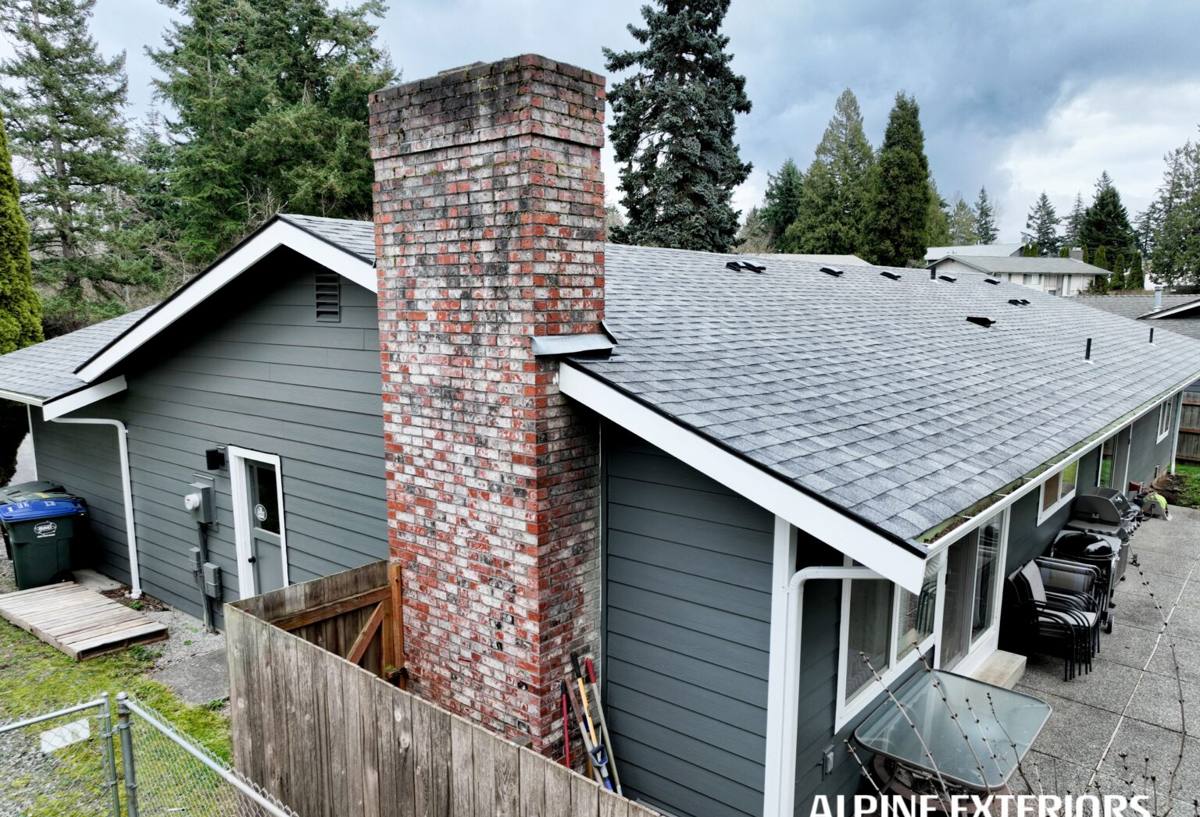
What Whatcom County's Climate Does to Siding Over Time
Driving rain and wind-driven moisture
Storms off the Salish Sea don't just fall on a house — they push against it. Wind-driven rain finds its way into any gap in flashing, caulk, or lap joints, and once water gets behind siding it can travel a surprising distance before it shows up as a stain, a soft spot, or peeling paint. This is why so many "small" siding repairs turn out to involve hidden water damage once the siding comes off.
Moss, algae, and shaded exposure
Lynden's mix of open farmland and tree-lined residential streets means some walls get near-constant shade for months at a time. Moss and algae take hold on siding that stays damp, and once established they hold moisture against the surface far longer than bare siding would. Over years, that constant dampness degrades paint, caulk, and — on wood-based or fiberboard products — the substrate itself.
Marine air and material fatigue
Even away from the immediate coastline, Whatcom County's air carries more moisture year-round than most of the state. That constant humidity cycle — wet, dry, wet again — is hard on caulk joints, fasteners, and any siding product with a paint film that isn't factory-cured. It's a slow process, which is exactly why so many repair needs go unnoticed until they've become bigger jobs.
Signs Your Lynden Home Needs Siding Repair
Most siding problems give warning signs well before they become structural. Worth a walk-around at least once a year, especially after the wetter months:
- Soft, spongy, or crumbling spots when you press on the siding, especially near the bottom of walls or below windows
- Visible moss or algae buildup, particularly on north- and west-facing walls
- Cracked, missing, or shrunk caulk at joints, corners, and window trim
- Paint that's peeling, bubbling, or chalking well before it's due for a repaint
- Staining or streaking below seams, nail heads, or trim boards
- Warped, bowed, or separating boards, especially where two pieces meet
- Any interior sign of a problem — a musty smell, a damp patch on drywall, or peeling interior paint on an exterior wall
Any one of these on its own might be minor. Several together, or anything paired with an interior symptom, usually means moisture has already gotten past the surface.
Common Repair Scenarios We See Around Lynden
The specifics vary by house, but the repair calls we get in this area tend to fall into a few categories:
Water intrusion at windows and doors
Flashing that was installed wrong — or wasn't installed at all — lets water behind the siding at penetrations. This is the single most common cause of hidden rot we find, and it's rarely visible until the siding around the opening is removed.
Impact and weather damage
Hail, falling branches, and the occasional lawn equipment mishap crack or dent individual boards. On fiber cement, this is usually a clean, contained repair. On more brittle or moisture-sensitive materials, a small impact can turn into a larger problem if it goes unaddressed.
Chronic moss and moisture zones
Shaded walls, areas under overhangs that never fully dry, and low spots where splashback from grade hits the siding all tend to need repeat attention if the underlying moisture issue isn't corrected alongside the siding repair itself.
Aging caulk and trim failure
Caulk has a service life, and once it shrinks or cracks, water gets a direct path behind the siding. This is often the cheapest fix on the list, and the one most likely to be neglected until it isn't cheap anymore.
Patch, Repair, or Replace? What Correct Work Actually Looks Like
Not every siding problem calls for the same fix, and a contractor who defaults to the cheapest option regardless of cause isn't doing the house any favors. Here's how we think through it:
| Approach | When it's appropriate | What it misses if used incorrectly |
|---|---|---|
| Caulk and paint touch-up | Minor cosmetic wear, no moisture intrusion, sound substrate underneath | Does nothing for hidden rot or failed flashing — just hides the surface |
| Section or board replacement | Isolated damage — a cracked board, one water-damaged area — with a sound structure around it | Needs correct flashing and moisture barrier work underneath, not just a new board over the old problem |
| Broader wall or elevation repair | Multiple failure points on one side of the house, often from a shared cause like grading, gutter overflow, or chronic shade | Treating symptoms one at a time instead of addressing the shared cause means it comes back |
| Full re-side | Widespread failure, aging or discontinued siding material, or repair costs approaching replacement cost | Sometimes repair money is better spent toward a full, correctly installed system |
Part of a proper estimate is telling a homeowner honestly which category their house falls into — including when a repair isn't the right call anymore.
How We Handle a Repair Job
- Inspect beyond the visible damage. We check the area around any obvious problem, not just the spot itself, since water rarely stays where it entered.
- Identify the cause, not just the symptom. Flashing, grading, gutter overflow, and chronic shade all get ruled in or out before we start cutting anything out.
- Remove damaged material and assess what's underneath. Sheathing, house wrap, and framing get evaluated once the siding is off — this is where hidden damage shows up.
- Repair the underlying moisture path first. Flashing, weather-resistive barrier, and drainage details get corrected before any new siding goes back on.
- Install matched or compatible siding. Where possible, we match profile and color; where an exact match isn't practical, we explain the options honestly.
- Finish and seal correctly. Caulk, paint, and trim details are finished to the same standard as new installation work, not treated as an afterthought.
Why We Repair With James Hardie, and What That Means for a Patch Job
We install and repair James Hardie fiber cement siding exclusively. For repair work specifically, that has practical advantages worth knowing about. Hardie's ColorPlus factory finish is baked on and color-matched to specific product runs, which makes blending a repaired section into existing siding far more reliable than trying to hand-match a field-painted product. Hardie's HZ product lines are engineered for exactly the wet-dry cycling and moisture exposure that Whatcom County delivers, so a correctly repaired section performs the same as the surrounding siding rather than becoming the next weak point. And because the material is non-combustible fiber cement, it doesn't carry the same rot, swelling, or pest vulnerability that repair work on wood-based or vinyl siding often has to work around.
We don't repair LP SmartSide, vinyl, Cemplank, Allura, or cedar siding to the standard we'd put our name on — not because those products are without merit, but because we've standardized our crews, materials, and warranty backing entirely around Hardie. If your home is currently sided in one of those products, we'll still give you an honest read on your repair versus replace question; we just won't pretend to be the right long-term repair partner for a material we don't install.
Why Hiring a Crew That Already Works in Lynden Matters
Siding repair is one of those jobs where local experience shows up in small decisions: knowing which wall orientations in this area tend to hold moisture, recognizing the difference between cosmetic moss and the kind that signals a bigger drainage problem, and understanding how Whatcom County's building conditions typically play out under fifteen- and twenty-year-old siding. A crew that's done this work around Lynden and the rest of Whatcom County isn't guessing at any of that — they've seen the same failure patterns on similar homes and know what to check before they ever open up a wall.
It also matters for accountability. A local contractor with an ongoing presence in the community has a reason to stand behind the work years down the road, not just get through the invoice.
Get a Straight Answer on Your Repair
If you're seeing moss buildup, soft spots, or paint failure on your siding, it's worth getting eyes on it before another wet season passes. We offer free, no-pressure estimates for siding repair in Lynden and the surrounding area — we'll tell you honestly whether you're looking at a targeted repair or something bigger, with no obligation either way. Use the form below to get started.