 Bellingham Siding
 Siding Replacement Built for Lynden's Climate
Lynden sits in the heart of Whatcom County's agricultural valley, framed by the Nooksack River lowlands and the marine-influenced weather that moves in off Bellingham Bay and the Salish Sea. That combination gives Lynden homes a specific kind of weather load: long stretches of driving rain carried on wind, a marine air layer that keeps humidity high even on dry days, and shaded north- and east-facing walls that stay damp long after a storm passes. Add in the moss and algae season that runs from fall through spring across this part of the Pacific Northwest, and you have a climate that is genuinely hard on exterior siding — not because any one storm is severe, but because the exposure is constant and cumulative.
We install siding replacement projects across the Bellingham and Whatcom County area, including Lynden, and we've built our process around what actually fails on siding here: trapped moisture behind the cladding, degraded caulk joints, moss and algae staining that eats into painted finishes, and swelling or delamination at butt joints and corners. A siding replacement done right for a Lynden home isn't just a fresh look — it's a system that's built to shed water, breathe correctly, and resist the moss and mildew that this climate throws at every exterior wall.
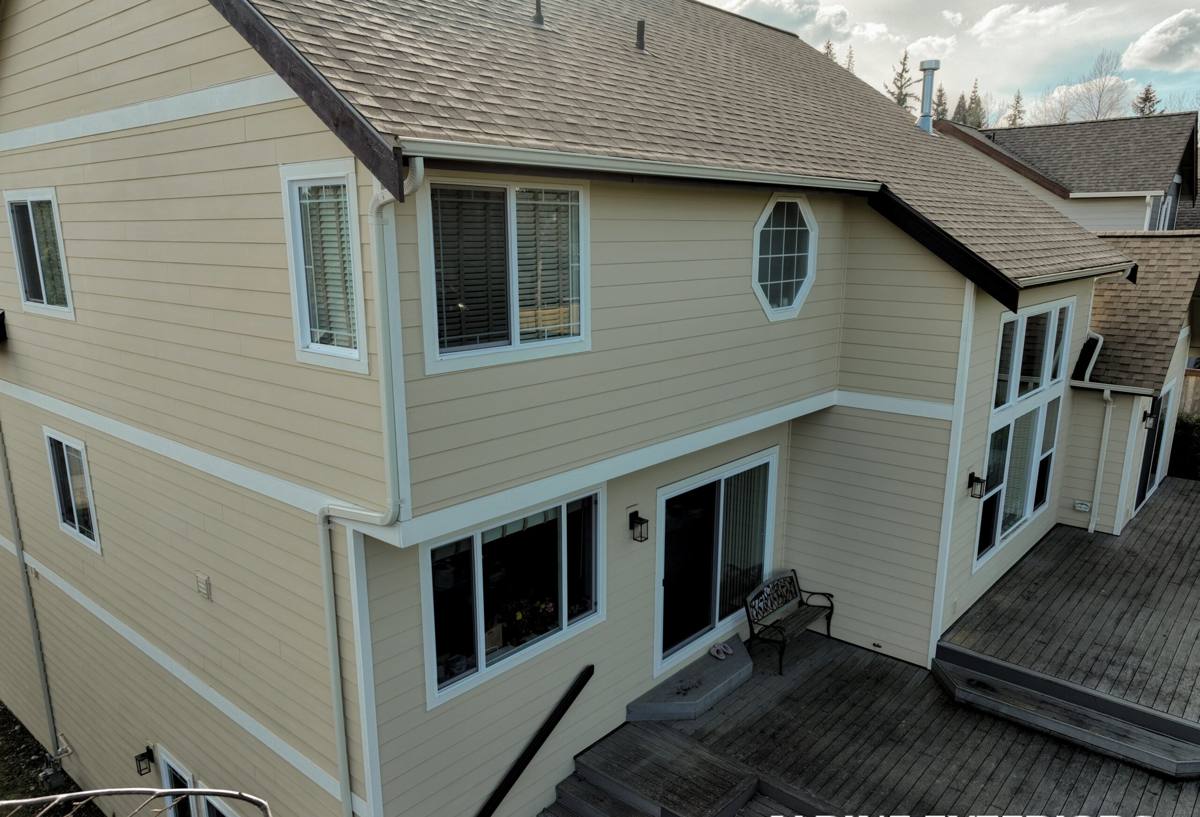
Why Siding Fails Faster in Lynden Than in Drier Climates
Homeowners moving to Whatcom County from drier regions are often surprised at how much faster exterior materials age here. It comes down to a few specific mechanisms:
Constant Moisture Exposure
Rain in this region tends to arrive as extended, low-intensity systems rather than short, intense downpours. That means siding surfaces and seams stay wet for hours or days at a stretch, not minutes. Materials that handle a hard 20-minute thunderstorm without issue can still absorb and hold moisture during a Whatcom County soaker that lasts through an entire weekend.
Wind-Driven Rain
Open exposure across the valley means wind-driven rain gets pushed sideways into wall assemblies, not just straight down onto horizontal surfaces. This stresses lap joints, corner trim, and butt seams — the places where water intrusion actually starts on most siding failures.
The Moss and Algae Season
Shaded, damp, and mild — that's exactly the environment moss and algae need to establish themselves on exterior surfaces. Once organic growth takes hold on a painted or coated siding surface, it holds moisture against the material even longer, accelerating whatever degradation is already underway underneath.
Marine Air and Salt-Tinged Moisture
Bellingham Bay's proximity means the air moving through Whatcom County carries a mild marine influence — enough humidity and salt-tinged moisture to matter for fasteners, trim, and any siding material that isn't dimensionally stable when wet.
What "Correct" Siding Replacement Actually Involves
A siding replacement is only as good as what's underneath it. On every Lynden project, our process addresses the whole wall assembly, not just the visible surface:
- Full tear-off and substrate inspection. We remove the old siding down to the sheathing and inspect for rot, soft spots, or prior water damage before anything new goes up.
- Repair before rebuild. Any compromised sheathing, framing, or trim is repaired or replaced — covering a damaged wall with new siding just hides the problem.
- Weather-resistive barrier, done properly. A correctly lapped and taped weather barrier is what actually keeps bulk water out of the wall; it matters as much as the siding itself.
- Rainscreen or proper drainage plane where called for. Given how long Whatcom County walls stay damp, a drainage gap behind the siding lets incidental moisture escape instead of sitting against the wall.
- Correct flashing at every penetration. Windows, doors, hose bibs, vents, and roof-to-wall intersections are the places siding jobs most commonly fail — flashing has to be right at each one.
- Manufacturer-spec fastening and clearances. Proper fastener spacing, ground clearance, and joint treatment are what let a siding product perform for its full rated life.
Why We Install Only James Hardie Fiber Cement in Lynden
We install James Hardie fiber cement siding exclusively — we don't offer vinyl, LP SmartSide, or other fiber cement brands. That's a deliberate standard, not a lack of options, and it's especially relevant in a climate like Lynden's.
Fiber cement is dimensionally stable when wet, which matters enormously in a region where siding stays damp for days at a time. It doesn't swell, warp, or absorb moisture the way wood-based composite products can, and it's non-combustible — a meaningful consideration given the dry summer wildfire smoke seasons the Pacific Northwest has seen in recent years. James Hardie's HardieZone system specifically engineers products for regional climate exposure, and the HZ5 line used in this part of Washington is built around resisting the moisture cycling that's normal here.
The factory-applied ColorPlus finish is also a real advantage for a moss-and-algae climate: it's baked on under controlled conditions, resists fading and chalking, and holds up to the repeated wet-dry cycling that breaks down field-applied paint faster than most homeowners expect. That translates directly into fewer repaint cycles and a finish that stays cleaner longer, even on the shaded, moss-prone walls common on Lynden lots.
Fiber Cement vs. Other Common Siding Materials in This Climate
| Factor | James Hardie Fiber Cement | Vinyl | Wood-Based Composite (e.g. LP SmartSide) |
|---|---|---|---|
| Moisture stability | Dimensionally stable wet or dry | Stable but can warp/buckle with heat cycling | Can swell at edges if moisture reaches the core |
| Combustibility | Non-combustible | Combustible | Combustible |
| Finish durability | Factory ColorPlus finish, long fade resistance | Color molded through, but can chalk/fade | Field-applied paint, shorter repaint cycle |
| Moss/algae resistance | Hard, dense surface resists staining | Can stain; softer surface holds grime | Textured surface can trap organic growth |
| Typical lifespan when installed to spec | Multiple decades | 20-40 years, variable | Shorter if moisture management fails |
Our Siding Replacement Process, Start to Finish
- On-site evaluation. We walk the exterior, check current siding condition, note problem areas (shaded walls, low-clearance sections, past water intrusion), and talk through product and color options.
- Detailed written estimate. Scope, materials, and pricing laid out clearly — no vague allowances.
- Tear-off and inspection. Old siding comes off, sheathing gets inspected, and we flag anything that needs repair before you approve added scope.
- Weather barrier and flashing installation. This is the step that determines whether the wall stays dry for the next 30+ years — we don't rush it.
- Hardie siding installation to manufacturer spec. Correct fastening, joint treatment, and clearances throughout.
- Trim, caulking, and final detailing. Clean lines at corners, windows, and transitions.
- Final walkthrough. We review the finished work with you before calling the job complete.
Signs a Lynden Home Needs Siding Replacement, Not Just Repair
- Soft or spongy siding when pressed, especially near the bottom courses or under windows
- Visible warping, buckling, or gaps opening up at seams
- Paint that won't hold, bubbling or peeling repeatedly in the same spots
- Persistent moss or algae staining that returns shortly after cleaning
- Rising utility bills that suggest the wall assembly is no longer insulating or sealing properly
- Visible rot or staining on trim boards, corner boards, or around penetrations
Not every one of these means a full replacement is necessary — sometimes it's a localized repair. But when several of these show up together, especially on a home more than 20-25 years old, it usually means the underlying wall assembly has been compromised long enough that patch repairs won't hold.
Why Local Installation Experience Matters
Siding installation instructions look straightforward on paper, but installing to spec in Whatcom County's actual weather is a different job than installing the same product in a drier inland climate. Clearance heights, flashing details, and drainage planning all need to account for how long walls here stay wet and how much wind-driven rain a given elevation actually sees. A crew that installs regularly in Lynden and the surrounding Bellingham area already knows which wall orientations need extra attention, how local moss growth patterns affect maintenance recommendations, and what detailing has proven itself over years of this specific climate — rather than relying on generic manufacturer guidance alone.
There's also a practical service side to hiring locally: warranty support, follow-up questions, and any future maintenance are easier to handle with a contractor who's a short drive away and familiar with your home, rather than a crew that worked in the area once and moved on.
Planning Your Project
Siding replacement cost depends on the size and complexity of the home, the condition of the substrate underneath the old siding, trim and detail work, and the specific James Hardie product line chosen. Homes with extensive water damage discovered during tear-off, complex rooflines, or a lot of trim and architectural detail will run higher than a straightforward rectangular home in good condition underneath. We provide a clear, itemized estimate after an on-site evaluation so you know exactly what you're paying for and why — no vague per-square-foot guesses without having actually looked at the wall.
If you're seeing early warning signs on your Lynden home, or you're simply due for a siding replacement and want it done with a moisture-first approach built for this climate, we'd be glad to take a look. Reach out for a free, no-pressure estimate using the form below.