 Bellingham Siding
 The Climate Silver Beach Homes Are Up Against
Silver Beach sits close enough to the water that homes here take a different kind of weathering than siding fifteen minutes inland. Salt-tinged marine air works on fasteners and finishes year-round. Driving rain off the water hits gable ends and west-facing walls at an angle, not straight down, which pushes water into laps and seams that a calmer climate would never test. And then there's the moss. Bellingham's wet season runs long, and in the shaded, moisture-holding microclimates near the water, moss and algae get a head start in October and don't fully let go until late spring.
None of that is exotic weather. It's just persistent. Siding on a Silver Beach home doesn't get a dry season to recover the way siding in a drier part of Whatcom County might. It's wet, dries slowly, and gets wet again — for months at a stretch.
Where Ordinary Siding Gives Out First
The failure points are predictable once you've seen enough of them:
- Bottom courses and areas near grade, where splashback and slow-draining soil keep material damp longer than anywhere else on the house
- Butt joints and seams that weren't properly sealed or flashed, where wind-driven rain finds a way in
- North- and shade-facing walls, where moss and algae colonize fastest and hold moisture against the surface
- Fastener heads and trim hardware exposed to salt-laden air, which corrode faster than the same hardware would inland
- Caulked joints that were never designed to be the primary water barrier, and dry out and crack within a few seasons
Wood-based products — solid cedar, primed spruce, or engineered wood siding — are the most exposed to this pattern because their core material swells, checks, or delaminates once moisture gets past the finish. Vinyl doesn't rot, but it doesn't stand up to the coastal wind loads and impact resistance this kind of exposure calls for, and it doesn't hold paint if you ever want to change the look. This is the exposure profile we design every Silver Beach installation around.
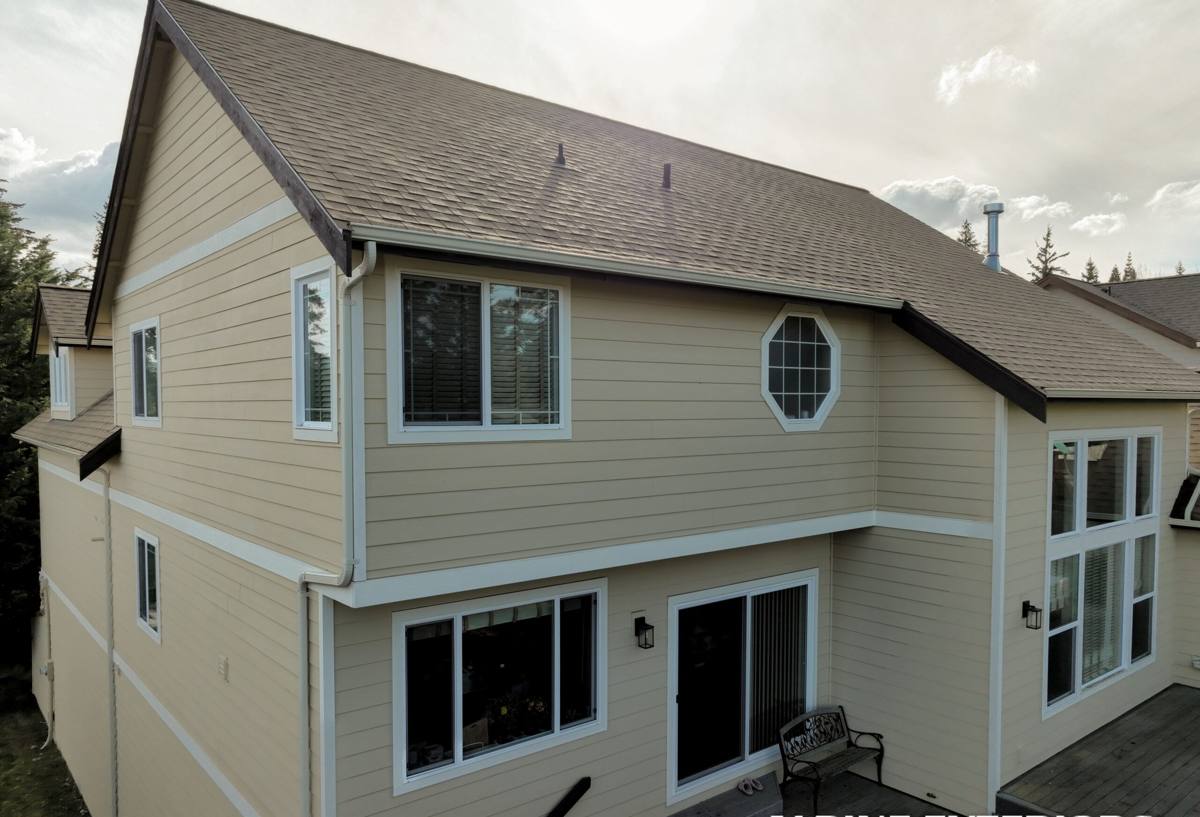
Why We Install Only James Hardie Here
We don't offer LP SmartSide, vinyl, Cemplank, Allura, primed spruce, or cedar as options on Silver Beach homes — not because those products don't have a place somewhere, but because we've made a standing decision as a company to install one product system and install it correctly, every time. On a lot exposed to salt air and driving rain, fiber cement's core advantage is that it isn't wood. It won't swell, rot, or delaminate the way wood-based products can when moisture gets past a finish. It's also non-combustible, which matters to insurers and to homeowners thinking about wildfire-season smoke and ember exposure that reaches even wet coastal climates during dry summer stretches.
The HZ5 Line: Engineered for This Exact Climate
James Hardie makes region-specific formulations, and the Pacific Northwest falls under their HZ5 engineering zone — the version of their product built for high-moisture, freeze-prone climates rather than the version sold in Phoenix or Miami. That distinction is one of the reasons we standardized on Hardie in the first place: the company engineers for actual regional exposure instead of selling one formulation everywhere.
The other piece is the factory-applied ColorPlus finish. It's baked on under controlled conditions rather than field-sprayed, which means better adhesion and more consistent coverage than a site-applied paint job — a meaningful advantage when the siding is going to sit under months of damp shade and repeated wet-dry cycles every winter. Hardie backs its products with a strong, transferable limited warranty, which matters on a waterfront-adjacent property where buyers pay close attention to exterior condition and maintenance history at resale.
What a Correct Installation Actually Involves
James Hardie siding is only as good as the installation behind it. The product is engineered to perform in this climate; a rushed or generic install can still let water in behind it. On every Silver Beach project we treat the following as non-negotiable, not optional upgrades.
Drainage and Flashing Come First
Before a single plank goes up, the wall needs a drainage plane — a weather-resistant barrier installed so any water that does get past the siding has somewhere to go besides the sheathing. Flashing goes over every window and door head, at deck ledgers, and anywhere a roofline meets a wall. On a home taking wind-driven rain off the water, these details do more work than the siding material itself.
Fastening, Clearances, and Sealed Cuts
Hardie publishes exact fastener spacing, type, and placement requirements, and they vary by product and climate zone — cutting corners here voids the warranty and shortens the product's real-world life. Just as important are the clearances: siding needs a gap from grade, from roof lines, and from decks and patios so water can't wick up into the bottom edge. Every factory cut and field-trimmed edge gets sealed, because an unsealed cut edge is the fastest way for a fiber cement product to take on moisture.
| Detail | Why it matters in Silver Beach |
|---|---|
| Weather-resistant barrier / drainage plane | Gives incidental moisture from wind-driven rain a way out instead of trapping it against the sheathing |
| Head flashing at windows, doors, and rooflines | Directs water away from the most common leak points on a wall exposed to angled rain |
| Manufacturer-spec fastening pattern | Keeps the product secured through coastal wind loads and preserves the warranty |
| Grade, roof, and deck clearances | Prevents wicking and splashback in a climate that stays damp for months at a time |
| Sealed factory and field cuts | Stops moisture entry at the one point on any fiber cement board that isn't factory-finished |
Our Process, Start to Finish
A siding job on a home this close to the water needs a process that accounts for what's usually already happening behind the old siding, not just what's visible from the curb.
- Assessment. We walk the exterior and check the areas that fail first in this climate — bottom courses, shaded walls, anywhere moss has built up — and look for signs of moisture behind the existing siding before we quote anything.
- Tear-off and sheathing check. Once the old siding is off, we inspect the sheathing and framing underneath. Any rot or soft spots get addressed before new material goes on; covering a moisture problem with new siding only hides it.
- Drainage plane and flashing. The weather-resistant barrier goes on, followed by flashing at every window, door, and roofline intersection.
- James Hardie installation. Planks or panels go up to Hardie's published fastening and clearance specs for the HZ5 zone, with every joint and cut edge properly sealed.
- Trim and detail work. Corners, trim boards, and transitions get finished so water is directed off the wall at every point, not just across the flat field of siding.
- Final walkthrough. We go over the finished work with the homeowner and point out anything they should watch for or know about maintaining it going forward.
James Hardie vs. the Alternatives in This Climate
Homeowners comparing options usually want to know how each material actually holds up here, not just what it costs going in.
| Factor | James Hardie (HZ5) | Vinyl | Wood / engineered wood |
|---|---|---|---|
| Moisture tolerance | Fiber cement core doesn't rot or swell | Doesn't absorb water, but seams and gaps can trap it behind panels | Core material can swell or delaminate once moisture reaches it |
| Moss and algae resistance | Factory finish holds up well; surface can be cleaned without stripping the color | Textured surfaces can trap grime and moss over time | Prone to biological growth, especially in shaded, damp spots |
| Salt air / coastal exposure | Engineered for high-moisture climates; fastener corrosion managed with correct hardware | Can become brittle with UV and temperature swings over time | Finish breaks down faster under salt exposure, exposing raw wood |
| Fire performance | Non-combustible core | Combustible | Combustible |
| Long-term appearance | Factory-applied ColorPlus finish holds color consistently | Can fade unevenly; color is limited to what was molded in | Requires repainting or restaining on a recurring cycle |
| Warranty | Strong, transferable limited warranty | Varies widely by manufacturer and product tier | Typically limited to the finish, not the substrate |
What Actually Drives the Cost of a Project Like This
We don't quote sight-unseen, but the same handful of factors move the price on nearly every Silver Beach project we look at.
| Cost factor | Why it matters |
|---|---|
| Home size and number of stories | More wall area and taller walls both add material and labor time |
| Condition of the sheathing underneath | Rot or moisture damage found during tear-off adds repair work before new siding can go on |
| Trim and architectural detail | Homes with more corners, gables, and window trim take more time to flash and finish correctly |
| Site access | Sloped lots, tight side yards, and limited staging space near the water can slow the work |
| Siding profile chosen | Lap, shingle, and panel styles differ in material and installation time |
| Scope of tear-off | Full removal of old siding down to the studs costs more than siding over an already-sound wall, but it's usually the right call on an older home |
Signs Your Siding Is Already Behind
Because this climate doesn't give siding a break to recover, small problems here tend to compound faster than they would elsewhere. Worth checking for:
- Dark green or black streaking that comes back within weeks of being cleaned
- Soft or spongy spots when you press on wood-based or engineered wood siding, especially near the bottom courses
- Paint or finish that's peeling, chalking, or bubbling rather than just fading
- Visible gaps or separation at butt joints and corner trim
- Rust streaks below fastener heads or trim hardware
- Any musty smell or visible staining on interior walls that back up to exterior siding
Any one of these on its own might just need attention. Several at once, especially on a home that hasn't had its siding replaced in a couple of decades, usually means the material has reached the end of what it can do in this climate.
Why Hiring a Crew That Already Works Silver Beach Matters
Fastening schedules and flashing details in a manufacturer's install guide are the same everywhere. What isn't the same is knowing, before the tear-off even starts, which walls on a home like this are most likely to have hidden moisture damage, how far moss has typically worked its way under a given siding style by the time it's visible from the ground, and how much clearance a particular lot's drainage actually needs versus the code minimum. A crew that has done this work throughout Bellingham and the surrounding Whatcom County shoreline brings that judgment to the estimate walkthrough, not just to the install itself — which is often the difference between a quote that holds and one that grows once the old siding comes off.
If you're weighing options for a home in Silver Beach, we're happy to walk the exterior with you, point out what we see, and put together a straightforward, no-pressure estimate — free, with no obligation to move forward.