 Bellingham Siding
 Why Roofs in Puget Wear Differently Than Roofs Inland
If you own a home in the Puget area near Bellingham, you already know your roof works harder than a roof forty miles inland. Whatcom County sits right up against Puget Sound and the Salish Sea, and that proximity to salt water changes what a roof has to survive year after year. Salt-laden air corrodes exposed metal faster than dry inland air does. Driving rain off the water pushes moisture sideways into laps and seams that a straight-down rain would never reach. And the long, wet, mild winters we get here create a moss and algae growing season that stretches for months, not weeks.
None of that means a roof in Puget is doomed to fail early. It means the roof has to be built and maintained with those specific stresses in mind, from the fasteners used to the way flashing is detailed around every penetration. A roof spec that works fine in a dry eastern Washington town is not automatically the right spec here.
The Three Big Local Stressors
- Salt air corrosion: unprotected or lower-grade fasteners, flashing, and vent components can rust and weaken years before the shingles or panels above them wear out.
- Wind-driven rain: storms coming off the Sound don't just fall on a roof, they drive into it sideways, testing every seam, valley, and step flashing detail.
- Moss and algae: shade, moisture, and mild temperatures let moss colonize faster here than in drier parts of the state, and moss holds water against roofing material long after a storm has passed.
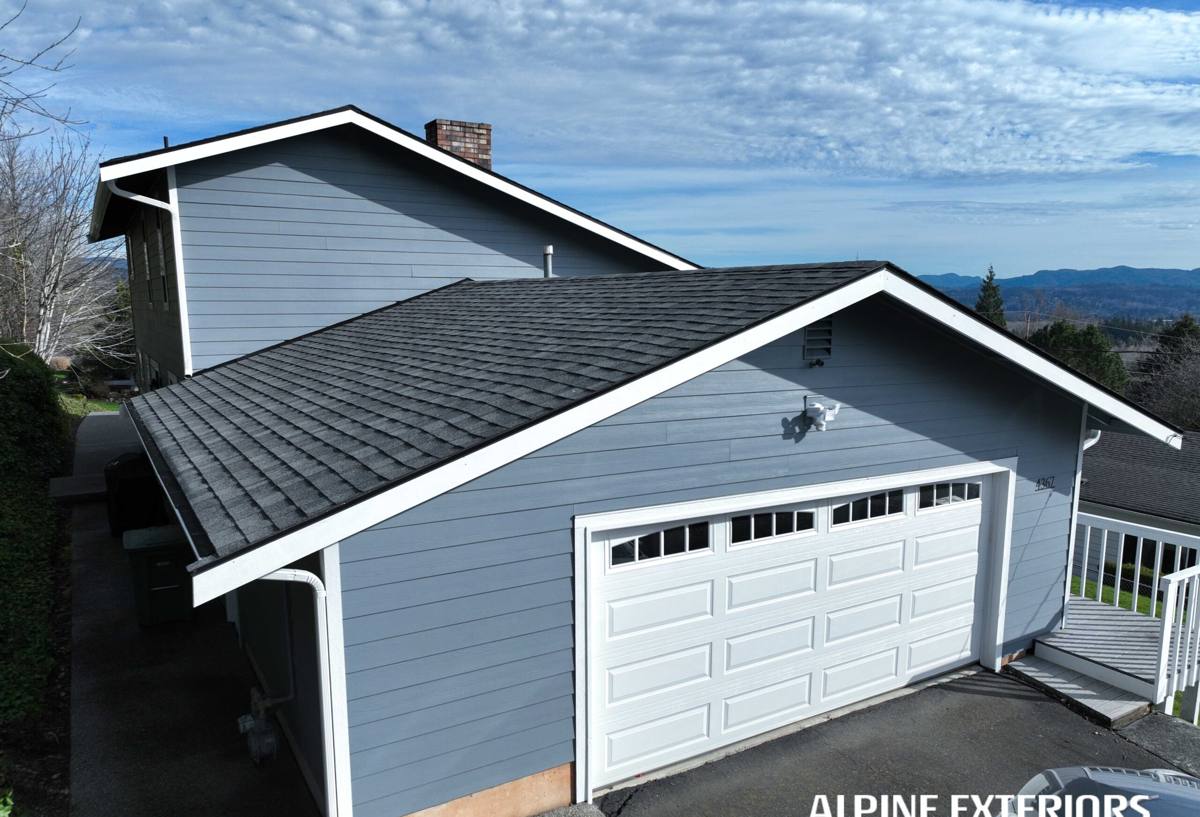
Signs a Puget Home Actually Needs a Roof Replacement
Not every roof problem calls for a full replacement, and we'll tell you honestly when a repair is the right call instead. But there are signs that point toward a roof that's genuinely at the end of its useful life rather than one that just needs attention.
- Granule loss heavy enough that you're finding grit in gutters and downspouts every time it rains
- Shingles that are cupping, curling, or cracking, especially on south- and west-facing slopes
- Moss growth that keeps coming back within a season or two of cleaning, a sign the surface underneath is already degrading
- Soft spots in the roof deck when walked, or visible sagging along a ridge or valley
- Rusted or failing flashing around chimneys, skylights, and roof-to-wall transitions
- Daylight visible through the attic roof boards, or stains on interior ceilings that track back to roof penetrations
- A roof that's simply reached the end of its material's realistic service life for this climate, even if it "looks okay" from the ground
If your roof is showing two or more of these, it's worth a real inspection rather than another round of patching.
What a Correct Roof Replacement Actually Involves
A roof replacement is more than swapping old shingles for new ones. In a coastal-influenced climate like Puget's, the parts you don't see are often what determine whether the new roof performs for its full expected lifespan or starts failing early.
Tear-Off and Deck Inspection
A full tear-off to the deck is the only way to actually see what's underneath. Years of moisture intrusion can rot sections of the deck or sheathing that aren't visible from inside the attic. Any soft or damaged decking gets replaced before anything new goes down — covering over a compromised deck is how brand-new roofs fail in five years instead of twenty-five.
Underlayment Built for Wind-Driven Rain
Given how often rain here comes in sideways off the water, underlayment choice matters more than it would in a drier region. Synthetic underlayment with properly lapped and sealed seams, along with self-adhered membrane at eaves, valleys, and any low-slope transitions, gives the roof a real second line of defense if wind ever drives water past the primary roofing material.
Flashing and Fasteners That Resist Salt Corrosion
Every penetration — chimneys, vents, skylights, roof-to-wall junctions — is a place where water finds its way in if flashing is cut corners on. In a salt-air environment, we use corrosion-resistant flashing and fastener materials rather than the cheapest option available, because standard galvanized components can start showing rust within a few years this close to the Sound.
Ventilation That Matches the Home
Proper intake and exhaust ventilation keeps the attic dry and temperature-balanced, which does two things: it protects the new roof deck from condensation-driven rot, and it slows ice formation and moisture buildup during our wetter, colder stretches. A roof replacement is the right time to correct ventilation that was never sized properly to begin with.
Roofing Material Options for Puget-Area Homes
There's no single "best" roofing material for every home — it depends on your roof's slope, your home's style, your budget, and how much long-term maintenance you want to take on. Here's how the common options stack up for a coastal Whatcom County climate specifically.
| Material | How It Handles Salt Air & Rain | Moss Resistance | Typical Lifespan Here |
|---|---|---|---|
| Architectural asphalt shingle | Good, when paired with corrosion-resistant flashing and fasteners | Moderate — benefits from algae-resistant granules and periodic cleaning | 20-30 years |
| Standing seam metal | Excellent if finish and fasteners are rated for coastal exposure | Strong — smooth surface sheds moss more easily | 40-50+ years |
| Composite/synthetic shake or slate | Good, materials don't absorb moisture like wood | Moderate to strong depending on product | 30-50 years |
| Cedar shake | Requires diligent maintenance in wet, mild climates | Weak without regular treatment — most prone to moss and rot here | Varies widely with upkeep |
We install and stand behind asphalt, metal, and composite systems that are proven to handle this climate. If a homeowner specifically wants cedar shake, we'll walk through honestly what that maintenance commitment looks like here — the moisture and moss pressure in a coastal, tree-shaded climate is simply higher than in drier parts of the state, and that's a maintenance conversation worth having up front rather than after the fact.
How Our Roof Replacement Process Works
- On-site inspection and honest assessment. We look at the whole system — shingles or panels, flashing, decking, ventilation, gutters — and tell you plainly whether you need a repair or a replacement.
- Written scope and material selection. You get a clear plan covering tear-off, decking, underlayment, flashing, ventilation, and the specific material chosen, with straightforward reasoning for each choice.
- Full tear-off. Old roofing comes off down to the deck so nothing is hidden or covered over.
- Deck repair as needed. Any rotted or soft sheathing is replaced before new material goes down.
- Underlayment and flashing installation. This is where wind-driven rain resistance is actually built in, at every seam, valley, and penetration.
- Roofing material installation. Installed to manufacturer specification, not shortcuts, so warranty coverage stays intact.
- Ventilation check and correction. Intake and exhaust balanced for the home's attic volume.
- Final walkthrough and cleanup. We review the completed roof with you and make sure the property is left clean, including magnetic sweep for stray nails.
Living With a Roof in a Moss Climate
Even the best-installed roof in this region will face moss pressure eventually, especially on shaded, north-facing slopes or under overhanging trees. That's not a defect — it's the climate. What matters is managing it correctly.
- Have moss removed by soft-washing or hand-brushing, never pressure-washed directly into the shingle surface, which can strip granules and shorten roof life
- Keep gutters and valleys clear so water has somewhere to go instead of pooling against moss growth
- Trim back overhanging branches where practical to reduce shade and debris buildup
- Consider zinc or copper strips near the ridge on new installations, which release trace metals that discourage moss regrowth over time
- Schedule a roof check-up every couple of years, not just when a problem is already visible
What Roof Replacement Typically Costs, and What Drives the Price
Every roof is different, and we'll only give you real numbers after seeing your roof in person. But the factors below are what actually move the price up or down, so you know what you're paying for and why.
| Cost Factor | Why It Matters |
|---|---|
| Roof size and number of stories | More square footage and steeper access both add labor time |
| Roof pitch and complexity | Multiple valleys, dormers, and penetrations mean more flashing detail work |
| Existing deck condition | Rotted sheathing found during tear-off adds material and labor |
| Material choice | Asphalt, metal, and composite systems have different material and installation costs |
| Layers to remove | Tearing off multiple existing layers takes longer than a single layer |
| Ventilation upgrades | Correcting undersized or missing intake/exhaust adds scope but protects the new roof |
Why It Matters That Your Crew Already Works in Puget
A roofing crew that regularly works homes in and around Puget and greater Bellingham already understands how the local climate behaves on a real roof — not in theory, but from having pulled off hundreds of squares of shingle and seen firsthand where salt air corrosion shows up first, where wind-driven rain finds its way in, and which slopes hold moss the longest. That local pattern recognition shapes decisions during the job: where to add extra flashing attention, which fastener grade to use, how to detail a valley that catches more water than most.
A crew unfamiliar with this specific coastal microclimate may build a technically fine roof that's still spec'd for a drier, calmer region — and that gap tends to show up as early corrosion or moss problems five or ten years down the road, right when it's most disruptive to fix.
A Quick Checklist for Vetting Any Roofing Contractor Here
- Do they do a full tear-off and deck inspection, or offer to install over existing layers?
- Do they specify corrosion-resistant flashing and fasteners for coastal exposure, or use standard-grade components by default?
- Do they check and correct attic ventilation as part of the job, or only touch the visible roofing surface?
- Can they explain their underlayment choice and how it handles wind-driven rain specifically?
- Are they licensed and insured to work in Washington State, and willing to put the scope in writing?
- Do they give you a straight answer about moss and maintenance rather than promising a maintenance-free roof?
If your roof in the Puget area is showing its age or you just want an honest read on where it stands, we're happy to take a look. Reach out for a free, no-pressure estimate using the form below — we'll walk the roof, tell you what we actually see, and lay out your real options.