 Bellingham Siding
 Why Cordata Siding Takes More Punishment Than It Looks Like
Cordata sits far enough from the water that homeowners sometimes assume salt air and marine moisture aren't really a factor here. In practice, Whatcom County's weather doesn't respect neighborhood boundaries. Air moving off Bellingham Bay and the Strait of Georgia carries salt and moisture well inland, and Cordata's mix of newer subdivision construction and older single-family homes means there's a wide range of siding ages and materials absorbing that exposure right now.
What actually wears siding down in this part of the county is the combination of three things happening at once: driving rain that gets pushed sideways into seams and trim by wind, a moss and algae season that can run from early fall through late spring, and salt-tinged air that accelerates corrosion on fasteners, flashing, and any exposed metal. None of these alone would be a big deal. Together, over years, they find every weak point in a siding system — the caulk joint that was never quite right, the trim board that wasn't primed on the cut end, the panel seam that's a few degrees off level.
The Repair Triggers We See Most in This Neighborhood
Most of the repair calls we get in Cordata trace back to moisture getting behind siding rather than damage to the face of the siding itself. A cracked caulk line, a missing kick-out flashing above a window, or a lap that wasn't overlapped correctly during the original install lets water in. It doesn't show up as a leak — it shows up months or years later as soft trim, peeling paint, or a musty smell near an exterior wall.
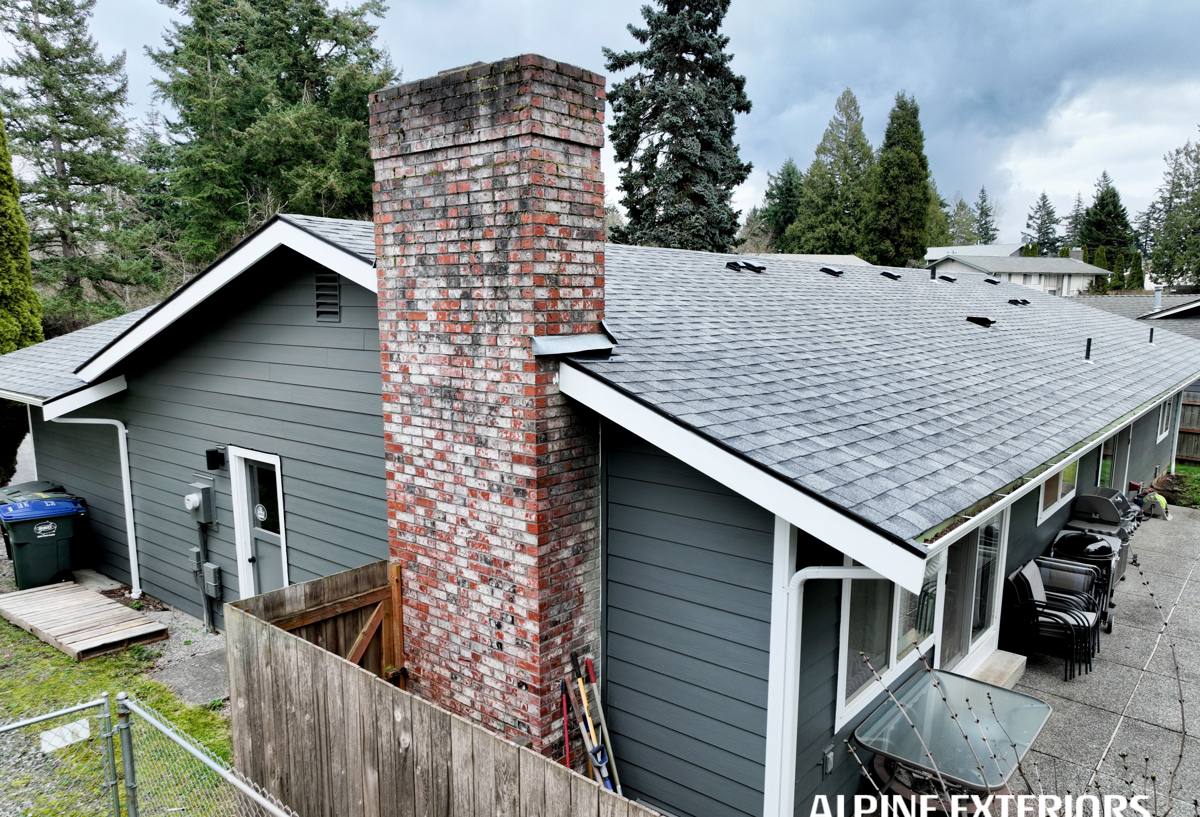
Signs Your Cordata Home Needs Siding Repair — Not a Full Replacement
Not every siding problem means you need to re-side the whole house. Catching issues early, while they're still localized, is what keeps a repair a repair instead of turning into a much bigger project. Here's what we tell homeowners to watch for between now and the next wet season:
- Soft or spongy spots when you press on siding or trim near the ground, around windows, or under roof lines
- Paint that's bubbling, peeling, or cracking in one section while the rest of the house looks fine
- Visible gaps opening up at corners, seams, or where siding meets window and door trim
- Moss or dark algae staining that comes back within a season or two of cleaning
- Panels that look warped, bowed, or slightly separated from the wall
- Staining or streaking below window sills, which usually points to water tracking from a failed sill flashing
- New or increased carpenter ant activity near exterior walls — a strong sign of trapped moisture
If you're only seeing one or two of these, isolated to a wall or a section of wall, that's typically a repair scope. If it's showing up on multiple elevations or you can push a screwdriver into soft wood, the conversation usually shifts toward replacement.
Common Siding Materials We Find in Cordata — and Where Each One Struggles
Cordata's housing stock spans several decades, so we see a real mix of siding types on service calls. Each one fails in a different way once our climate gets involved:
| Material | Common Issue in This Climate | Repair Approach |
|---|---|---|
| Vinyl | Becomes brittle and cracks in cold snaps; can buckle in heat; hides moisture damage to sheathing behind it until it's advanced | Panel replacement is usually straightforward, but we always check what's happening underneath before closing it back up |
| LP SmartSide (engineered wood) | Edges and cut ends swell when caulking fails, since it's an OSB-based product that depends on an intact factory seal | Requires resealing exposed edges and monitoring; swollen sections generally need to be cut out and replaced, not patched |
| Cedar lap or shingle | Absorbs moisture readily, which feeds the moss and mildew growth this climate is known for; needs regular re-staining to hold up | Spot repairs are possible, but matching weathered cedar and keeping up the maintenance schedule is an ongoing commitment |
| James Hardie fiber cement | The material itself doesn't rot or feed moss, but a poor original installation — caulked joints instead of proper laps, missing flashing — can still cause localized failures | Repairs focus on correcting the underlying installation detail, not just the visible panel |
What a Correct Siding Repair Actually Involves
It Starts Behind the Siding, Not on the Surface
Anyone can pull off a damaged panel and nail up a new one. That's not a repair — it's a cosmetic patch that leaves the actual cause in place. A correct repair starts with pulling back enough surrounding material to check the weather-resistive barrier, the sheathing, and the flashing around any nearby penetrations like windows, hose bibs, or light fixtures. If the sheathing has soaked up moisture, replacing the siding without addressing that just seals the problem back in.
Matching What's Already There
Once we know the repair is contained to a section, matching becomes the next real challenge. Lap exposure, panel profile, and trim reveal all need to line up with the existing siding, and factory-finished products fade slightly with UV exposure over time, so a brand-new piece next to a ten-year-old one can look slightly off if you don't account for it. We factor that into the repair plan up front rather than discovering it after the fact.
Our Siding Repair Process for Cordata Homes
- On-site inspection — we look at the visible damage and everything around it, not just the spot you called about
- Moisture check — a moisture meter tells us whether the sheathing behind the siding is dry, damp, or compromised
- Diagnosis — we identify whether this is an isolated failure (flashing, caulk, a single panel) or a symptom of a wider installation issue
- Written repair plan — scope, materials, and cost before anything is opened up, so there are no surprises
- The repair itself — correcting the underlying cause first (flashing, barrier, framing if needed), then replacing siding and trim to match
- Cleanup and walkthrough — we show you what we found and what we did about it
Repair or Replace? How We Help You Decide
This is the question every homeowner asks, and the honest answer depends on more than the size of the visible damage. Here's how we weigh it:
| Factor | Leans Toward Repair | Leans Toward Full Replacement |
|---|---|---|
| Age of existing siding | Under 10–12 years, still structurally sound | Past its expected service life or already showing widespread wear |
| Extent of damage | Isolated to one wall or a few panels | Recurring across multiple elevations |
| Sheathing condition | Dry, minor or no rot found during inspection | Rot or soft sheathing found in more than one location |
| Underlying cause | A single fixable detail — flashing, caulk, one bad panel | A systemic original installation flaw affecting the whole house |
| Cost relative to full re-side | Repair cost is a small fraction of replacement | Repair scope starts approaching a meaningful share of full replacement cost |
We'll always give you the repair option when it genuinely makes sense. We don't have an incentive to push a full re-side on a house that just needs a section corrected — but we also won't patch over a problem that's going to reopen in two years.
Why We Use James Hardie Fiber Cement for These Repairs
We install James Hardie exclusively, and that shows up in how we approach repair work too. When a repair calls for new siding material — whether the home already has Hardie or we're replacing a failed section of something else — Hardie's HZ5 product line is engineered for exactly the wet, moss-prone conditions Whatcom County deals with. It's non-combustible, it doesn't feed mold or moss the way wood-based products can, and the factory-applied ColorPlus finish holds its color far longer than field-applied paint, which matters when you're trying to match new material to existing.
If your home currently has vinyl, LP SmartSide, or cedar and the damaged section is small, we'll talk with you honestly about whether a like-for-like patch or a transition to Hardie in that area makes more sense — factoring in appearance, longevity, and what's happening with the rest of the siding on the house.
Why Hiring a Crew That Already Works in Cordata Matters
Siding repair is detail work, and local familiarity shortens the distance between diagnosis and a correct fix. A crew that's already worked on homes in this part of Bellingham knows which wall orientations in Cordata subdivisions tend to take the worst driving rain, how quickly moss reestablishes itself here compared to drier parts of the county, and what permitting looks like with the City of Bellingham or Whatcom County when a repair grows into something larger. That familiarity also means faster response — a soft spot caught and repaired in one visit is a lot cheaper than the same spot ignored through another wet season.
Maintaining Your Siding Between Repairs
A good repair buys you years, but a little maintenance keeps it that way. A few habits go a long way in this climate:
- Gently clean moss and algae growth before it establishes a foothold — soft washing rather than high-pressure spraying directly into seams
- Keep gutters clear so overflow doesn't run down siding faces and pool at the base
- Trim back shrubs and trees that shade siding and slow drying after rain
- Do a quick visual check of caulk joints and trim each fall, before the wet season sets in
- Address small paint failures or gaps immediately — they're cheap to fix now and expensive to ignore
If you're noticing soft spots, recurring moss stains, or gaps in your siding anywhere in Cordata, we're happy to take a look and give you a straight answer on what it needs. Reach out for a free, no-pressure estimate using the form below.