 Bellingham Siding
 Edgemoor's Setting Is Hard on Siding
Edgemoor sits close to Bellingham Bay, on bluff and waterfront lots shaded by mature evergreen canopy. That combination — salt-laden air off the water, near-constant marine moisture, and tree cover that keeps north and side walls damp and shaded for long stretches of the year — is a tougher environment for exterior cladding than most inland Whatcom County neighborhoods see. Homes here don't fail because owners neglect them; they fail because the siding wasn't specified for what this particular setting throws at it.
A siding replacement in Edgemoor has to account for three things at once: airborne salt accelerating corrosion on fasteners and trim, driving rain pushed sideways by wind off the bay, and a moss season that, thanks to the shade canopy, can run longer here than it does a mile inland. Get the product and the install details right for those three factors and a siding job on an Edgemoor home should outlast most of what's currently on the market. Get them wrong and you're repainting or patching within a decade regardless of what brand name was on the box.
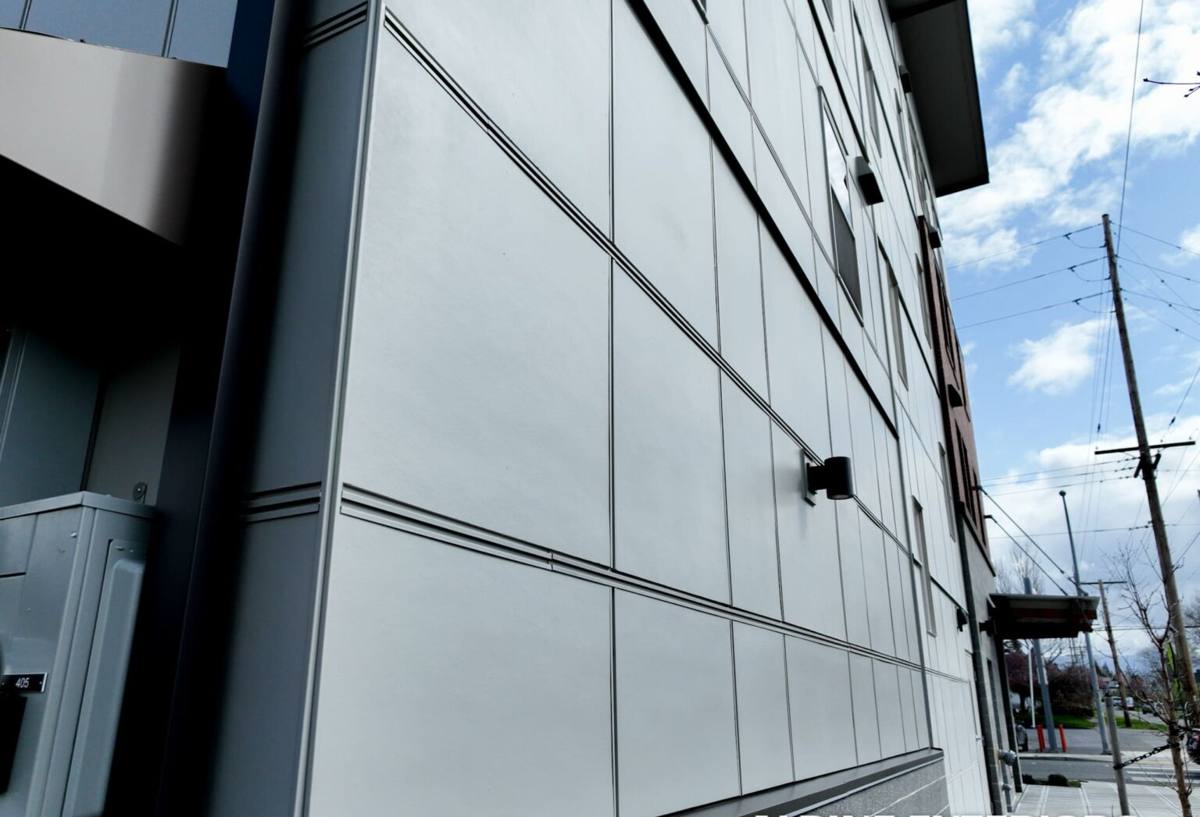
What Salt Air, Rain, and Moss Actually Do to Siding
Salt Air and Metal Fasteners
Airborne salt from Bellingham Bay doesn't just affect boats and railings. It settles on siding, trim, and — more importantly — on every nail head, screw, and piece of flashing on the exterior of the house. Standard fasteners corrode faster near the water than they do even a few miles inland. Corroding fasteners loosen, stain the siding face with rust streaks, and eventually let water behind the cladding.
Driving Rain and Wind-Loaded Water
Bellingham's rain rarely falls straight down. Storms moving in off the water push rain sideways into wall assemblies, forcing water up under laps and around penetrations that would stay dry in a calmer climate. Siding systems and installation details that work fine in a low-wind, low-rain region get exposed for their weak points here — usually at butt joints, window and door trim, and inside corners.
Moss, Algae, and Shade
Tree canopy is part of what makes Edgemoor desirable, but it also means longer periods where siding stays damp and shaded — exactly the conditions moss and algae need. Wood-based and wood-look products absorb that moisture into the material itself; the surface finish matters as much as the substrate underneath it.
What a Correct Siding Replacement Actually Involves
Replacing siding is not just pulling off old boards and nailing up new ones. Done correctly, especially on a shaded, moisture-exposed lot, the job includes:
- Full tear-off and inspection of the sheathing underneath — soft, delaminated, or rotted sheathing gets found and replaced now, not discovered as a callback later
- A code-compliant weather-resistive barrier installed with proper overlaps, not just stapled up and covered
- Correct flashing at every window, door, deck ledger, and roof-to-wall transition — this is where most water intrusion actually starts
- Rainscreen or drainage gap detailing where the wall assembly and exposure call for it, so incidental moisture behind the cladding can drain and dry
- Fasteners and trim hardware rated for coastal/corrosive exposure, driven to the manufacturer's specified pattern and depth
- Factory-finished siding installed per the manufacturer's fastening and clearance requirements — ground clearance, gutter clearance, and joint treatment all affect long-term performance
Skip any one of these steps and the new siding will look fine for a few years before the same problems the old siding had start showing up again.
Why We Install Only James Hardie Fiber Cement
We standardized on James Hardie fiber cement siding and don't install vinyl, LP SmartSide, Cemplank, Allura, primed spruce, or cedar. That's not a marketing position — it's a decision based on what actually holds up in a climate like Bellingham's, and specifically in higher-exposure settings like Edgemoor.
Fiber cement is non-combustible, which matters increasingly as insurance underwriting tightens around exterior materials. It doesn't absorb moisture the way wood-based products do, so it isn't the food source that moss and algae need to establish themselves on a damp, shaded wall. Hardie's ColorPlus factory finish is baked on under controlled conditions rather than field-applied, which gives it better adhesion and color retention than site-painted products — a real advantage on a job where the fascia and trim spend a good part of the year under shade and moisture.
Hardie also builds specific product lines engineered for climate zones — the HZ5 line is formulated for wetter, colder regions like ours, as opposed to a one-size-fits-all formulation. Combined with a strong transferable warranty, that gives homeowners a siding system that's actually specified for the environment it's going on, not just whatever's cheapest to stock.
How the Common Options Stack Up in This Environment
| Material | Moisture/Salt Air Behavior | Moss/Algae Resistance | Finish Longevity | Fire Rating |
|---|---|---|---|---|
| James Hardie fiber cement | Dimensionally stable, doesn't swell or rot | Non-organic surface, resists growth | Factory ColorPlus finish, long warranty | Non-combustible |
| Vinyl | Won't rot, but can warp/crack in wind and cold snaps | Surface can host growth in shaded areas | Color fades, can't be repainted easily | Combustible, can melt/deform near heat |
| LP SmartSide (engineered wood) | Wood-based core, vulnerable if moisture gets behind it | More susceptible than fiber cement | Field or factory finish, shorter track record here | Combustible |
| Cedar / primed wood | Absorbs moisture, needs consistent maintenance | High — requires regular treatment/cleaning | Repainting/staining cycle every few years | Combustible |
This isn't a claim that other products are unusable everywhere — it's why, for the specific combination of salt air, wind-driven rain, and shade that Edgemoor homes deal with, we've chosen to only stand behind one system.
Our Process for an Edgemoor Project
Because we already work in this part of Bellingham, we know what to check before a single board comes off the house.
1. On-Site Assessment
We walk the exterior looking for the usual failure points on shaded, water-adjacent lots: soft trim near ground contact, staining patterns that indicate where water is tracking, moss buildup on north- and west-facing walls, and any existing corrosion around fasteners or flashing.
2. Moisture and Sheathing Check
Wherever staining, softness, or past patch work suggests water has gotten behind the old siding, we probe and, where needed, open up the wall to confirm sheathing condition before quoting a final scope. This avoids surprises mid-project.
3. Scope and Product Plan
We spec the Hardie product line, profile, and color that fit the home, confirm trim and flashing details for the specific exposures on that lot, and lay out the fastening schedule appropriate for a coastal-influenced site.
4. Tear-Off and Installation
Full removal of the old cladding, sheathing repair as needed, correct weather barrier and flashing installation, then Hardie siding installed to manufacturer spec — clearances, fastener pattern, and joint treatment included, not skipped to save time.
5. Final Walkthrough and Cleanup
We walk the finished job with the homeowner, confirm trim, caulking, and touch-up work meet spec, and clear the site of old material and debris.
What to Ask Any Crew Bidding This Kind of Job
- Will you inspect and, if necessary, replace sheathing before re-siding, or just cover what's there?
- What fastener and flashing hardware are you using, and is it rated for coastal/corrosive exposure?
- Which Hardie product line and profile are you specifying, and why that one for this house?
- What's your plan for maintaining proper clearance at the ground, roofline, and deck ledgers?
- Is the manufacturer warranty transferable, and what voids it if the install deviates from spec?
- Have you worked on homes in this specific area before, and can you speak to what you saw when you opened up similar walls?
Why a Crew That Already Works Edgemoor Matters
Bluff and waterfront lots in this part of Bellingham often come with their own site considerations — drainage patterns, retaining structures, tree root systems close to the foundation, and sometimes tighter access for equipment and material staging. A crew that has already worked lots like this in Whatcom County knows to plan for those constraints before the job starts, not discover them mid-tear-off. That familiarity also extends to knowing which wall assemblies in this specific microclimate tend to be hiding moisture problems and which are usually fine — it changes how thorough an inspection needs to be before quoting the job with confidence.
It also matters for permitting and code compliance. Whatcom County's requirements around weather-resistive barriers, flashing, and exterior wall assemblies apply everywhere, but a crew that pulls permits regularly in this jurisdiction moves through that process faster and with fewer surprises than one working here for the first time.
Ready When You Are
If your Edgemoor home's siding is showing moss staining, soft trim, or paint that won't hold anymore, it's worth having someone look at what's actually happening behind the surface before deciding what to replace it with. We'll come out, walk the exterior with you, and give you a straightforward, no-pressure estimate based on what your home actually needs — use the form below to get started.