 Bellingham Siding
 Why Birch Bay's Shoreline Climate Is Hard on Siding
Birch Bay sits directly on the Salish Sea in Whatcom County, and that waterfront position changes what a home's exterior has to survive compared to a house a few miles inland. Wind off the water carries salt spray onto siding, trim, and fasteners year-round. Storms roll in with wind-driven rain that hits walls sideways instead of falling straight down. And the long gray stretch from fall through spring keeps north-facing and shaded walls damp long enough for moss and algae to take hold. None of this is unique to one house — it's the baseline condition for almost every property near the water in this part of Whatcom County.
Salt Air and Coastal Wind
Airborne salt is corrosive to unprotected metal and can accelerate the breakdown of some paints and coatings over time. It doesn't just affect siding panels — it works on fasteners, flashing, and trim edges, which is often where problems actually start even when the siding face looks fine.
Wind-Driven Rain and Wall Assemblies
When rain is pushed horizontally by wind instead of falling straight down, water finds its way into laps, joints, and penetrations that would stay dry in a calmer climate. This makes flashing details and drainage behind the siding just as important as the siding material itself.
The Long Moss Season
Shaded walls, roof overhangs, and areas near mature trees stay damp for months at a stretch. Moss and mildew don't just look bad — sustained moisture against a wall surface is what eventually finds gaps in caulking or fastener holes and gets behind the cladding.
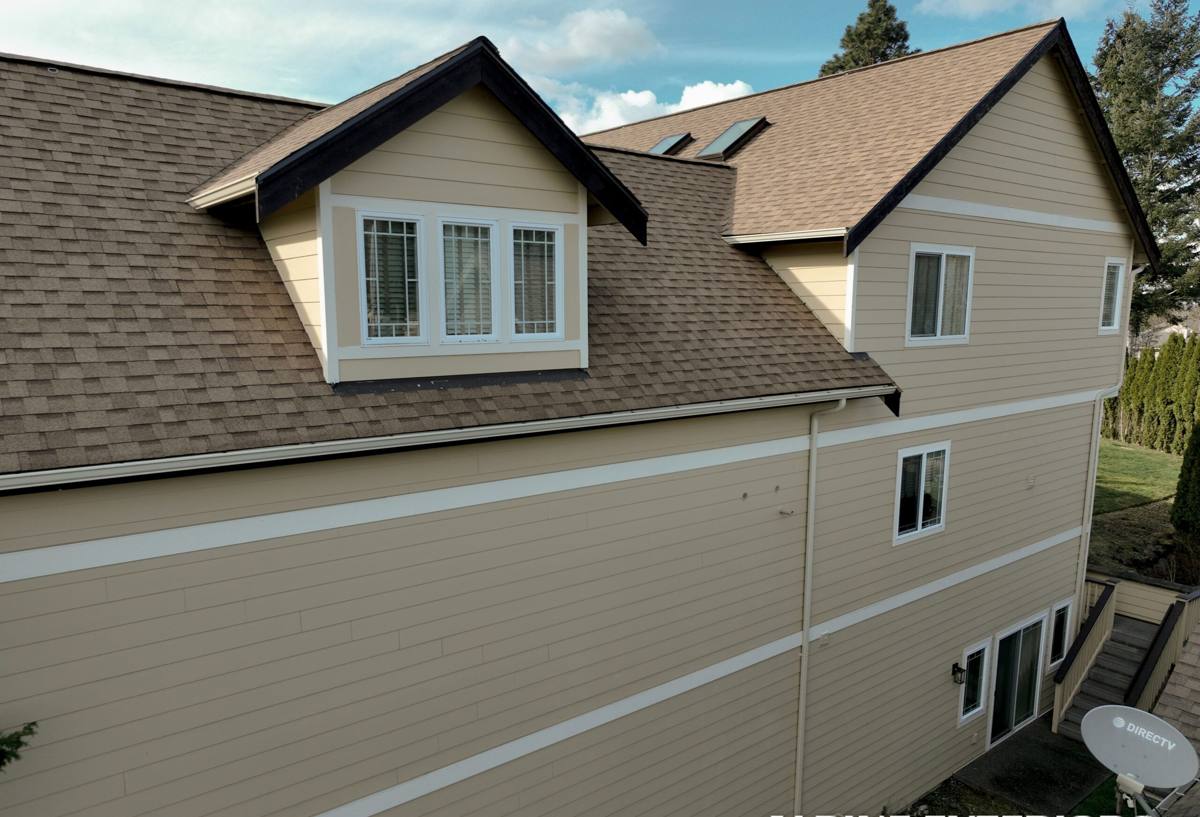
What This Climate Actually Demands From a Siding Material
Given those three conditions, a siding product for a Birch Bay home needs to do more than look good. It needs to hold its factory finish against salt and UV exposure without chalking or fading unevenly, resist moisture absorption so it doesn't swell, cup, or rot when it stays wet for extended periods, and present a hard, dense surface that doesn't feed mold and moss growth the way some organic materials do. It also needs to be dimensionally stable enough that it doesn't shift and open joints as it cycles through wet and dry seasons.
Why We Install Only James Hardie Fiber Cement
We standardized on James Hardie for every siding job we do, including here in Birch Bay, because it's the product that consistently meets those requirements when it's installed correctly. We don't install vinyl, LP SmartSide, cedar, or other fiber cement brands — not because those products have no merit, but because we've built our process, our training, and our warranty backing around one system we trust completely in this climate.
ColorPlus Factory Finish
Hardie's ColorPlus finish is baked on at the factory in a controlled environment, rather than sprayed or brushed on site. That matters directly for salt-air exposure: a factory-cured finish holds up more evenly against UV and coastal weathering than field-applied paint, and it comes with its own finish warranty separate from the substrate.
Engineered for Climate Zones
James Hardie engineers its HZ product lines for different U.S. climate zones rather than selling one formulation everywhere. Whatcom County's coastal exposure — high moisture, relatively mild winters — is a different engineering problem than a region with hard freeze-thaw cycles, and Hardie's climate-specific formulation is one of the reasons we trust the product here rather than treating siding as a one-size-fits-all decision.
A Non-Combustible Core
Fiber cement is non-combustible, which matters everywhere but carries extra weight for properties near dry brush, wooded lots, or with neighboring structures close by — a fire-safety advantage that vinyl and wood-based products simply can't offer.
How James Hardie Compares to Other Siding Homeowners Consider
Most homeowners researching a siding replacement look at more than one product. Here's an honest comparison of how the main options typically perform against Birch Bay's specific conditions:
| Factor | James Hardie Fiber Cement | Vinyl | Cedar / Wood | LP SmartSide |
|---|---|---|---|---|
| Salt air / coastal exposure | Strong; factory finish resists UV and salt weathering | Can become brittle and fade unevenly over time near the coast | Vulnerable without diligent, ongoing sealing and finishing | Engineered wood strand core is more moisture-sensitive at cut edges |
| Moisture / rot resistance | High; cement-based, doesn't rot | Doesn't rot but can trap moisture behind it if installed poorly | Prone to rot without consistent maintenance | Can swell or delaminate if moisture reaches the wood core |
| Moss / mildew growth | Low; dense, hard surface | Low, but staining is common in shaded areas | Higher; organic surface is more hospitable to growth | Moderate; more porous than fiber cement |
| Fire performance | Non-combustible | Combustible | Combustible | Combustible |
| Ongoing maintenance | Low; occasional rinse and caulk check | Low, but repairs can be hard to color-match | High; regular staining/sealing needed | Moderate; edge sealing and paint upkeep |
This isn't a claim that other products are unusable — it's why, after weighing these trade-offs, we chose to build our business around installing one product correctly rather than several products at varying levels of confidence.
What a Correct James Hardie Installation Involves Here
The material is only half the equation. Most siding failures we see in coastal Whatcom County trace back to installation shortcuts, not the product itself.
Clearance and Flashing Details
Hardie's specifications call for specific clearances from grade, roof lines, decks, and other horizontal surfaces where water can splash back or pool. In a driving-rain climate, flashing at windows, doors, and any wall penetration has to be sequenced correctly — installed so water is always directed out and down, never trapped behind the cladding.
Fastener and Trim Corrosion Resistance
Given the salt exposure, fastener choice matters more here than it would inland. Using corrosion-resistant fasteners and properly rated trim components is a small line-item that has an outsized effect on how the wall assembly holds up over years of salt-laden wind.
Rain-Screen and Drainage Behind the Cladding
Siding is not a waterproof membrane by itself — it's the first line of defense over a water-resistive barrier that's designed to manage the moisture that does get past the surface. In a wind-driven rain climate, making sure that drainage plane is intact and continuous is as important as the siding panels themselves.
Common Installation Mistakes We See in Coastal Homes
A few shortcuts show up repeatedly on older or poorly installed jobs in this area, and they're worth knowing whether you're comparing bids or evaluating your current siding:
- Butt joints and seams sealed entirely with caulk instead of proper flashing, which fails as caulk ages and shrinks
- Siding installed tight to grade, patios, or roof lines with no clearance for water to drain away
- Standard fasteners used in a salt-air environment instead of corrosion-resistant hardware
- Panels face-nailed or over-driven, which can crack the material or reduce its ability to move with temperature and moisture changes
- Missing or poorly lapped flashing at windows, doors, and roof-to-wall intersections
Our Process for a Birch Bay Siding Project
We approach every Birch Bay job with the shoreline exposure in mind from the first walkthrough:
- On-site assessment of the home's exposure — which walls take the most wind-driven rain, salt spray, and shade — since not every side of the house needs the same attention to detail
- Inspection of the sheathing and wall assembly once old siding is removed, checking for moisture damage that needs to be addressed before new siding goes on
- Installation following James Hardie's published specifications for clearances, fastening, and flashing, adjusted for this specific site's exposure
- Use of corrosion-resistant fasteners and trim components appropriate for a coastal property
- Final walkthrough covering caulking points, drainage details, and what routine maintenance to expect going forward
Living With Hardie Siding in a Moss-Prone, Salty Climate
Correctly installed Hardie siding is genuinely low-maintenance, but "low-maintenance" doesn't mean "no maintenance" — especially this close to the water. A little routine attention goes a long way toward getting the full lifespan out of the material:
- Rinse siding periodically to clear salt residue, especially on walls that face the water directly
- Keep gutters clear so overflow doesn't run down and pool against the siding
- Trim back vegetation and tree cover that keeps shaded walls damp longer than necessary
- Check caulking at joints, trim, and penetrations annually and re-seal as needed before small gaps become water paths
- Look at flashing and trim for early signs of corrosion, particularly on ocean-facing elevations
Why Hiring a Crew That Already Works Birch Bay Matters
Siding specifications are written for a whole country's worth of climates, and a contractor who mostly works drier or more sheltered inland jobs may not default to the clearance, flashing, and fastener choices that matter most a few hundred feet from saltwater. A crew that regularly works Birch Bay and the surrounding shoreline communities already knows which walls take the worst of the weather, where moss builds up fastest, and which installation details are worth the extra care rather than treating every job identically. That local pattern recognition is often the difference between siding that looks good for a couple of seasons and siding that actually performs for decades in this specific environment.
If you're planning a siding replacement in Birch Bay and want a straight answer about what your home actually needs, we're happy to take a look and walk you through it. Reach out for a free, no-pressure estimate — there's a form below to get started.