 Bellingham Siding
 Why Blaine's Weather Is Hard on Roofs
Blaine sits at the northern tip of Washington, wrapped by Semiahmoo Bay and Drayton Harbor and just minutes from the Canadian border. That location puts local roofs in a different weather lane than homes even twenty minutes inland. Storms roll off open water with almost nothing to slow them down before they hit a roofline, the air carries salt, and the wet season runs long. No single one of those factors is dramatic, but stacked together over a few winters they wear roofing components down faster than most homeowners expect.
Three things do most of the damage: wind-driven rain that gets pushed sideways and even upward instead of simply running downhill, salt-laden marine air that speeds up corrosion on exposed metal and fasteners, and a moss season that can run from October into May on shaded, damp roof planes. A roof that would coast along fine in a drier climate needs closer attention here, and after an actual storm event it needs a real inspection — not a guess from the driveway.
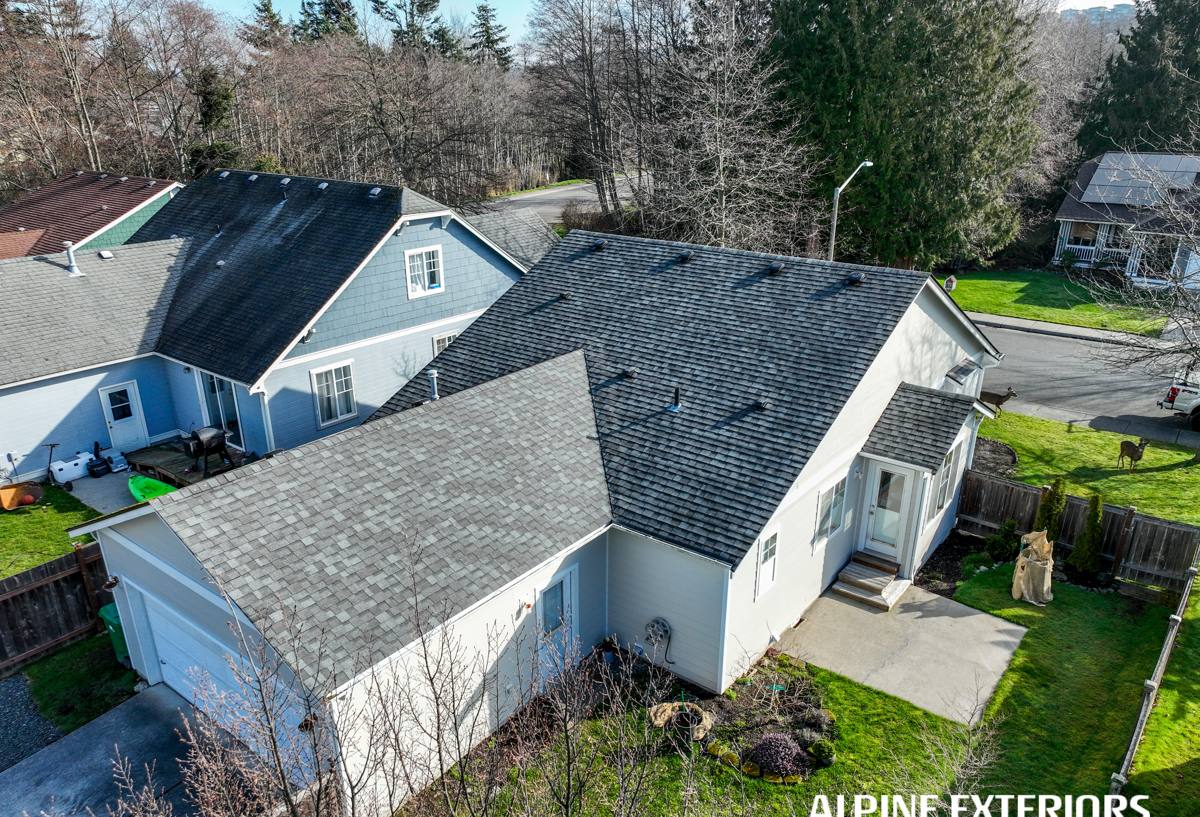
What Actually Counts as Storm Damage
Not everything wrong with a roof after a windstorm is storm damage in the repair or insurance sense, and not everything that is storm damage shows up from the ground. Wind can lift a shingle tab just enough to break its seal without tearing it off — it looks fine until the next rain finds the gap. Flying debris can crease flashing or punch a small hole that doesn't show as a ceiling stain for weeks. The only reliable way to know what you're dealing with is to get eyes on the roof itself, particularly at valleys, penetrations, and edges, where wind pressure concentrates and problems start.
Signs worth a closer look after any significant wind or rain event include:
- Missing, cracked, or curled-back shingles, especially near ridges and edges
- Exposed or raised nail heads where a shingle has shifted
- Granules collecting in gutters or piling at the base of downspouts
- Dented, bent, or lifted flashing around chimneys, vents, and skylights
- Small punctures or bruised spots from branches or wind-borne debris
- Soft or spongy areas underfoot, a sign of trapped moisture rather than simple surface wear
- New or worsening leaks, drips, or ceiling stains showing up after a storm
What a Correct Storm Repair Actually Involves
Matching Materials, Not Just Covering a Hole
A storm repair that's done right ties into the existing roof system rather than sitting on top of it. That means matching shingle profile, weight, and color as closely as the market allows, tying new underlayment under the surrounding courses rather than butting it against them, and re-securing with fasteners rated for the exposure. A patch that's simply nailed or caulked over a damaged spot without integrating into the surrounding layers will usually fail again at the seam within a season or two, especially with the wind-driven rain common here.
Flashing Is Usually the Real Problem
Most leaks that get blamed on "the roof" actually start at flashing — the metal that seals transitions at chimneys, vent pipes, skylights, valleys, and where a roof meets a wall. Flashing takes the brunt of wind uplift and is the first place salt air corrodes, so after any storm it deserves at least as much attention as the field shingles. Repairing shingles while leaving compromised flashing in place is the single most common shortcut that leads to a repeat call.
Fasteners and Sealants Suited to the Exposure
In a marine climate, the fasteners and exposed metal used in a repair matter more than they would inland. Standard electro-galvanized nails and generic flashing metal corrode noticeably faster in salt-laden air near the water. We use fasteners and flashing rated for coastal exposure so a repair isn't undone by corrosion in a few years, and we're straightforward about which materials hold up here and which don't, rather than defaulting to whatever is cheapest on the shelf.
Choosing the Right Scope
| Repair Type | What It Covers | Typical Cost Range | Best Fit |
|---|---|---|---|
| Spot / Patch Repair | A single damaged area — a few shingles, one flashing point | Often $300–$900 | Isolated damage on an otherwise sound, reasonably young roof |
| Section / Slope Replacement | One full roof plane or a cluster of repeated problem spots | Often $1,500–$4,500 | Damage spread across a wide area of one slope, or when matching a small patch isn't practical |
| Full Roof Replacement | Entire roof system, decking checked and replaced as needed | Often $8,000 and up, depending on size and material | Roof already near the end of its service life, or damage scattered across multiple slopes |
Costs vary with roof size, pitch, material, and access, so these ranges are meant as general orientation, not a quote. Part of an honest inspection is telling you when a patch is enough and when it isn't — we don't upsell a full reroof when a targeted repair will hold, and we don't recommend a patch on a roof that's clearly past the point of spot fixes.
How Our Process Works
- Initial call and photos. If you can safely get ground-level photos of visible damage, that helps us prioritize the visit, especially right after a widespread storm when several homes in the area need attention at once.
- On-roof inspection. We walk the roof itself rather than relying on a ground-level look, checking field shingles, flashing, valleys, and penetrations, and we document what we find with photos.
- Written scope and estimate. You get a clear explanation of what's damaged, what caused it, and what it will take to fix — in plain language, before any work starts.
- Repair work. Matching materials, proper flashing integration, and fasteners suited to a coastal climate, done in a single visit for most spot and section repairs.
- Cleanup and walkthrough. Debris and old materials removed, and we walk the finished repair with you so you know exactly what was done.
Working With Insurance on Wind and Storm Claims
Most homeowners insurance policies in Washington cover sudden wind and storm damage to a roof, though coverage details, deductibles, and depreciation schedules vary by policy and carrier. What we can control is the documentation: clear photos of the damage, a written description of what happened and when, and an honest scope that separates storm-caused damage from pre-existing wear. Insurers distinguish between the two, and an inspection that inflates ordinary aging into "storm damage" tends to slow a claim down or get parts of it denied rather than help it. We're glad to meet an adjuster on-site and walk the roof with them if that's useful for your claim.
Where Roofing Meets Siding: The Overlooked Failure Point
Because we work on full exteriors, not just roofs in isolation, we pay particular attention to the places where roofing and siding meet — kickout flashing at roof-to-wall transitions, fascia and soffit boards, and the trim that ties a roofline into the wall below. These spots take repeated wind-driven rain intrusion over the years, and when kickout flashing is missing or undersized, water gets diverted straight into the wall assembly instead of off the roof, leading to rot in fascia and sheathing long before anyone notices a leak inside. A storm repair that only addresses the roof deck and ignores this interface is treating half the problem.
Moss, Debris, and the Long Wet Season
Moss and lichen don't just look bad — they hold moisture against the shingle surface for months at a time, which speeds granule loss and can lift shingle edges enough for wind to get underneath during the next storm. Shaded, north-facing slopes and roofs under tree cover are the most affected, and in this climate that growing season runs long. A few simple habits go a long way toward keeping storm damage from compounding:
- Keep gutters and downspouts clear so wind-driven rain has somewhere to go
- Trim back branches that overhang the roof to reduce both debris and shade-driven moss growth
- Have zinc or copper control strips installed near ridgelines if moss is a recurring problem
- Avoid pressure-washing moss off — it can drive water under shingles and strip protective granules
- Schedule a roof check after any named storm or sustained high-wind event, not just when a leak appears
Why Hiring a Crew That Already Works Blaine Matters
Roof exposure isn't uniform across Whatcom County. A home a block off Semiahmoo Bay takes a different wind and salt load than one further inland, and a crew that works this area regularly knows the difference — which slopes take the worst of the weather, which fastener and flashing choices actually hold up near the water, and how fast a repair needs to happen before a temporary tarp becomes a bigger problem. Local experience also means fewer surprises with permitting and inspection requirements, and a faster response after a storm moves through, since we're not routing a crew in from somewhere unfamiliar with the area's conditions. Based in Bellingham and working throughout Whatcom County, we treat Blaine's coastal exposure as a normal part of the job, not an afterthought.
If a recent storm has you wondering whether your roof needs attention, we're happy to take a look. Fill out the form below for a free, no-pressure estimate — we'll tell you honestly what we find, whether that's a small patch or something bigger.