 Bellingham Siding
 Siding Installation Built for Cordata's Climate
Cordata sits far enough inland from Bellingham Bay to feel a little sheltered, but it still gets the same weather pattern that wears down siding across Whatcom County: long stretches of driving rain from fall through spring, salt-tinged air pulled in off the Strait of Georgia and Bellingham Bay, and a moss season that can run eight months out of the year under the tree cover common in this part of town. Homes here don't fail because of one big storm. They fail slowly, from siding that was never really matched to this environment in the first place.
We install James Hardie fiber cement siding exclusively — not vinyl, not LP SmartSide, not primed wood, not other fiber cement brands. On a page like this, that matters because Cordata's mix of older ranch-style homes and newer infill construction gives us a good cross-section of what works long-term here and what doesn't. This page walks through what siding installation actually involves in this neighborhood, and why the product and the crew both matter as much as the install itself.
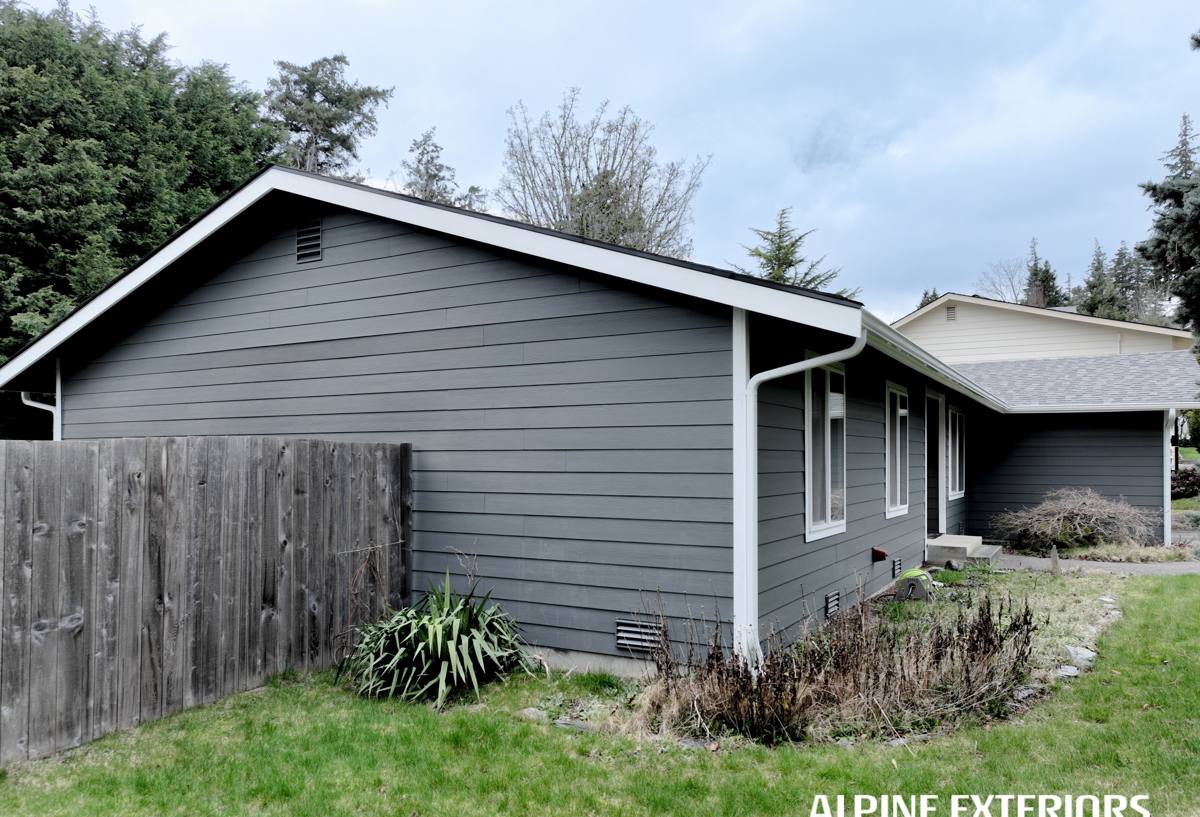
What Cordata Homes Are Up Against
Moisture That Doesn't Let Up
Bellingham's rainfall isn't the heaviest in the state, but it's persistent — steady, low-intensity rain over many months rather than short intense storms. That pattern is hard on siding seams, butt joints, and anything with a wood-based core, because the moisture has time to work into small gaps instead of just running off. Siding in Cordata needs to shed water reliably at every joint, not just resist a single downpour.
Salt Air, Even This Far Inland
Cordata is a few miles from the water, but Whatcom County's marine air still carries salt content that accelerates corrosion on fasteners, trim flashing, and any metal components in a siding system. It's less severe here than for a home directly on the bay, but it's not negligible — it shows up over a decade or two as premature rust bleed and fastener failure if the wrong materials were used.
Moss, Algae, and Shade
Cordata has a good tree canopy in places, and shaded, north-facing walls stay damp longer after every rain. That's exactly the condition moss and algae need to get established. Once organic growth takes hold on a wood or wood-composite product, it holds moisture against the surface and speeds up rot underneath — even if the siding still looks intact from the sidewalk.
Why We Only Install James Hardie Here
Fiber cement isn't a marketing choice for us — it's a response to exactly the three conditions above. James Hardie's HZ5 product line is engineered for climates with sustained moisture exposure, which describes Whatcom County well. It's non-combustible, it doesn't absorb water the way wood-based products do, and it holds paint and factory finish far longer under UV and moisture cycling than primed wood substrates.
The ColorPlus factory finish matters specifically in a moss-prone neighborhood like Cordata, because a baked-on finish resists the kind of surface breakdown that gives algae and moss something to grip. Field-applied paint on other sidings starts to chalk and micro-crack years sooner, and that texture becomes a foothold for organic growth. We're not saying every alternative product fails — we're saying that for this climate, the trade-offs on moisture tolerance, maintenance, and long-term finish life consistently favor Hardie, and that's the standard we hold every install to.
How Hardie Compares for a Cordata Home
| Factor | James Hardie Fiber Cement | Wood-Based / Composite Siding | Vinyl |
|---|---|---|---|
| Moisture resistance | Engineered non-organic core, doesn't swell or rot | Wood fiber core can absorb moisture at cut edges and joints | Doesn't absorb water, but seams can trap it behind the panel |
| Moss/algae resistance | Factory finish resists surface breakdown that feeds growth | Field paint chalks over time, giving growth a foothold | Smooth surface resists growth but can still stain |
| Coastal/salt air durability | Stable with corrosion-resistant fastening | Fasteners and cut edges vulnerable over time | Generally stable, but can become brittle |
| Fire resistance | Non-combustible | Combustible | Can deform/melt under heat |
| Finish longevity | 15-year ColorPlus finish warranty (product line dependent) | Repaint typically every 5-8 years | Color built into material, but fades over time |
What a Correct Siding Installation Actually Involves
The siding product is maybe half the equation. The other half is installation detail, and this is where a lot of problems on Whatcom County homes actually start — even on houses with decent siding material.
Water Management Comes First
Before a single piece of siding goes up, the wall needs a correctly lapped weather-resistant barrier, properly integrated window and door flashing, and rainscreen or drainage gap detailing where the assembly calls for it. In a climate like Bellingham's, siding is the last line of defense, not the only one. If the water management layer behind it is wrong, the best siding in the world will still let moisture into the wall assembly over time.
Fastening and Clearances to Manufacturer Spec
James Hardie has specific fastening patterns, nail spacing, and butt-joint treatment requirements, along with minimum clearances from grade, roof lines, and decks. These aren't suggestions — they're what the warranty is actually built on. Under-driven or over-driven fasteners, missed stud lines, or tight clearances at grade are common ways an otherwise good product ends up failing early.
Trim, Caulking, and Joint Detail
Every outside corner, inside corner, and butt joint is a place water can find its way in if it's not detailed correctly. In a neighborhood with Cordata's moisture load, we pay particular attention to horizontal joints and any transition where two different materials meet — those are the spots that show problems first if the install was rushed.
Our Process for a Cordata Project
- Walk-through and assessment — we look at existing siding, sheathing condition where visible, drainage patterns around the home, and shaded/high-moisture wall sections that need extra attention.
- Removal and inspection — once old siding is off, we check sheathing and framing for hidden moisture damage before anything new goes up. This step catches problems that aren't visible from the outside.
- Water management repair or upgrade — weather barrier, flashing, and drainage detailing get corrected or installed to current standards, not just patched around.
- James Hardie installation to manufacturer spec — correct fastening, clearances, and joint treatment throughout, on every elevation, not just the street-facing side.
- Final detail and walkthrough — trim, caulking, and touch-up finished, with a walkthrough so you understand what was done and why.
What to Check Before You Hire Anyone for This
- Ask what siding product they install and why — a contractor who installs everything usually isn't specializing in the details any one product needs.
- Ask specifically about water management: weather-resistant barrier, flashing, and drainage gap detailing, not just "we'll put new siding on."
- Ask how they handle shaded, moss-prone walls differently, if at all — a contractor familiar with neighborhoods like Cordata should have an answer.
- Confirm they're following manufacturer fastening and clearance specs, since that's what protects the product warranty.
- Ask about their experience with older homes in this area specifically, versus new construction — the retrofit details differ.
- Get it in writing what's included: removal, disposal, sheathing repair if needed, trim, and paint/finish details.
Cost Factors for Cordata Siding Projects
| Factor | Why It Affects Cost |
|---|---|
| Home size and wall complexity | More corners, gables, and dormers mean more cutting, trim, and labor time |
| Condition of existing sheathing | Hidden moisture or rot found during removal adds repair scope |
| Siding profile and trim selection | Lap width, trim style, and accent details affect material cost |
| Access and site conditions | Tree cover, fencing, or tight lot lines can slow the work |
| Story height | Two-story walls require more scaffolding/staging time than single-story |
We don't publish fixed prices because every home and every wall condition is different — but we'll give you a clear, itemized estimate after an actual walk-through, not a phone-quote guess.
Why Local Experience with Cordata Homes Matters
A crew that already understands Whatcom County's rain pattern, the salt air this close to the coast, and the shaded, moss-heavy conditions common in neighborhoods like Cordata makes fewer assumptions on your project. We're not learning this climate on your house. That familiarity shows up in small decisions — where extra flashing attention is worth it, which walls need particular care around joints, how to sequence work around the region's weather — that add up to a siding job that actually holds up over the next few decades instead of just looking good on install day.
If you're planning a siding project in Cordata, we're happy to walk your home, look at what you're currently dealing with, and give you a straightforward, no-pressure estimate for a James Hardie installation done right. Fill out the form below to get started.