 Bellingham Siding
 Edgemoor's Waterfront Climate: What It Does to a Deck
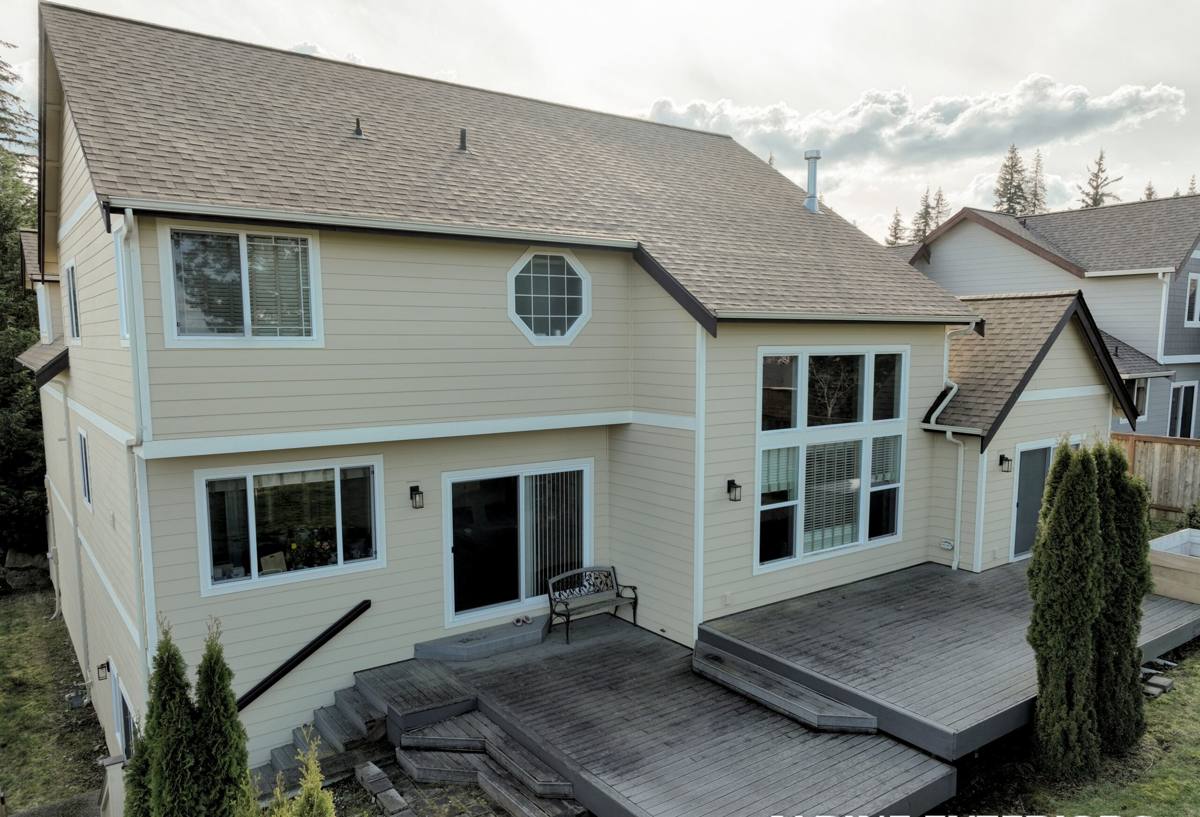
Edgemoor sits close to the water, and that proximity cuts both ways. The views and the setting are part of why people build outdoor living space here in the first place, but the same conditions that make the neighborhood desirable are hard on decking materials. Salt-laden air off Bellingham Bay works into fasteners, hardware, and any exposed wood grain. Driving rain off Whatcom County storms doesn't just fall straight down — wind pushes it sideways under railings and against fascia boards, finding every gap a deck wasn't built to handle. And because so many lots here are shaded by mature trees, decks go through a long moss and algae season every year, sometimes eight or nine months of the calendar, where surfaces rarely get a full day of direct sun to dry out.
None of that is unusual for this part of Washington. But it does mean a deck built to a generic spec — the kind of build that would be fine in a drier, sunnier part of the state — tends to underperform in Edgemoor faster than the homeowner expects. Fastener corrosion, soft spots at the ledger board, and a slick, mossy walking surface are the three most common complaints we hear on decks in this area, and all three trace back to the same root causes: moisture that doesn't drain or dry, and hardware that wasn't rated for salt exposure.
Salt Air and Hardware
Standard galvanized fasteners hold up fine inland but corrode faster near saltwater. Once a fastener starts rusting, it weakens, stains the surrounding decking, and eventually needs replacement — which on a wood deck means pulling boards. This is one of the biggest reasons hardware selection matters more here than it does even a few miles inland.
Moss, Shade, and Standing Water
A deck that stays damp for days at a time grows moss whether it's wood or composite. The difference is what that moss does to the material underneath. On wood, trapped moisture accelerates rot at the board's core, often invisibly, until a soft spot shows up. On composite, moss and algae are a surface issue that can be pressure-washed off without touching the structural integrity of the board — but only if the deck was built with airflow underneath and gaps that let water actually leave instead of pooling.
Composite vs. Wood vs. PVC: What Actually Holds Up Here
We install composite decking on most Edgemoor projects because it's the material best matched to this specific climate — not because it's the only decent product on the market. Every decking material has trade-offs, and being straight about them up front is part of doing this job honestly.
| Material | Moisture Behavior | Maintenance | Typical Lifespan |
|---|---|---|---|
| Pressure-treated wood | Absorbs water, prone to rot at fasteners and ledger | Annual staining/sealing, regular inspection | 10-15 years in this climate |
| Capped composite | Doesn't absorb water into the core; surface sheds moisture | Periodic washing, no staining or sealing | 25-30+ years, backed by manufacturer warranty |
| Cellular PVC | Fully moisture-proof, no wood content | Low; can show scratches more readily | 25-30+ years |
Wood is the lowest up-front cost and some homeowners genuinely prefer the look and the ability to refinish it themselves. Our professional standard is to steer waterfront and shaded Edgemoor clients toward capped composite or PVC when the goal is a low-maintenance, long-term deck, because the annual sealing that wood requires in this climate is easy to fall behind on, and once it does, moisture damage moves fast.
What a Correct Composite Deck Installation Involves
Composite boards themselves are low-maintenance, but the deck they're attached to only performs as well as the structure underneath. This is where a lot of decking problems in wet climates actually start — not with the boards, but with a substructure that wasn't built for the conditions.
Substructure and Ledger Attachment
The ledger board — where the deck attaches to the house — is the single most moisture-sensitive connection point on any deck. It needs proper flashing to keep water from tracking behind the siding and into the wall assembly, which is doubly important on a home that's already dealing with driving rain off the bay. We also spec joists and framing rated for composite loads and local exposure, since composite boards are heavier than wood and some framing lumber isn't sized for it by default.
Fastening
We use hidden fastener systems on most composite installs — clips that hold boards from the sides rather than screws through the face. This keeps the walking surface free of exposed metal, which matters in salt air where any exposed screw head is a future rust spot. Where a project calls for face-fastening, we use stainless or coated fasteners rated for coastal exposure, not standard-grade hardware.
Drainage and Airflow
Board spacing and under-deck ventilation are what actually keep moss and mildew from building up underneath the deck where you can't see it. A deck installed tight to the ground with no airflow will trap moisture regardless of what the boards are made of. We grade and vent the substructure so water has somewhere to go and air has a way to move through.
Choosing the Right Board for a Salt Air, High-Moss Environment
Not all composite decking is built the same way, and the differences matter more in a climate like this one than they would somewhere dry.
- Fully capped composite has a polymer shell wrapped around all four sides of the board, which is what actually blocks moisture absorption at the core — this is the tier we recommend for Edgemoor's shaded, damp lots.
- Capped on three sides (top and edges, exposed core on the underside) costs less but leaves the bottom of the board able to absorb some moisture where airflow is poor.
- Uncapped composite is the older generation of the product — cheaper, but it can fade, absorb moisture, and grow mold at a rate closer to wood. We generally don't recommend it for waterfront properties.
- Mineral-based composite is a newer category with very low moisture absorption and good traction underfoot, which is worth considering on decks that stay shaded most of the day.
Color and texture matter too, but less than people expect for slip resistance. A deck under tree cover for most of the year benefits from a board with a textured, low-sheen surface — smooth, glossy composite boards can get slick with a thin film of algae faster than a textured board will.
Our Process for Edgemoor Composite Decking Projects
- On-site assessment of the existing deck or build site, including ledger condition, drainage, shade exposure, and proximity to the water.
- Board and hardware recommendation based on that specific site — not a one-size answer, since a shaded, low-lying lot needs different attention than a more open, elevated one.
- Permitting and structural planning, including framing sized correctly for composite board weight and local building code.
- Demolition of the old deck if applicable, with attention to what the removal reveals about ledger and framing condition.
- Framing, flashing, and ledger work — the part of the job that determines how the deck performs in five or ten years, not just how it looks on day one.
- Board installation with hidden or coastal-rated fasteners and proper spacing for drainage.
- Final walkthrough covering care and what to expect from the material through the wet season.
Cost Factors for Composite Decking in Edgemoor
Composite decking costs more up front than pressure-treated wood, and the final number on any project depends on several site-specific factors rather than a flat per-square-foot rate.
| Factor | Why It Affects Cost |
|---|---|
| Board tier (capped vs. mineral-based vs. entry composite) | Material cost varies significantly by product line and warranty length |
| Substructure condition | Rotted or undersized framing found during demo adds repair scope |
| Deck height and railing requirements | Elevated waterfront lots often need code-compliant railing systems, which adds labor and material |
| Access to the site | Sloped or wooded Edgemoor lots can complicate material staging and equipment access |
| Fastener and hardware spec | Coastal-rated stainless hardware costs more than standard-grade fasteners |
We give a real number after seeing the site, not before. A quote based on square footage alone, without accounting for what's under the existing deck or how exposed the lot is to wind-driven rain, usually ends up wrong in one direction or the other once work starts.
Maintenance: What a Composite Deck Still Needs Here
Composite decking is low-maintenance, not no-maintenance — that distinction matters most in a climate with a long wet, shaded season.
- Sweep debris and fallen needles or leaves off the deck regularly; trapped organic matter is what feeds moss and algae growth.
- Wash the surface with soap and water or a composite-safe cleaner once or twice a year, more often on heavily shaded sections.
- Check fastener heads and railing hardware periodically for early rust, especially on decks closer to the water.
- Keep gutters and downspouts near the deck clear so runoff isn't dumping extra water onto the surface or substructure.
- Trim back overhanging branches where practical to get more sun and airflow onto shaded sections of the deck.
- Avoid pressure-washing at close range or high PSI directly into board seams, which can drive water into the substructure instead of just cleaning the surface.
Why a Bellingham Crew That Knows Edgemoor Matters
Decking specs written for a national market don't always account for a specific neighborhood's exposure. A crew that regularly works Edgemoor and similar waterfront, tree-covered parts of Bellingham already knows which fastener grade holds up, which board tiers actually resist the moss season, and where drainage tends to fail on lots like this one. That's the kind of knowledge that shows up years later in whether a deck is still performing or already showing problems — not something a homeowner can easily verify from a brochure or a generic estimate.
We're a Whatcom County crew, and composite decking in a climate like this one is as much about the build underneath the boards as it is about the boards themselves. If you're planning a new deck or replacing an aging one in Edgemoor, we're glad to take a look at the site and put together a free, no-pressure estimate — just fill out the form below.