 Bellingham Siding
 Why Metal Roofing Makes Sense for Puget Homes
Puget sits close enough to the water that salt-laden air is a constant factor in how a roof ages, and far enough into Whatcom County's marine weather pattern that homes see long stretches of driving rain followed by damp, shaded months where moss gets a real foothold. That combination is hard on roofing. Asphalt shingles granulate faster in salt air, moss roots into the mat and lifts edges, and the freeze-thaw cycles that hit us in winter work into every small crack. Metal roofing holds up well against all three of those pressures when it's specified and installed correctly for this specific environment — which is different from specifying it for a dry inland climate.
We're not telling homeowners metal is the only right answer. It's a significant investment and it isn't the best fit for every home or every budget. But for Puget properties dealing with salt exposure, heavy rain volume, and persistent moss and algae growth, metal roofing solves problems that shingle roofs in this area run into again and again.
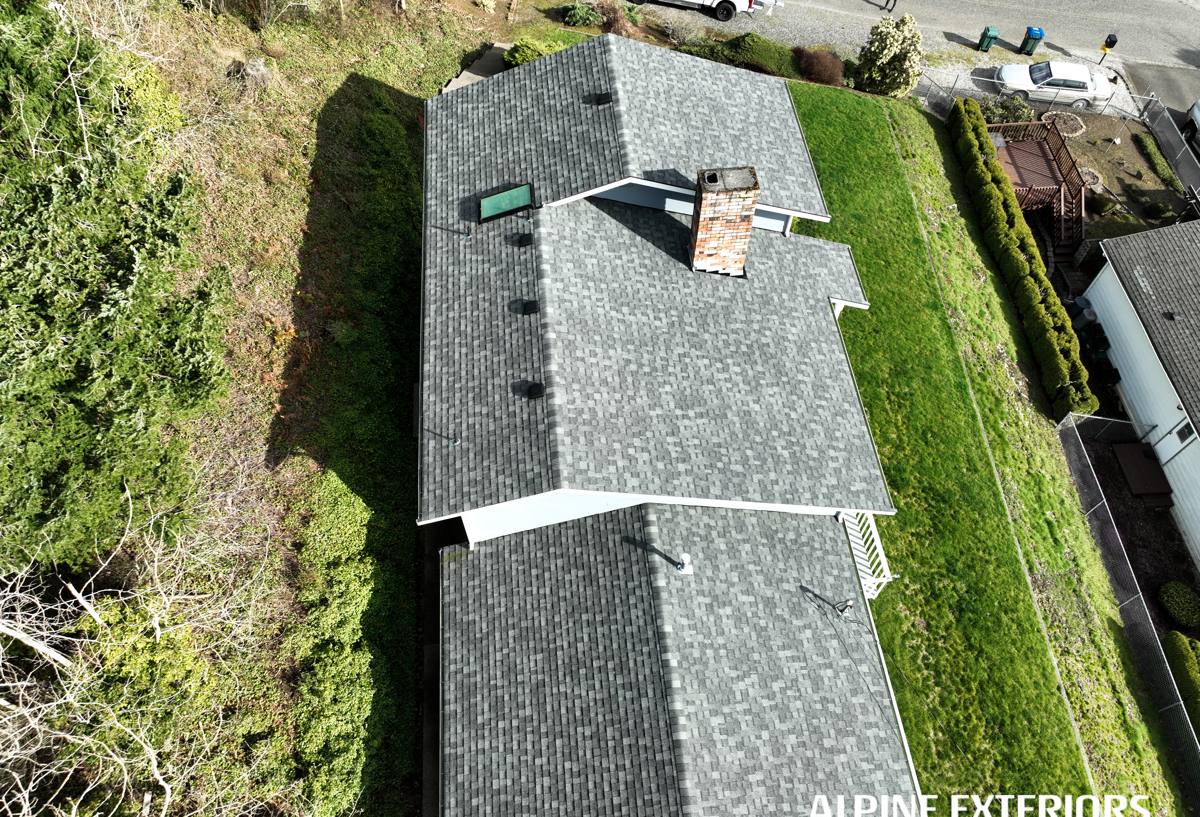
What the Puget Climate Actually Does to a Roof
Salt Air and Corrosion
Proximity to Bellingham Bay and the greater Puget Sound means airborne salt settles on every exterior surface, roofs included. On metal roofing, this makes fastener choice, flashing material, and coating quality the difference between a roof that lasts decades and one that shows rust streaks within a few years. Bare or poorly coated steel fasteners are usually the first failure point we see on metal roofs in this area.
Driving Rain and Water Intrusion
Rain here doesn't just fall straight down — wind off the water pushes it sideways and up under laps, ridges, and penetrations. A metal roof's water-shedding performance depends almost entirely on correct lap direction, underlayment choice, and flashing detail at every valley, chimney, vent, and wall intersection. Skip any of that and you get leaks that have nothing to do with the metal itself and everything to do with the installation.
Moss and Organic Growth
Whatcom County's shaded, damp winters are ideal moss conditions, especially on north-facing slopes and under tree cover. Moss on a roof isn't just cosmetic — it holds moisture against the roofing surface and, on shingles, lifts tabs and accelerates granule loss. Metal roofing gives moss far less to grip onto, and a properly finished panel sheds water and dries out faster than a shingle mat, which slows regrowth substantially even though it doesn't make a roof moss-proof.
What a Correct Metal Roofing Job Involves
A metal roof is only as good as what's underneath it and how it's detailed. For Puget homes specifically, we treat the following as non-negotiable:
- Marine-grade or coated fasteners rated for salt-air exposure — not standard hardware store screws
- A synthetic or high-temp underlayment rated for our wet climate, not builder's felt
- Ice-and-water shield at eaves, valleys, and low-slope transitions where wind-driven rain pools
- Proper panel overlap and fastening pattern matched to the roof's specific slope and exposure
- Custom-formed flashing at every penetration, wall intersection, and valley — not generic stock pieces
- Ventilation planning so the roof deck doesn't trap moisture underneath the panels
- Verification that gutters and downspouts are sized to handle metal's faster water shed rate
That last point catches people off guard. Metal sheds water quickly and in volume, and a drainage system sized for a shingle roof's slower runoff can overflow during a heavy Puget storm. Part of doing this job right is checking that the rest of the water management system can keep up.
Metal Roofing Options We Work With
| Panel Type | Best For | Trade-offs in This Climate |
|---|---|---|
| Standing seam steel | Homes wanting the cleanest look and longest service life | Higher upfront cost; excellent water-shedding on our steep, rain-heavy roofs |
| Corrugated / exposed-fastener steel | Budget-conscious projects, outbuildings, simpler rooflines | Exposed fasteners need regular inspection near salt air — a maintenance commitment |
| Stone-coated steel | Homeowners wanting a shingle or tile look with metal's durability | More surface texture can hold moss debris longer than smooth standing seam |
| Aluminum panel systems | Properties very close to the water with heavier salt exposure | Costs more than steel; naturally resists salt corrosion without added coating |
We'll walk through which of these fits your roofline, your budget, and how close your property sits to salt exposure — that last factor matters more here than it does for most inland jobs.
A Note on Coatings and Finishes
The paint or coating system on a steel panel is doing real work in this climate, not just adding color. We look for finishes with a track record in coastal and marine environments, and we're upfront when a lower-cost finish option carries a real trade-off in long-term appearance or corrosion resistance near the water. It's better to know that before installation than to be surprised by chalking or fading a few years in.
Our Process on a Puget Metal Roofing Project
- On-site assessment — we look at slope, orientation, tree cover, and proximity to the water to understand your specific exposure, not just a generic roof estimate.
- Deck and structure check — metal roofing is unforgiving of a soft or uneven deck, so we confirm what's underneath before anything goes on top.
- Material selection — we walk through panel type, gauge, and finish options against your budget and how the home sits relative to salt air and shade.
- Underlayment and flashing detail — this is where most roofs succeed or fail long-term, and it's where we spend the most care.
- Installation — panels, fasteners, and trim installed to manufacturer spec and adjusted for our wind and rain exposure.
- Final walkthrough — we check drainage performance, flashing tie-ins, and ventilation before calling the job done.
Cost Factors for Metal Roofing in This Area
Metal roofing costs more upfront than asphalt shingles, and the honest range depends heavily on panel type, roof complexity, and how much tear-off and deck repair is involved. Rather than quote a number that won't apply to your roof, here's what actually moves the price:
- Panel type — standing seam runs higher than exposed-fastener corrugated panels
- Roof complexity — valleys, dormers, and multiple penetrations add labor and custom flashing
- Existing deck condition — rot or soft sheathing found during tear-off adds cost but shouldn't be skipped
- Access and slope — steeper roofs and difficult access affect labor time
- Underlayment and coating upgrades chosen specifically for salt-air and moisture exposure
We give a written estimate that breaks these out so you can see what you're paying for, rather than a single lump number.
Why Hire a Crew That Already Works in Puget
Roofing crews that mostly work drier, inland regions sometimes underspecify for what Puget actually throws at a roof — lighter underlayment, standard fasteners, generic flashing details that work fine somewhere with less rain and no salt air. We work in Whatcom County and see this climate's effect on roofs regularly, which shapes how we spec every metal roofing job here: fastener grade, flashing detail, underlayment choice, and drainage sizing all get adjusted for what this specific area does to a roof over time, not what a manufacturer's general install guide assumes for an average climate.
That local familiarity also means we know which details on a Puget roof tend to fail first — usually flashing and fastener choice, rarely the panels themselves — and we build the job around avoiding those specific failure points from the start.
Maintenance Expectations After Installation
Metal roofing is lower-maintenance than shingles, but it isn't maintenance-free in this climate. A reasonable expectation for a Puget property:
- Annual visual check of flashing, fasteners, and any exposed seams
- Gutter and downspout clearing, especially after fall leaf drop and before winter rain volume peaks
- Occasional soft wash to clear moss and organic buildup from shaded slopes
- Prompt attention to any scratch or ding that exposes bare steel, before rust has a chance to start
None of this is heavy work, but skipping it for years at a stretch is how small issues become real ones.
Get a Straight Answer for Your Roof
Every roof in Puget carries its own mix of sun, shade, tree cover, and distance from the water, and that mix should drive the material and installation choices — not a one-size-fits-all quote. If you're weighing metal roofing for your home, we're glad to come take a look and give you a free, no-pressure estimate built around what your specific roof actually needs. Use the form below to get started.