 Bellingham Siding
 Birch Bay's Climate and What It Does to Siding
Birch Bay sits right on the water in Whatcom County, and that location is exactly what makes siding here wear differently than siding a few miles inland. Homes closer to the shoreline take a steady dose of salt-laden air, which accelerates corrosion on fasteners, trim, and any metal flashing that isn't properly protected. Add the driving rain that comes off the Strait during fall and winter storms, and you've got wind-driven moisture finding every gap, seam, and nail hole that isn't sealed correctly.
Then there's moss season, which around here isn't really a season — it's most of the year. Shaded north walls, tree-lined lots, and the persistent damp keep moisture sitting against siding surfaces longer than in drier climates. On wood-based products, that moisture gets absorbed. On any siding with compromised caulking or damaged panels, it works its way behind the surface where you can't see it until the damage is already done.
None of this means Birch Bay homes need constant repair. It means the repairs that do come up need to actually address moisture intrusion, not just cover it up — and it means the material behind the repair matters as much as the repair itself.
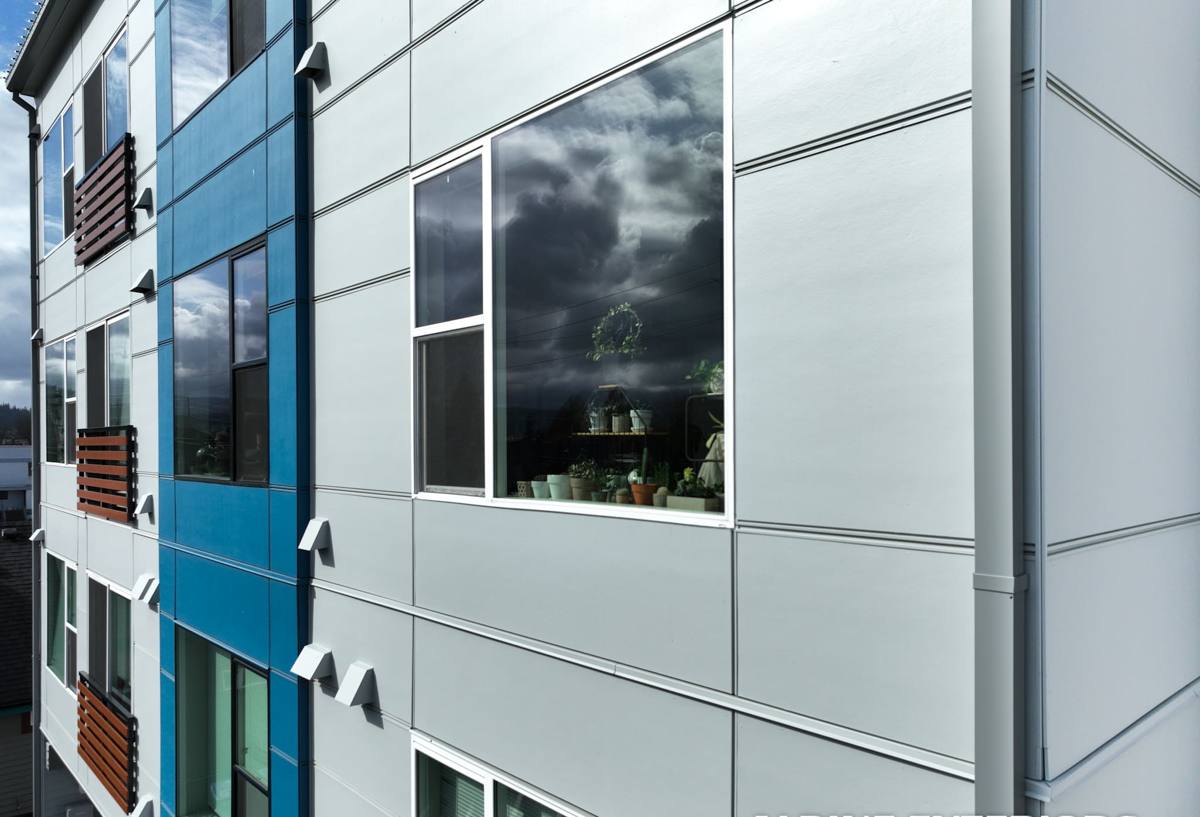
Warning Signs You Need Siding Repair
Most siding problems in Birch Bay start small and get expensive if they're ignored through a wet season or two. Here's what we tell homeowners to watch for:
- Soft or spongy spots when you press on a wall, especially near the bottom courses or around windows
- Persistent black or green staining that comes back within weeks of cleaning
- Cracked, bubbled, or peeling paint in one localized area rather than across the whole wall
- Gaps opening up at seams, corners, or where siding meets trim, window frames, or the foundation
- Visible warping or buckling panels, particularly on walls that face prevailing wind and rain
- Rust streaks below nail heads or metal flashing
- A musty smell in an adjacent interior room, which often means moisture has already gotten past the siding
Any one of these on its own might be minor. Several showing up on the same wall usually means water has been getting behind the siding for a while, and the visible damage is smaller than what's happening underneath.
What Correct Siding Repair Actually Involves
A repair that just replaces the damaged board and calls it done is a repair that's going to fail again. Done right, siding repair in a place like Birch Bay means dealing with the cause, not just the symptom.
Finding the actual entry point
Damaged siding is usually a downstream problem. The real issue is often a gap in flashing, a failed sealant joint, a penetration (vent, hose bib, light fixture) that was never properly flashed, or a grading/drainage issue sending water up against the wall. We open up the area enough to see what's actually happening before we decide what to fix.
Checking what's behind the siding
If water has been getting in, the housewrap or building paper and the sheathing underneath need to be checked. Replacing siding over damaged sheathing just buys you a shorter interval until the next repair call.
Matching materials and finish correctly
A patch that doesn't match the surrounding siding's profile, reveal, or finish stands out and often performs differently in weather. On factory-finished products, matching color and sheen matters for both appearance and how the patch weathers over time.
Resealing and re-flashing properly
Every penetration, seam, and transition gets sealed with the right product for that location — not a bead of caulk over everything, which is a common shortcut that fails within a season or two in a wet coastal climate.
Repair or Replace? Reading the Situation Honestly
Not every problem calls for a full re-side, and not every problem is fixable with a patch. Part of doing this job honestly is telling a homeowner which situation they're actually in.
| Situation | Repair usually makes sense | Replacement usually makes sense |
|---|---|---|
| Damage extent | Isolated to one or two areas | Recurring across multiple walls or seasons |
| Underlying sheathing | Sound, dry when opened up | Soft, stained, or previously patched more than once |
| Siding material | Still structurally intact, matchable | Original material discontinued, brittle, or failing broadly |
| Cause | A fixable defect (one bad flashing detail, one impact spot) | Systemic moisture behavior tied to the material itself |
| Age of siding | Well within expected service life | Near or past the material's realistic lifespan |
We've walked away from repair jobs and told homeowners the honest answer was a partial or full re-side, because patching material that's already failing broadly just delays a bigger cost. We've also talked people out of full replacement when a targeted repair and better flashing detail solved the actual problem.
Why the Material Behind the Repair Matters
A lot of the repair calls we get in Birch Bay trace back to the original siding material, not workmanship. Cedar siding looks great when it's new, but it needs consistent refinishing to resist the moisture this area sees, and once it starts absorbing water, rot spreads underneath the surface. LP SmartSide and similar engineered wood products hold up reasonably well when installation and caulking are perfect and stay perfect — but any breach in that seal lets moisture into the wood strand core, and repair at that point often means replacing more than the damaged section. Vinyl doesn't rot, but it isn't repaired so much as replaced piece by piece, it can warp with sun and heat cycling, and it doesn't stop moisture from reaching whatever's behind it.
This is a big part of why we only install James Hardie fiber cement siding. It's non-combustible, it doesn't absorb and swell the way wood-based products do, and it holds up to the salt air and constant damp along the Whatcom County coastline better than the alternatives we used to install. When we do a repair on Hardie siding, we're generally dealing with an installation detail — a flashing gap, a caulk failure — not the material itself breaking down. That's a fundamentally easier and more permanent repair.
If your home currently has cedar, LP, vinyl, or another product and the damage is more than isolated, we'll say so directly. Sometimes the honest recommendation is a full re-side with Hardie rather than continuing to chase repairs on a material that's reaching the end of what it can do in this climate.
Cost Factors for Siding Repair in Birch Bay
Repair costs vary a lot based on what we find once a wall is opened up, but a few factors consistently drive the number up or down:
| Factor | Effect on cost |
|---|---|
| Extent of hidden water damage | Largest single factor — sheathing replacement adds significantly more than surface repair |
| Accessibility (height, landscaping, decks) | Second-story or obstructed walls take longer to scaffold and work safely |
| Material matching | Matching an existing factory finish or discontinued profile can add cost or lead time |
| Number of separate damage locations | Multiple small repairs across a house cost more in mobilization than one larger contiguous area |
| Underlying cause complexity | A single bad flashing detail is cheaper to fix than a systemic drainage or grading issue |
We give a real number after we've actually looked at the wall, not a phone estimate. Guessing on a coastal repair job usually means guessing wrong in one direction or the other.
Our Process for Birch Bay Repair Calls
- On-site assessment — we look at the damage, open up enough to check what's happening underneath, and identify the actual cause
- Honest scope recommendation — repair, partial re-side, or full replacement, explained in plain terms with the reasoning behind it
- Written estimate — a clear breakdown of what's being done and why, before any work starts
- Repair or replacement work — matched materials where repairing, correct flashing and sealant details at every penetration and seam
- Final check — we walk the repair with you before calling it finished
Why It Matters That We Already Work in Birch Bay
A repair crew that regularly works Birch Bay and the surrounding Bellingham area already knows which wall orientations take the worst weather, how moss and moisture behave on shaded lots near the water, and what flashing details actually hold up here versus what looks fine on paper. That's not something you get from a contractor doing their first coastal Whatcom County job. It shows up in fewer callbacks and repairs that are still holding when the next wet season rolls through.
If you're seeing soft spots, staining, or gaps in your siding, we're happy to take a look and give you a straight answer — repair, partial fix, or something bigger — with no pressure either way. Reach out for a free estimate using the form below.