 Bellingham Siding
 Why Silver Beach Siding Wears Differently Than Siding Inland
Silver Beach sits where Whatcom County's marine climate and heavy tree cover overlap. Like the rest of Bellingham's low-lying, lake-adjacent neighborhoods, homes here catch salt-tinged marine air moving in off Bellingham Bay, layered on top of the shade and standing moisture that comes from being close to the water and surrounded by mature evergreens. That combination is harder on exterior siding than a straightforward rainy climate alone. It's not one problem — it's three, stacked on top of each other, and each one attacks siding in a different way.
Salt Air and Metal Fasteners
Salt-laced air accelerates corrosion on anything metal that's exposed or under-protected — nail heads, flashing edges, trim fasteners. On older siding, corroding fasteners are one of the most common root causes of a repair call that looks, at first glance, like a completely different problem: a stain, a soft spot, a panel that's started to bow.
Driving Rain, Not Just Rain
Whatcom County doesn't just get a lot of rain — a good share of it arrives sideways, pushed by wind off the water. Wind-driven rain finds the horizontal gaps, unsealed butt joints, and undersized flashing that ordinary vertical rain would never reach. It's the reason two houses on the same street, sided the same year, can age completely differently depending on how carefully the original install handled joints and flashing.
A Moss Season That Runs Half the Year
Shade from tree cover plus consistent moisture means moss and algae get a long runway here — often from fall through late spring. Moss holds water against the siding surface far longer than open air would, which is exactly the condition that lets rot start underneath a coating that still looks fine from the sidewalk.
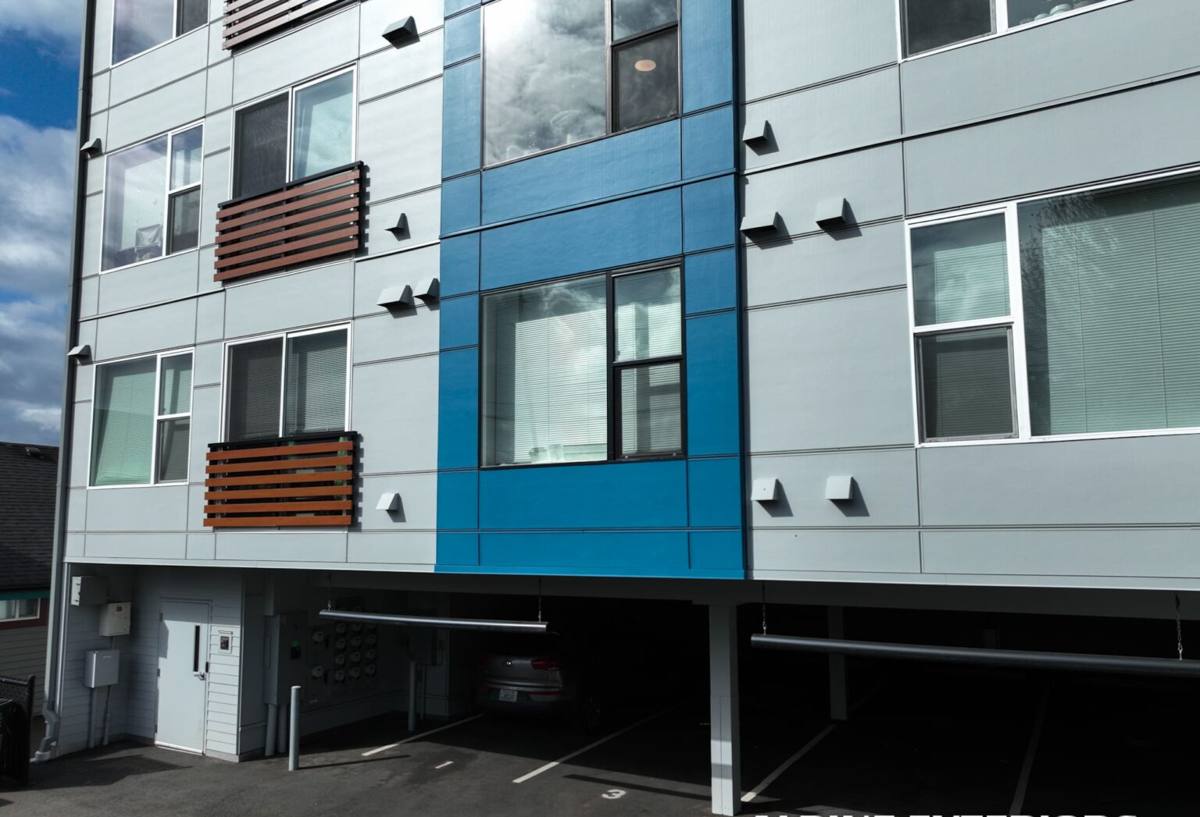
What "Correct" Siding Repair Actually Means
A repair that just patches the visible symptom tends to fail again within a season or two. A repair done right treats the visible damage as a clue, not the whole story.
Diagnosing the Real Problem First
Before any siding comes off, the real question is why that section failed where the rest of the wall didn't. Common root causes we look for on Silver Beach homes:
- Corroded or improperly set fasteners letting water track behind the panel
- Missing or undersized flashing at a window, door, or roofline transition
- A failed caulk joint that's been sealing water in rather than keeping it out
- Moss or algae buildup that's held moisture against the surface long-term
- Original installation gaps — panels installed too tight to the ground, trim, or each other
Skip this step and you're just replacing boards in the same conditions that damaged the last ones.
Matching Existing Siding vs. Replacing a Section
If your home is already sided in James Hardie fiber cement, a proper repair means matching the exact profile, exposure, and ColorPlus finish so the patched section doesn't read as a patch. If your home was sided in something else — vinyl, LP SmartSide, cedar, or a lesser fiber cement — we'll be honest with you about the limits of a spot repair on that material and what your options actually are, including whether a full re-side with Hardie makes more long-term sense than continuing to chase failures on an aging product.
Common Repair Scenarios We See in This Area
| What You Notice | Likely Cause | Typical Fix |
|---|---|---|
| Soft or spongy spot near the bottom of a wall | Splash-back moisture or ground contact rot behind the panel | Remove and inspect sheathing, correct clearance, replace affected boards |
| Dark streaking or green film on north-facing walls | Moss/algae growth held against the surface by shade and moisture | Soft wash, inspect underlying panel condition, reseal or replace as needed |
| Staining around a window or door corner | Missing or failed flashing letting wind-driven rain behind the trim | Correct flashing detail, replace damaged trim and panel sections |
| Rust streaks below nail heads | Corroded fasteners from prolonged salt-air exposure | Replace fasteners with corrosion-resistant hardware, patch panel |
| Bowed or buckled panel | Moisture trapped behind the board, often from a joint or caulk failure | Remove panel, address the moisture source, install matched replacement |
Our Process for a Silver Beach Repair Call
- On-site inspection. We look at the damaged area and the surrounding wall assembly, not just the spot you called about.
- Root-cause diagnosis. We identify what let water or moisture in — flashing, fasteners, caulking, or moss buildup — before recommending a fix.
- Straight talk on scope. If it's a genuine spot repair, we say so. If the damage points to a wider problem, we explain why and let you decide how to proceed — no pressure toward a bigger job than the house needs.
- Matched materials. For Hardie-sided homes, we match profile, exposure, and ColorPlus color as closely as the product line allows.
- Correct reinstallation. Proper fastener placement, clearances, and flashing details — the same standards we'd use on a full install, applied to the repair.
- Cleanup and walkthrough. We show you what we found and what we did about it.
Why We Only Repair and Install James Hardie Fiber Cement
We don't install or patch with vinyl, LP SmartSide, Cemplank, Allura, primed spruce, or cedar. That's a standard we hold across every job, not just repairs, and it matters even more in a climate like this one.
Vinyl expands and contracts with temperature swings and can crack or warp under prolonged UV and moisture cycling; patched sections rarely blend well and the material itself doesn't hold up as consistently in wind-driven rain conditions. LP SmartSide and other engineered wood products are wood-based, which means any breach in the factory coating gives moisture a path into a material that's naturally more moisture-sensitive — a real liability in a neighborhood with a moss season this long. Primed spruce and cedar require ongoing maintenance — repainting, resealing, moss treatment — that most homeowners underestimate until they're already behind on it.
James Hardie fiber cement is non-combustible, engineered specifically for climates like the Pacific Northwest's through its HZ5 product line, and finished at the factory with ColorPlus technology, which resists fading and chipping far better than field-applied paint. It doesn't rot, and it isn't a food source for moss the way wood-based products can be. That's why it's what we put on homes, and why we recommend it even when a homeowner is only looking for a repair, not a full re-side.
What to Expect: Cost and Timeline
Every repair is different, but a few factors consistently drive the scope and cost of a job:
| Factor | Why It Matters |
|---|---|
| Extent of hidden moisture damage | Sheathing or framing damage behind the siding adds time and cost beyond the visible panel |
| Age and availability of matching siding | Older ColorPlus colors and discontinued profiles can be harder to match exactly |
| Number and location of affected areas | Ground-level spot repairs are simpler than damage near rooflines or second-story walls |
| Root cause complexity | A simple caulk failure is a quick fix; a flashing redesign at a window takes more time |
| Access and weather window | Tree cover and wet weather can affect scheduling and drying time between steps |
Before your appointment, it helps to have a few things ready:
- Know roughly when the damage was first noticed or when it seemed to get worse
- Note whether the area has been repaired or caulked before
- If you have them, keep any paperwork from your original siding installation on hand
- Point out any interior signs — stains, soft drywall, musty smell — near the exterior area in question
Why Hiring a Crew That Already Works Silver Beach Matters
Siding repair in this neighborhood isn't the same trade as siding repair in a dry inland climate. A crew that already works Bellingham's lake-adjacent, tree-covered neighborhoods knows to check for moss-related moisture retention before assuming a simpler cause, knows what wind-driven rain does to a poorly flashed joint, and knows how Whatcom County's weather patterns affect scheduling and drying times between repair steps. That local pattern recognition is what separates a repair that solves the actual problem from one that just replaces the board and waits for the same issue to come back.
Keeping Repaired Siding From Becoming a Repeat Call
Once a repair is done right, a little seasonal attention keeps it that way:
- Keep gutters clear so overflow doesn't run down the wall face
- Trim back branches and vegetation that keep siding shaded and damp longer than it needs to be
- Rinse visible moss or algae buildup before it has time to hold moisture against the surface
- Walk the exterior each fall and spring, checking caulk joints and trim for early signs of failure
- Address small issues — a lifted piece of trim, a cracked caulk bead — before the next wet season, not after
If you're seeing a stain, a soft spot, or moss buildup on your siding and want a straight answer on what's actually going on, we're happy to take a look. The estimate is free, there's no pressure to turn it into a bigger job than it needs to be, and you'll get a plain-English explanation of what we find and what it would take to fix it right.