 Bellingham Siding
 Building a Deck That Actually Holds Up in Sunnyland
Sunnyland is one of Bellingham's older, established neighborhoods, and a lot of its homes are decades old — which means a lot of the decks attached to them are, too. When we get called out to look at a deck in this part of town, the story is usually the same: it looked fine from the yard, but the ledger board is soft, the joists are showing rot at the ends, and the fasteners have bled rust down the face boards. None of that is bad luck. It's what Bellingham's climate does to a deck that wasn't built, or wasn't maintained, with this area's weather in mind.
Whatcom County sits right up against the Salish Sea, and that means salt-laden air, long stretches of driving rain off the water, and a moss season that can run eight or nine months out of the year in shaded yards. A deck built the same way you'd build one in a drier inland climate will not last as long here. This page covers what we actually do differently for decks in Sunnyland and the surrounding Bellingham neighborhoods, and what you should expect from any contractor building or replacing one.
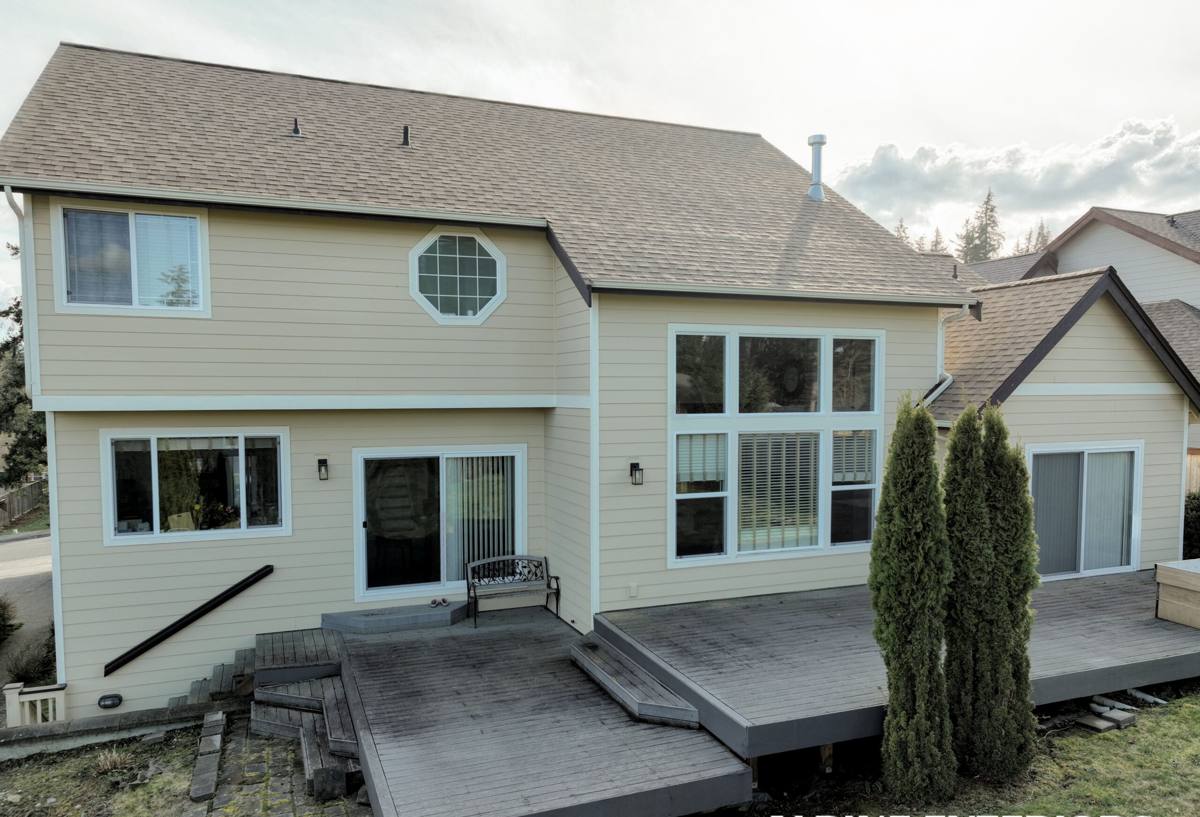
What Bellingham's Climate Does to an Improperly Built Deck
Salt Air and Fasteners
Even a few miles inland from Bellingham Bay, the air here carries enough salt to accelerate corrosion on anything less than a properly rated fastener. Standard electro-galvanized screws and nails will start showing surface rust within a couple of seasons, and once a fastener starts corroding, it loses holding strength right where the deck needs it most — at the connections.
Moss, Algae, and Slip Hazards
Sunnyland has enough mature tree cover and shaded lots that moss and algae growth on deck surfaces is a normal, ongoing maintenance item rather than an occasional nuisance. On wood decking, moss holds moisture against the board and speeds up rot from the top down. On any decking material, a mossy surface gets slick fast, and that's a real fall risk on stairs and landings.
Driving Rain and Ledger Rot
The ledger board — where the deck attaches to the house — is the single most important connection on the structure, and it's also the point most exposed to wind-driven rain running down the siding. Without correct flashing, water tracks behind the ledger and rots both the ledger and the rim joist it's fastened to, often invisibly until the deck starts to feel spongy or pull away from the house.
Decking Material Options for This Climate
There's no single "right" decking material for every Sunnyland project — it depends on budget, how much sun the deck gets, and how much upkeep you actually want to do. Here's how the common options hold up against Bellingham's rain and moss:
| Material | Moisture/Moss Behavior | Maintenance | Typical Lifespan Here |
|---|---|---|---|
| Pressure-treated lumber | Absorbs water, needs sealing to resist moss and checking | Annual cleaning, re-sealing every 2-3 years | 10-15 years |
| Cedar | Naturally rot-resistant but still needs finish to stay moss-free | Cleaning and re-staining every 1-2 years for appearance | 15-20 years |
| Capped composite | Non-absorbent surface sheds moisture, still needs occasional cleaning where moss can gain a foothold in debris buildup | Periodic washing, no sealing or staining | 25-30 years |
| PVC decking | Fully non-absorbent, best resistance to moss and algae staining | Occasional washing | 25-30+ years |
Cost follows this same order, roughly — pressure-treated is the least expensive up front, capped composite and PVC cost more per square foot but avoid the recurring sealing and staining that wood needs to survive a wet climate. We'll walk through the real trade-offs for your specific deck rather than push one material across the board.
What a Correctly Built Deck Requires Here
Footings Sized for Our Soil and Frost Depth
Footings need to be sized and set to the depth required by local code, and in Whatcom County that also means accounting for our soil conditions, which vary block to block in Sunnyland's older lots. Undersized or shallow footings are a common shortcut on older decks and one of the first things we check when a deck feels like it's shifting.
Ledger Attachment and Flashing Done Right
A correctly flashed ledger uses proper step flashing integrated with the house's water-resistive barrier, not just a bead of caulk, plus lag bolts or through-bolts rated for the load — never just deck screws or nails. This is the detail that determines whether your deck is still solid in fifteen years or soft in five.
Fasteners and Hardware Rated for Coastal Air
We use stainless steel or heavy hot-dip galvanized fasteners and structural hardware throughout — hangers, ties, and connectors included — specifically because standard hardware corrodes faster this close to the water. It costs a bit more up front and it's the difference between hardware that's still solid at year twenty and hardware that's staining the boards by year three.
Drainage and Airflow Underneath
Framing and ledger flashing both need to shed water away from the structure, and low decks need enough clearance and grading underneath for airflow — without it, moisture sits under the deck and speeds up rot from below, which is often the last place anyone thinks to check.
Our Deck Building Process
- On-site assessment — we look at sun exposure, drainage, existing structure if it's a replacement, and how the deck ties into the house.
- Design and material selection — sizing, layout, railing style, and decking material based on your budget and how much maintenance you want to take on.
- Permit and code review — we handle the permit application and make sure the design meets current requirements before any work starts.
- Demo and footings — removal of the old structure if applicable, then footings set to proper depth and inspected.
- Framing and ledger attachment — structural framing with correctly flashed ledger connections and rated hardware throughout.
- Decking, railing, and finish work — surface installation, railing, stairs, and any finish or sealant the material requires.
- Final walkthrough — we go over the finished deck with you, including what maintenance it actually needs going forward.
Permits and Code in Bellingham and Whatcom County
Most new decks and many deck replacements require a building permit, whether the property is inside Bellingham city limits or in unincorporated Whatcom County, and the requirements differ slightly depending on jurisdiction. Skipping the permit step is a real risk — beyond the legal exposure, an unpermitted deck can become a problem when you go to sell the house or file an insurance claim. We handle the permit process as part of the job so you don't have to sort out which jurisdiction's rules apply.
Maintenance That Actually Matters Here
Whatever material you choose, a few habits make the biggest difference in how long a Bellingham deck lasts:
- Sweep leaves and debris off the surface regularly, especially in fall — trapped organic matter is what feeds moss growth
- Wash the deck surface at least once a year with a deck cleaner appropriate to the material to remove algae and moss before it takes hold
- Check the ledger board area and any spots where the deck meets the house siding for signs of water staining or soft wood
- Re-seal or re-stain wood decking on the schedule the finish product calls for — don't wait until it's visibly gray and weathered
- Keep gutters and downspouts near the deck clear so runoff isn't being directed onto or under the structure
- Have fasteners and hardware inspected every few years, particularly on older decks built before corrosion-resistant hardware was standard practice
Why Hire a Crew That Already Works in Sunnyland
A deck built to a generic spec sheet is not the same as a deck built for this specific climate. We already know which details matter in Sunnyland and the rest of Bellingham — the fastener grade, the flashing detail at the ledger, the footing depth for local soil, the material trade-offs given how much moss pressure a given yard actually gets. That's not something you can shortcut with a lower bid; it shows up five or ten years later as rot, corrosion, or a deck that needs premature repair. Hiring a crew that already builds decks in this exact climate means those decisions get made correctly the first time.
If you're planning a new deck or need to replace one that's showing its age, we're happy to take a look and give you a straightforward, no-pressure estimate. There's a form below — reach out and we'll get a time on the calendar to come see the space.