 Bellingham Siding
 Windows That Actually Hold Up in Sunnyland
Sunnyland sits close enough to Bellingham Bay that homes here take a different kind of weather beating than neighborhoods further inland. Salt-laden air off the water accelerates corrosion on hardware and fasteners, wind-driven rain finds its way into any gap in flashing or sealant, and the long gray stretch of fall through spring keeps moss and algae working on anything that stays damp. Windows are one of the first places all three of those show up — pitted latches, soft sills, fogged glass, and frames that swell or stick. An energy-efficient window replacement done right in Sunnyland has to solve for comfort and heating bills, but it also has to solve for the coastal Whatcom County climate specifically, not just meet a generic efficiency spec.
We've replaced windows on plenty of homes in this part of Bellingham, from older bungalows near the water to newer infill construction. The pattern is consistent: the windows that fail early aren't usually the wrong style or the wrong color, they're the wrong material or installation approach for this exact microclimate.
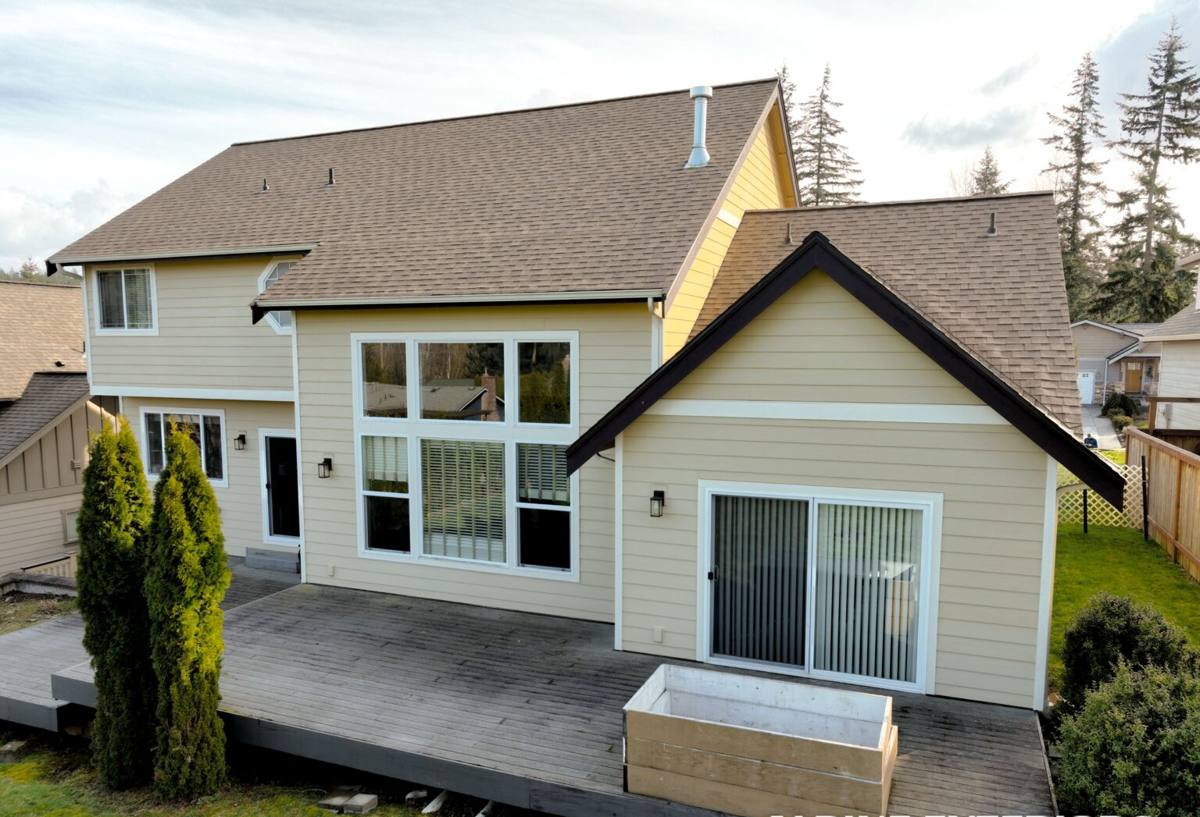
What Sunnyland's Climate Actually Does to a Window
Salt Air and Hardware Corrosion
Proximity to the bay means airborne salt settles on exterior surfaces year-round, not just during storms. Cheap aluminum hardware, uncoated fasteners, and low-grade weatherstripping clips corrode faster here than they would ten or fifteen miles inland. Once hardware corrodes, locks bind, cranks stick, and the compression seal that keeps a window airtight stops closing evenly — which quietly kills the efficiency rating you paid for.
Driving Rain and Wind-Loaded Water
Storms coming off the Strait of Georgia and the Sound don't just drop rain straight down — wind pushes it sideways and up under trim, sills, and poorly lapped flashing. A window that would stay dry in a calmer climate can leak here if the flashing detail, sill pan, or sealant joint isn't built for wind-driven water. Most of the water damage we find around old window openings didn't come through the glass or the frame itself — it came through a gap at the perimeter that was never properly flashed.
Moss, Algae, and the Long Wet Season
Whatcom County's wet season runs long, and anything shaded or slow to dry — north-facing sills, window wells under overhangs, low horizontal trim — becomes a place for moss and algae to establish. On wood-framed or wood-clad windows, sustained moisture plus organic growth is how rot starts. It's slow and often invisible until a sill feels soft underfoot or paint starts bubbling.
What "Correct" Actually Means for This Job
A proper energy-efficient window installation in Sunnyland isn't just swapping glass units. It's a system: frame material, glazing package, flashing detail, sealant, and hardware all working together against this specific climate.
- Frame material suited to coastal moisture and salt exposure, not just cost
- Glazing package matched to our marine climate — low-E coatings and gas fill tuned for cool, wet conditions rather than desert heat
- Sill pan flashing that sheds water out and away from the framing, every time, on every window
- Corrosion-resistant hardware and fasteners rated for coastal or marine-grade exposure
- Proper sealant joints at the perimeter, sized and placed to handle wind-driven rain, not just a bead of caulk around the trim
- Correct shimming and squaring so the sash compresses evenly against the weatherstripping on all four sides
Skip any one of those and you can end up with a window that has a great efficiency rating on paper but still leaks air, fogs between panes within a few years, or lets water into the wall cavity.
Frame Material: What We Recommend and Why
We get asked often whether vinyl, fiberglass, or wood-clad is the right call for a Sunnyland home. Our honest answer depends on the house, but here's how they generally compare in this climate:
| Frame Type | Coastal/Salt Air Behavior | Maintenance | Where It Fits Best |
|---|---|---|---|
| Vinyl | Doesn't corrode; performs well against salt air, but quality varies a lot by manufacturer | Low — no painting, occasional cleaning | Most homes prioritizing efficiency and budget |
| Fiberglass | Excellent dimensional stability, very good moisture and corrosion resistance | Low | Homes wanting a longer-term investment and slimmer sightlines |
| Wood-clad | Good if the exterior cladding is intact, but any breach exposes wood to our wet season | Higher — cladding and seals need periodic inspection | Homes prioritizing a specific interior wood look |
| Bare aluminum | Poor — corrodes visibly in salt air over time, thermally weak | Moderate to high | We generally don't recommend it for Sunnyland's exposure |
We don't push one material on every job. What we won't do is install bare aluminum-framed windows this close to the water, or wood-clad units without being upfront that the cladding integrity is what stands between the frame and our wet season — that's a maintenance commitment, not a flaw in the product itself.
Glazing: Getting the Efficiency Numbers That Matter Here
Efficiency ratings printed on a window label were tested somewhere, but not necessarily under conditions like ours. In a marine climate like Bellingham's, the numbers that matter most are:
- U-factor — how well the window resists heat loss; lower is better for our cool, damp winters
- Solar Heat Gain Coefficient (SHGC) — how much solar heat passes through; moderate values usually make sense here since we don't get the intense sun load of drier climates
- Air leakage rating — arguably the most overlooked number, and the one most affected by installation quality rather than just the product itself
We'll walk through what these mean for your specific exposure — a west-facing window catching afternoon storms off the water needs a different glazing approach than a sheltered north-facing window under an eave.
Our Installation Process
1. Assessment
We look at each window opening individually — existing sill condition, evidence of past water intrusion, orientation, and exposure to wind-driven rain. Not every window on the same house needs the identical solution.
2. Removal and Opening Inspection
Once the old window is out, we inspect the framing and sill for hidden rot or moisture damage before anything new goes in. This is often where we find the real story behind a homeowner's complaint about drafts or fogging.
3. Flashing and Sill Pan
We install sill pan flashing and integrate it properly with the building's water-resistive barrier so water is directed out, not trapped behind the new window.
4. Set, Shim, and Square
The new window is shimmed and squared so it operates smoothly and compresses evenly against the weatherstripping — critical for both efficiency and long-term seal performance.
5. Seal and Finish
Perimeter sealant is applied to handle wind-driven rain, and trim is finished to shed water rather than trap it against the frame.
6. Final Check
We confirm smooth operation, even reveals, and a tight seal before calling the job done.
Signs Your Sunnyland Home Needs This Now
- Visible fog or moisture between panes of double-glazed units
- Hardware that's corroded, stiff, or won't latch tight
- Cold drafts near the window even when it's fully closed
- Soft or spongy feeling in the sill or lower frame
- Moss or dark staining building up on horizontal trim or sills
- Condensation forming on the interior glass regularly through winter
- Noticeably higher heating bills compared to similarly sized homes nearby
Why Hiring a Crew That Knows Sunnyland Matters
A window installer who mostly works drier inland climates can do a technically fine install and still miss the details that matter here — the sill pan flashing sized for wind-driven rain, the hardware spec that resists salt air, the sealant joint that accounts for our wet season rather than a typical dry-climate install. We work this part of Whatcom County regularly, which means we're not guessing at how a particular exposure — bay-facing, shaded, low-lying — is going to behave over the next Bellingham winter. That local pattern recognition is worth more than a lower bid from a crew unfamiliar with the coast.
Cost Factors Worth Understanding
| Factor | Why It Moves the Price |
|---|---|
| Frame material | Vinyl is typically the most budget-friendly; fiberglass and wood-clad cost more upfront |
| Number of window openings | Per-window cost usually drops slightly as the total job size increases |
| Existing sill/frame condition | Rot or water damage found during removal adds repair scope before the new window goes in |
| Glazing package | Higher-performance low-E coatings and gas fills cost more but pay back in comfort and energy use |
| Access and window size | Upper-story, oversized, or hard-to-access windows take more labor |
We won't quote a job without seeing the actual openings — sight-unseen estimates tend to miss the sill damage or flashing issues that change the real scope.
Get a Straight Answer for Your Sunnyland Home
If your windows are fogging, drafty, sticking, or just old enough that you're wondering whether it's time, we're happy to take a look and give you a straightforward read on what you actually need — no upsell, no pressure. Reach out for a free estimate using the form below.