 Bellingham Siding
 Blaine's Siding Problem Is Different From Most of the County
Blaine sits at the top corner of Whatcom County, right on Semiahmoo Bay and a few miles from the Strait of Georgia. That location changes what siding has to survive. Homes here deal with salt-laden air blowing in off the water, wind-driven rain that hits walls sideways instead of falling straight down, and a wet season that runs long enough to keep north- and west-facing walls damp for weeks at a stretch. Add the shade from mature evergreens on a lot of Blaine properties and you get ideal conditions for moss and algae to take hold on any siding that gives them a foothold.
None of that is unusual for the Pacific Northwest coast. But it's more concentrated in Blaine than in, say, inland Bellingham or the Fraser Valley side of the county. A siding material that performs fine forty minutes inland can struggle here — salt accelerates corrosion of fasteners and trim, driving rain finds gaps that would stay dry elsewhere, and moss doesn't need much encouragement once it's established.
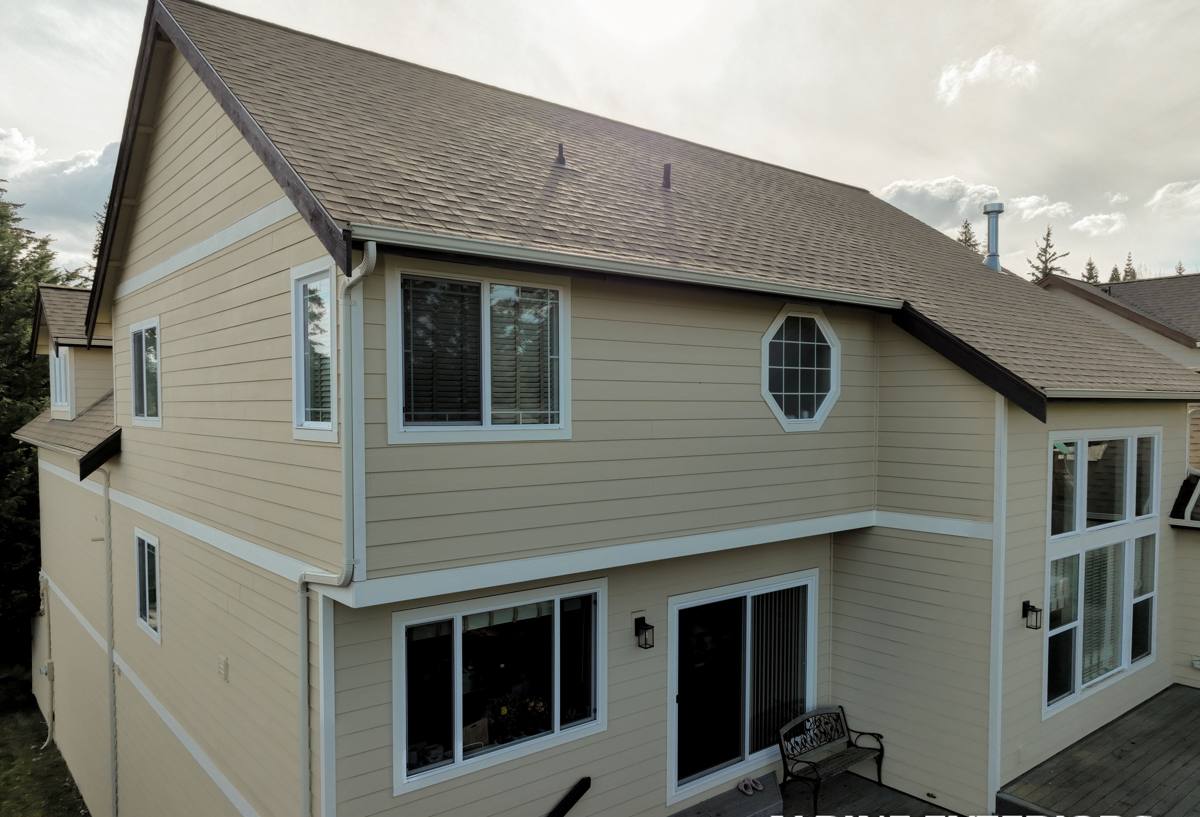
Why Fiber Cement Holds Up Where Other Materials Struggle
Fiber cement siding is made from cement, sand, and cellulose fiber, pressed and cured into planks that don't rot, don't feed insects, and don't warp the way wood-based products can when they take on moisture. That matters directly in a place like Blaine:
- Salt exposure: Fiber cement itself doesn't corrode. The parts that can — nails, screws, trim flashing — need to be the right corrosion-resistant grade, which is a detail worth confirming with any contractor bidding a coastal job.
- Driving rain: Fiber cement is dimensionally stable, so it doesn't swell and shrink the way wood or wood-composite products can when repeatedly soaked and dried. That stability keeps caulk joints and butt seams tighter over time.
- Moss and algae: Fiber cement won't feed organic growth the way wood siding can, and a factory-applied finish gives moss and algae a harder surface to grip. It still needs periodic cleaning in a shaded, damp yard — no siding is maintenance-free here — but it isn't decaying underneath the growth the way untreated wood can.
This is also why we install James Hardie fiber cement exclusively and don't offer vinyl, LP SmartSide, primed spruce, or cedar. Vinyl can warp and crack in temperature swings and doesn't hold paint if you ever want to change color. Wood-based products, including engineered wood siding, are more vulnerable to moisture intrusion at cut edges and fastener holes — a real risk on a site that stays wet as long as Blaine does. We'd rather put one product on a house and get it right than offer four products and hope the cheaper ones hold up.
What a Correct Fiber Cement Install Actually Involves
Fiber cement siding fails early almost exclusively because of installation mistakes, not because the material itself gave out. In a wet coastal climate, the following details separate a job that lasts decades from one that needs rework in five years:
Moisture management behind the siding
A weather-resistive barrier (housewrap or building paper) goes on the sheathing first, lapped correctly at every seam so water runs down and out, never in. On a lot of Blaine homes we recommend a rainscreen gap — a thin drainage space between the barrier and the siding — so any water that does get behind the planks has somewhere to drain and dry instead of sitting against the wall.
Flashing at every penetration
Windows, doors, hose bibs, light fixtures, vents — every opening in the wall is a place water can get behind the siding if it isn't flashed correctly. This is where driving rain finds the weak points, and it's the single most common source of the moisture problems we get called out to fix on homes that weren't originally sided by us.
Fastening and clearances
James Hardie specifies fastener type, spacing, and how far each plank should sit above grade, decks, and roof lines. Those clearances matter more in a wet climate because splash-back and standing moisture at the bottom of a wall are where rot and staining start first, even on a material that resists it as well as fiber cement does.
Caulking and paint touch-up
ColorPlus factory-finished siding needs specific touch-up products at cut edges and fastener heads to keep the factory warranty intact — generic paint or the wrong caulk formulation can void coverage and won't perform the same way over time.
How We Approach a Blaine Job
The process is the same discipline on every house, but a few steps get extra attention on a site this close to the water:
- Walk and assess: We look at wall orientation relative to prevailing wind and rain, existing moisture damage, tree cover and shade patterns that affect drying time, and the condition of the sheathing underneath the current siding.
- Tear-off and sheathing check: Old siding comes off and we inspect what's underneath before anything new goes up. Rot or soft sheathing gets repaired now, not covered over.
- Weather barrier and drainage plane: Housewrap, flashing, and — where the wall assembly calls for it — a rainscreen gap go in before a single piece of siding is hung.
- Install to Hardie spec: Correct fasteners, spacing, clearances, and joint treatment, following the manufacturer's installation instructions for the specific product line and climate zone.
- Trim, caulk, and touch-up: Manufacturer-approved products at every seam and fastener head.
- Final walk-through: We go over the finished job with the homeowner and cover basic care — what to expect from the finish, when to clean it, what not to use on it.
James Hardie Product Lines for This Climate
Hardie makes climate-engineered product lines, and for a coastal Whatcom County home we're typically looking at their HZ5 line, engineered for wetter, colder climates like the Pacific Northwest. Panel, plank, and shingle profiles are all available in ColorPlus factory finishes, which hold up to UV and moisture better over time than field-applied paint and come with their own finish warranty separate from the substrate warranty.
| Factor | What It Means for a Blaine Home |
|---|---|
| Climate engineering | HZ5 formulation is built for Pacific Northwest moisture and temperature cycling, not a generic national spec. |
| Factory finish (ColorPlus) | Baked-on finish resists fading and moisture intrusion better than job-site paint, with its own warranty coverage. |
| Fire rating | Non-combustible material — a genuine benefit given wildfire smoke seasons are now a regional reality even here. |
| Warranty | Manufacturer warranty is transferable to a future buyer, which matters in a market where homes do change hands. |
| Maintenance | Periodic rinsing to keep moss and salt film from building up; no repainting cycle like wood siding needs. |
Living With Fiber Cement in a Salt-Air, Moss-Prone Yard
Fiber cement isn't zero-maintenance, and we won't pretend it is. A shaded, damp Blaine lot will still grow moss on any hard surface eventually, siding included. What changes is the stakes: a periodic gentle rinse (never a high-pressure wash directly at seams or under the bottom edge of planks) keeps the finish clean without the material underneath breaking down the way wood can. Salt film from ocean air is worth rinsing off the same way you'd rinse a vehicle that sits outside near the water — it's cosmetic maintenance, not structural repair.
Signs a Blaine Home May Need Siding Attention
- Soft or spongy spots when you press on the siding, especially near the bottom of walls or below windows
- Persistent moss or dark staining that comes back quickly after cleaning
- Paint that's peeling or bubbling, which often points to moisture trapped behind the surface
- Visible gaps, warping, or cupping in existing wood or composite siding
- Rust streaks around fasteners or trim, common where salt air accelerates corrosion
- Rooms that feel damp or musty along exterior walls after heavy rain
Why Hiring a Crew That Already Works Blaine Matters
Siding installation isn't just about following a manufacturer's manual — it's about knowing how a specific wall assembly behaves in a specific location. A crew that regularly works Blaine and the surrounding Whatcom County coastline already knows which walls take the worst of the driving rain, where rainscreen detailing earns its keep, and which fastener and flashing choices actually hold up against salt air instead of just meeting a generic spec sheet. That local pattern recognition is the difference between a warranty-backed install and a house that looks right for a few years before problems show up where they were never checked for in the first place.
If you're weighing a siding replacement on a Blaine home, we're happy to take a look, walk the exterior with you, and give you a straightforward assessment — no pressure, no upsell. Request a free estimate using the form below and we'll set up a time to come take a look.