 Bellingham Siding
 Deck Repair in Sehome: What Actually Wears Decks Out Here
Sehome sits close enough to the water and up against enough tree cover that decks in this part of Bellingham take a specific kind of beating. It's not one big storm that wrecks a deck — it's the slow grind of a wet season that runs long, salt-tinged air off the bay, and moss that never fully lets go even when the sun finally shows up in July. If you own a home in Sehome with a deck more than eight or ten years old, there's a good chance some part of it is quietly failing right now, even if the surface still looks fine.
We work decks across Bellingham and Whatcom County, and Sehome jobs follow a pattern we see over and over: ledger boards and joists that stay damp longer than they should because of tree canopy or a north-facing exposure, fasteners that have corroded faster than the wood around them, and surface boards that look weathered but are structurally sound underneath — right next to a support post that isn't. Knowing which is which without tearing the whole thing apart is the actual skill in deck repair.
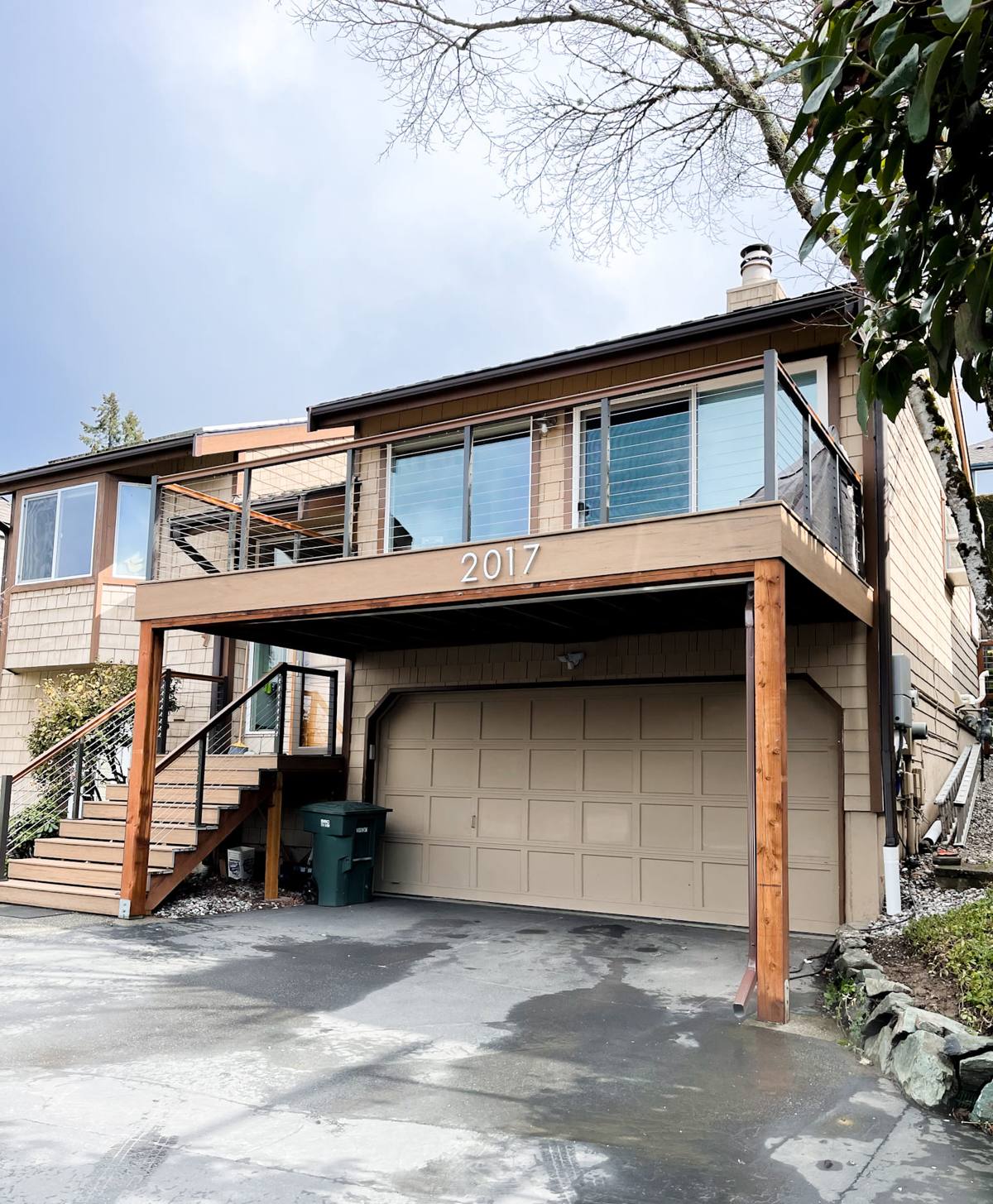
Why the Bellingham Climate Is Hard on Decks Specifically
A deck is different from siding or a roof in one important way: it's horizontal. Water doesn't run off it as fast, it doesn't dry as fast, and every joint, fastener hole, and board gap is an entry point sitting flat and waiting. In a climate with our rain totals and our long stretch of overcast, damp months, that adds up.
- Driving rain gets pushed under rail caps, into end-grain cuts, and behind ledger flashing that's aged out or was never installed correctly.
- Salt air off the water accelerates corrosion on fasteners, brackets, and any exposed metal hardware — often faster than the wood itself deteriorates.
- Moss and algae hold moisture against the deck surface for weeks at a time, and on top of that, moss on stair treads and walking surfaces gets genuinely slick — that's a fall risk, not just a cosmetic issue.
- Freeze-thaw cycling, even our relatively mild version of it, opens up cracks in wood fibers and fastener holes that then take on more water next time it rains.
None of this means a deck in Sehome can't last decades. It means the details — flashing, fastener choice, ventilation underneath, and drainage — matter more here than they would in a drier climate, and cutting corners on any of them shows up as a problem within a few years, not a few decades.
The Parts That Fail First, and Why
In our experience, deck failure in this area follows a fairly predictable order:
- Ledger board connection. Where the deck attaches to the house is the single most common failure point. If flashing is missing, undersized, or was caulked instead of properly lapped, water tracks behind it and rots the ledger, the rim joist, and sometimes framing inside the wall — invisible from outside until it's advanced.
- Fasteners and hardware. Older decks built with standard (non-coated) screws or nails, especially against pressure-treated lumber, corrode from the inside out. You'll see rust streaking around fastener heads before you see wood failure — that streaking is worth paying attention to.
- Joists and beams underneath. Hidden from view, these are where rot does the most damage before anyone notices, particularly at joist hangers where debris and moisture collect.
- Deck boards and stair treads. The most visible and least structurally critical — but also where moss buildup creates a real slip hazard well before the boards themselves are unsafe.
- Railings and posts. Code-critical for safety, and a common spot for a post base sitting in standing water to rot from the bottom up while the visible rail looks fine.
What a Correct Deck Repair Actually Involves
A lot of "deck repair" in this region is really just board replacement — swap the obviously bad boards, sand and reseal, call it done. Sometimes that's genuinely all a deck needs. But if the ledger flashing, joists, or fastener corrosion aren't checked, you're painting over a problem that's going to resurface, usually at the worst possible time.
Here's what we actually check and address on a Sehome repair call:
| Area | What We Check | Common Fix |
|---|---|---|
| Ledger board / house connection | Flashing condition, fastener spacing, signs of moisture behind siding | Re-flash properly, re-fasten to code, address any wall sheathing damage |
| Framing (joists, beams, posts) | Soft spots, discoloration, joist hanger corrosion, post base moisture | Sister or replace damaged members, upgrade hardware, correct drainage at post bases |
| Decking surface | Cupping, splitting, fastener pop, moss/algae buildup | Replace failed boards, clean and treat remaining boards, re-fasten with proper hardware |
| Railings and stairs | Post stability, baluster spacing, tread wear and slip risk | Rebuild to current code where needed, re-secure loose components |
| Drainage and ventilation | Grading under the deck, gaps for airflow, gutter/downspout interaction | Improve underdeck drainage, clear blocked airflow paths |
We don't recommend rebuilding what doesn't need it. Plenty of Sehome decks need targeted repair — a ledger reflash, a handful of joists, new stair treads — not a full teardown. But we also won't resurface a deck and leave a known structural issue underneath, because that's not a repair, it's a delay.
Repair vs. Replace: How We Make That Call
This is the question every homeowner actually wants answered, and the honest answer is "it depends on what we find once we're under the boards." A few general guidelines:
- If the framing (joists, beams, ledger) is sound and the damage is limited to surface boards, railings, or fasteners, repair is almost always the right call and the more cost-effective one.
- If rot has spread through multiple structural members, or the ledger connection has been compromised for a long time, a partial or full rebuild of the frame may be the more honest recommendation — patching around widespread structural rot just moves the problem a few years down the road.
- Age matters less than exposure. A 12-year-old deck under heavy tree cover with poor drainage can be in worse shape than a 20-year-old deck that's been well-maintained and gets more sun.
We'll tell you which category your deck falls into before any work starts, with a clear explanation of what we found and why — not a sales pitch toward the bigger job.
Our Process for Sehome Deck Repairs
1. Inspection
We check the ledger connection, probe framing members for soft spots, inspect fasteners and hardware for corrosion, and assess the decking surface and railings. We look underneath, not just at the walking surface.
2. Written Scope and Estimate
You get a clear breakdown of what needs repair, what's optional (cosmetic vs. structural), and a straightforward cost range — no vague allowances that balloon once work starts.
3. The Repair
We replace or sister damaged framing, correct flashing and drainage issues at the source, and use fasteners and hardware rated for our moisture and salt-air conditions — not whatever was cheapest to keep the original build on budget.
4. Final Check
Before we consider the job done, we walk the deck with you, point out what we did and why, and flag anything worth keeping an eye on going forward (a drainage spot, a shaded area prone to moss, etc.).
Materials and Hardware: What We Use and Why
For structural repairs, we use hardware rated for exterior and coastal-adjacent exposure — corrosion-resistant fasteners and connectors matched to the wood treatment being used, since mismatched metals accelerate corrosion in a marine-influenced climate like ours. For decking surfaces, the right choice depends on your budget, maintenance appetite, and how much sun the deck gets:
| Decking Type | Maintenance | Moisture Performance in This Climate |
|---|---|---|
| Pressure-treated lumber | Periodic sealing/staining needed | Good if properly sealed and maintained; vulnerable if maintenance lapses |
| Cedar | Regular sealing to maintain appearance and moisture resistance | Naturally moisture-resistant but still needs upkeep in shaded, damp spots |
| Composite decking | Low — occasional cleaning | Very good moisture resistance; still needs airflow underneath to manage mold/mildew on the surface |
We'll walk through the trade-offs for your specific deck rather than pushing one product — the right call depends on how much shade the deck gets, how it drains, and how much upkeep you actually want to do.
A Practical Checklist: Signs Your Sehome Deck Needs Attention
- Boards that feel spongy, springy, or noticeably different underfoot in one area
- Rust streaking around screw or nail heads
- Gaps, cracking, or separation where the deck meets the house
- Persistent moss or algae that comes back within weeks of cleaning
- Railings or posts that wobble or flex under light pressure
- Visible daylight or moisture staining on framing when you look underneath the deck
- Stair treads that feel slick even when dry
If more than one or two of these apply, it's worth having someone look underneath before the next wet season, not after.
Why a Local Crew Matters for This Job
Deck repair is one of those jobs where local knowledge changes the outcome, not just the pitch. A crew that works Sehome and the surrounding Bellingham neighborhoods regularly knows which lots tend to hold moisture longer, which orientations get hit hardest by driving rain, and what typically shows up under decks built during specific eras of local construction. That's the difference between a repair that addresses what's actually happening to your deck and a generic fix that assumes a drier, more uniform climate than Whatcom County actually has.
We're also familiar with permitting and code requirements that apply to deck and railing work in Bellingham, which matters if your repair touches structural framing or railing height/spacing — those aren't optional details, and getting them wrong can mean redoing work later.
Get a Straight Answer on Your Deck
If your Sehome deck has some soft spots, a section of moss that won't quit, or you just haven't had anyone look underneath it in a while, we're happy to take a look and tell you plainly what we find — repair, partial rebuild, or "it's actually fine, here's what to watch." Fill out the form below for a free, no-pressure estimate.