 Bellingham Siding
 Siding in Edgemoor: Bluff-Top Wind, Salt Air, and Deep Shade
Edgemoor sits on the bluffs and wooded shoreline south of downtown Bellingham, and that setting creates a specific mix of demands on exterior siding that's different from an inland Whatcom County lot. Homes here get direct exposure to wind and salt-laden air coming off Bellingham Bay, and at the same time many of those same properties sit under mature stands of fir, cedar, and maple that keep whole walls shaded and damp for long stretches of the year. That combination — open water exposure on one side of the house and deep tree cover on the other — is harder on siding than either condition alone.
We install James Hardie fiber cement siding exclusively in Edgemoor and across the rest of our Whatcom County service area. That's not a brand we picked because it's easy to sell — it's the product we settled on after seeing, year after year, which siding actually holds up under this particular combination of coastal wind and heavy shade, and which ones quietly fail behind a good-looking surface.
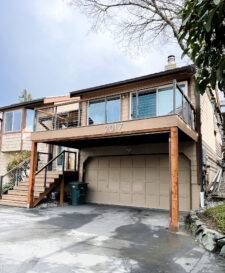
What Edgemoor's Setting Does to a House
Wind and Salt Air Off the Water
Because Edgemoor sits directly along the bluff overlooking Bellingham Bay, homes here catch more direct wind and marine air than properties set further back from the water. Salt-laden air speeds up corrosion in fasteners, flashing, and hardware, and it can break down a lower-grade finish faster than you'd see on a drier, more inland lot. Siding and trim details that would be adequate a mile or two inland sometimes aren't enough this close to open water.
Deep Tree Canopy and Persistent Shade
The flip side of Edgemoor's setting is how much of it is wooded. Large, mature trees are part of what makes the neighborhood distinctive, but they also mean many walls — especially north-facing ones and anything tucked under a stand of conifers — rarely get direct sun or a good drying wind. That combination of shade and moisture is exactly what moss, algae, and mildew need to take hold, and it's a longer season here than on an open, sun-exposed lot.
Wind-Driven Rain Against Exposed Walls
On a bluff, rain doesn't always fall straight down. Wind pushes it sideways into lap joints, trim details, and corner boards, which puts more stress on seams and flashing than a simple annual rainfall total would suggest. A siding system that performs fine in a sheltered, inland setting can still fail here specifically because water is finding its way in from the side rather than from above.
Why We Only Install James Hardie Siding
We used to offer a broader range of siding products. We narrowed that down, and the reason was practical rather than a marketing decision: what we kept finding during tear-offs and service calls in exactly this kind of coastal, shaded environment pushed us toward one system we could fully stand behind.
- Non-combustible core: Fiber cement doesn't feed a fire the way wood-based products can, which matters for household safety and insurance underwriting alike.
- Factory-applied ColorPlus finish: The color is baked on under controlled conditions rather than brushed on in the field, so it holds up far longer against sun, moisture, and salt exposure than site-applied paint.
- Climate-engineered HZ5 line: Hardie's HZ5 formulation is built for regions with sustained moisture and freeze-thaw cycling, which fits a shaded, coastal Whatcom County lot better than a generic national product.
- Dimensional stability: Fiber cement doesn't swell, cup, or warp the way engineered wood siding can after repeated wet-season moisture cycles in a shaded yard.
- Strong transferable warranty: Hardie backs its products with one of the more substantial warranty structures in the industry, provided the installation follows spec.
We won't install LP SmartSide, vinyl siding, Cemplank, Allura, primed spruce, or cedar. Every one of those products has a legitimate place in the market, and plenty of homeowners are satisfied with them elsewhere. But given how much sustained moisture and shade a typical Edgemoor lot deals with, we made a professional call that one system we trust completely is worth more than a cheaper alternative that quietly transfers maintenance risk to the homeowner a few years down the road.
What Edgemoor Homes Specifically Need From Their Siding
Matching Existing Character
Edgemoor has a higher concentration of older, larger, architecturally distinct homes than a lot of newer Whatcom County subdivisions. When we're re-siding a home like that, matching board width, reveal, and trim profile to the house's existing style matters as much as the material itself. James Hardie's range of lap profiles, panel siding, and trim options gives us enough flexibility to keep a home's original look intact instead of forcing every project into the same generic modern siding pattern.
Repair vs. Full Replacement
Not every siding issue on an Edgemoor home calls for a full tear-off. A section damaged by a fallen branch, storm impact, or isolated moisture intrusion around a window can sometimes be repaired and matched into existing Hardie siding without redoing the whole house. But when moisture has been tracking behind a wall for a while under that tree canopy, or the existing siding is an older material that's reached the end of its service life, patching it usually just postpones a bigger project. We'll tell you plainly which situation you're actually in.
What a Correct Installation Involves Here
Material choice only gets you part of the way. On a shaded, wind-exposed lot like a typical Edgemoor property, a James Hardie installation needs correct fastening patterns, proper clearance from grade and roof lines, lapped and sealed joints, and a house wrap and flashing system that actually works with the siding rather than against it. Under heavy tree cover, drying time after a wet spell is longer, so getting the drainage plane and rainscreen detailing right behind the siding matters even more than it would on an open, sun-exposed wall. Skipping any of these steps is one of the more common ways a good product ends up performing poorly, which is why we treat installation detail as seriously as the material spec itself.
Our Process for an Edgemoor Job
- On-site walkthrough: We look at sun exposure, tree cover, wind direction, and any existing moisture damage before quoting anything, since two Edgemoor lots a few blocks apart can have very different exposure.
- Material and profile selection: We spec HZ5 fiber cement and choose lap or panel profiles that match the home's existing character where that matters.
- Tear-off and substrate inspection: Removing old siding lets us check sheathing and framing for hidden moisture damage before anything new goes on.
- Weather barrier and flashing: We install house wrap, flashing, and drainage detailing sized for wind-driven rain and slow-drying, shaded conditions.
- Installation to Hardie spec: Correct fastening, clearances, and joint sealing so the warranty stays intact and the system performs as designed.
- Final walkthrough: We go over the finished job with you before calling it done, not after the invoice is sent.
Siding Cost Factors in Edgemoor
| Factor | What It Affects | Why It Matters Here |
|---|---|---|
| Home size and architectural detail | Total material and labor | Edgemoor's larger, more detailed homes often have more trim, dormers, and corners |
| Tear-off vs. overlay | Labor scope and substrate access | Tear-off reveals hidden moisture damage common under older siding on shaded lots |
| Substrate condition | Repair costs before new siding goes on | Extended shade and slow drying can let trapped moisture damage sheathing over time |
| Access and tree cover | Setup, staging, and equipment needs | Wooded, sloped, or bluff-adjacent lots can require more careful staging than a flat open lot |
| Trim and color selection | Material cost and finish longevity | ColorPlus factory finishes hold up better against salt air and UV than field-applied paint |
These numbers vary quite a bit from house to house, which is why we walk each property before giving a real estimate instead of quoting from a generic price sheet.
Signs Your Edgemoor Home's Siding Needs Attention
- Moss or dark staining that returns quickly after cleaning, especially on shaded, tree-covered walls
- Soft or spongy siding, particularly low on the wall or around window and door trim
- Peeling paint, bubbling, or visible warping on siding boards
- Cracked, chipped, or missing sections after windstorms or falling branches
- Visible gaps at seams, corners, or trim joints where wind-driven rain can track in
- A musty smell or rising energy bills that may point to a wall assembly no longer sealing properly
Roofing, Windows, and Decks Alongside Your Siding
Siding problems on a shaded, wooded lot rarely show up in isolation. A leaking roof valley under overhanging branches, a poorly flashed window, or a deck ledger trapping moisture against the house can all surface as siding damage even though the siding itself isn't where the water actually got in. Because we handle roofing, windows, and decks in addition to siding, we can look at an Edgemoor home as one connected exterior system instead of diagnosing a wall in isolation and missing the real entry point.
Why a Local Crew That Already Works Edgemoor Matters
A crew that works across Bellingham and Whatcom County regularly sees how bluff-top wind, salt air, and heavy tree shade actually behave on real houses over a full year, not just how a product performs on a spec sheet. That shows up in practical decisions on install day: which walls need extra flashing attention, how much drying time to plan for around wet weather, and where a shaded, wooded lot needs different detailing than an open one a few blocks away. Edgemoor's mix of waterfront exposure and dense tree cover isn't identical to the rest of Bellingham, and a crew with local experience accounts for that instead of applying the same approach to every job.
Get a Free, No-Pressure Estimate
If your Edgemoor home needs new siding, repair work, or an honest second opinion on what's going on behind an aging wall, we're glad to take a look. Reach out using the form below to schedule a free estimate — no pressure, no upsell script.